• Home
  • About
  • Events Calendar
  • Blueprint Guidelines
  • Privacy Policy
  • Manage Email Delivery
  • NextGenInfra.io
No Result
View All Result
Converge Digest
Sunday, July 5, 2026
  • Home
  • About
  • Events Calendar
  • Blueprint Guidelines
  • Privacy Policy
  • Manage Email Delivery
  • NextGenInfra.io
No Result
View All Result
Converge Digest
No Result
View All Result

Home » Marvell Industry Analyst Day: Solving the Connectivity Bottleneck in AI Infrastructure

Marvell Industry Analyst Day: Solving the Connectivity Bottleneck in AI Infrastructure

December 9, 2025
in All
A A

Marvell Chief Operating Officer Chris Koopmans opened the company’s Industry Analyst Day by emphasizing that hyperscalers are undertaking one of the largest capital investment cycles in history. He noted that total spending on data center infrastructure in 2025 is nearly 400 billion dollars higher than in 2023, eclipsing last year’s already dramatic projections. This surge is reshaping the semiconductor market, which has moved from an 800-billion-dollar 2028 forecast to a one-trillion-dollar outlook within a single year, driven overwhelmingly by AI data center demand rather than consumer devices.

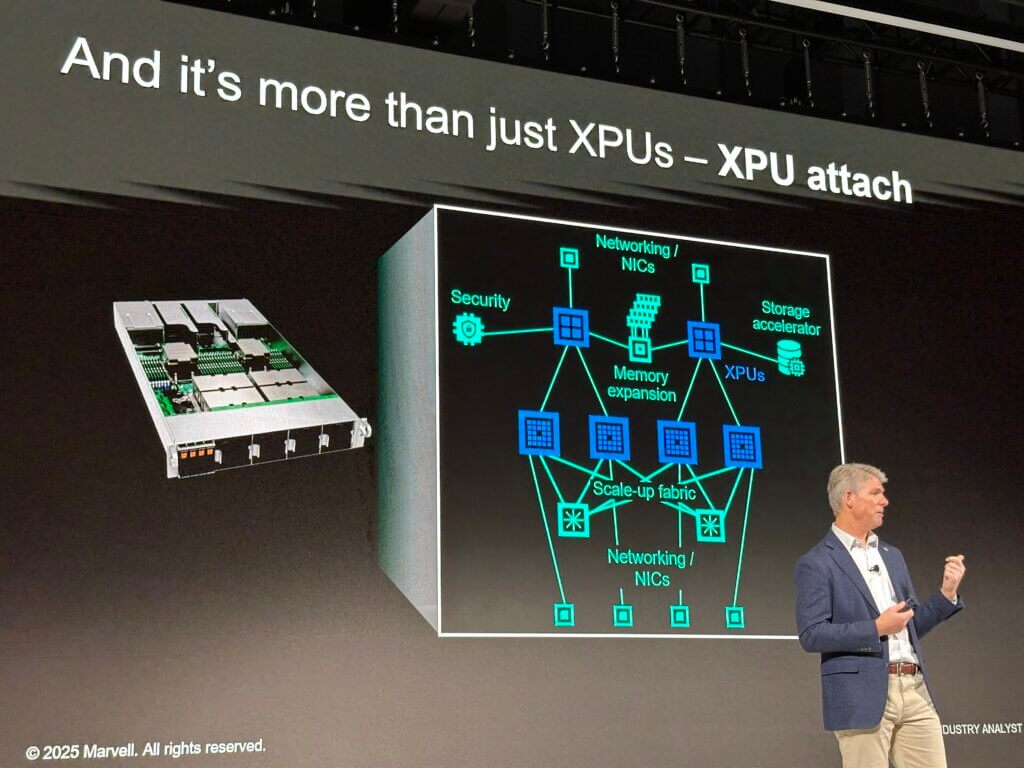
Koopmans argued that the industry has entered an era where the primary bottleneck is no longer compute capacity but connectivity. Modern AI workloads must be partitioned across many processors, making high-speed I/O, SerDes, die-to-die links, memory attach, and optical interconnects essential to overall system performance. He described advanced packaging, chiplets, XPU attach silicon, retimers, active electrical cables, and long-haul optical engines as foundational to scaling AI clusters. Marvell positions itself as one of the few companies capable of supporting every distance and design point, from chip-level communication to data-center-scale optical transport.

Looking ahead, Koopmans said accelerated compute domains will increasingly incorporate switching, moving beyond today’s mostly direct-connected GPU/XPU clusters. He pointed to UALink as a purpose-built protocol for high-bandwidth, low-latency memory access across XPUs, while also noting continued advantages for Ethernet-based switching. Marvell plans to support both approaches, including a 115 Tbps UALink switch expected in the second half of 2026 and its next-generation Ethernet switch families. He added that Marvell’s acquisition of Celestial AI enhances its ability to deliver dense optical chiplets optimized for XPU fabrics, helping expand the switching and optical interconnect opportunity to multiples of today’s market.

• Hyperscaler CapEx rising nearly $400B compared to 2023

• Global semiconductor forecast shifts from $800B (2028 estimate last year) to $1T today

• Reticle limits drive adoption of advanced packaging, chiplets, and optical I/O

• High-speed I/O now central to performance: SerDes, die-to-die fabrics, CXL and PCIe retimers, active copper and optical cables

• Growing need for switching inside accelerated compute clusters; UALink and Ethernet approaches advancing in parallel

• Marvell roadmap includes 115 Tbps UALink switches and next-generation Ethernet portfolios

• Celestial AI acquisition adds high-density optical chiplets for XPU-scale fabrics

• Marvell aims to lead high-speed connectivity across all design distances in the data center

“This isn’t a computing show anymore—it’s a connectivity challenge,” Koopmans said.

ShareTweetShareSummarizeSummarize
Previous Post

Marvell Unveils Golden Cable Initiative to Accelerate AI-Scale Connectivity

Next Post

Marvell Industry Analyst Day: Celestial AI Lands a Hyperscaler Win

Jim Carroll

Jim Carroll

Editor and Publisher, Converge! Network Digest, Optical Networks Daily - Covering the full stack of network convergence from Silicon Valley

Related Posts

Optical

Coractive Accelerates Hollow-Core Fiber Development

July 5, 2026
Optical

Proximus Selects Ekinops for Nationwide 800G Backbone Upgrade

July 4, 2026
AI Infrastructure

QTS Drops Digital Gateway Data Center Campus in VA

July 4, 2026
Space Networking & Orbital Data Centers

Vodafone Ireland Tests Direct-to-Device Satellite Emergency Communications

July 3, 2026
Subsea

NEC to Supply I-2SEA Cable Linking India’s AI Hubs with Singapore

July 3, 2026
All

Pasqal Launches Canadian PIC Packaging Center

July 3, 2026
Next Post

Marvell Industry Analyst Day: Celestial AI Lands a Hyperscaler Win

Categories

  • 5G / 6G / Wi-Fi
  • AI Infrastructure
  • All
  • Automotive Networking
  • Blueprints
  • Clouds and Carriers
  • Corporate Strategies
  • CPO
  • Data Centers
  • Enterprise
  • Explainer
  • Feature
  • Hot Start-ups
  • Last Mile / Middle Mile
  • Legal / Regulatory
  • Optical
  • Optical I/O
  • Pluggable Optics
  • Quantum
  • Research
  • Security
  • Semiconductors
  • Silicon Photonics
  • Space Networking & Orbital Data Centers
  • Subsea
  • Sustainability
  • Video
  • Webinars

Archives

Tags

5G All AT&T Australia AWS Blueprint columns BroadbandWireless Broadcom China Ciena Cisco Data Centers Dell'Oro Ericsson FCC Financial Financials Huawei Infinera Intel Japan Juniper Last Mile Last Mille LTE Mergers and Acquisitions Mobile NFV Nokia Optical Packet Systems PacketVoice People Regulatory Satellite SDN Service Providers Silicon Silicon Valley StandardsWatch Storage TTP UK Verizon Wi-Fi
Converge Digest

A private dossier for networking and telecoms

Follow Us

  • Home
  • About
  • Events Calendar
  • Blueprint Guidelines
  • Privacy Policy
  • Manage Email Delivery
  • NextGenInfra.io

© 2026 Converge Digest - A private dossier for networking and telecoms.

No Result
View All Result
  • Home
  • About
  • Events Calendar
  • Blueprint Guidelines
  • Privacy Policy
  • Manage Email Delivery
  • NextGenInfra.io

© 2026 Converge Digest - A private dossier for networking and telecoms.

This website uses cookies. By continuing to use this website you are giving consent to cookies being used. Visit our Privacy and Cookie Policy.
Go to mobile version