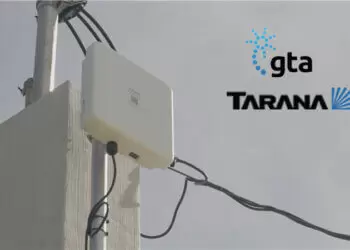
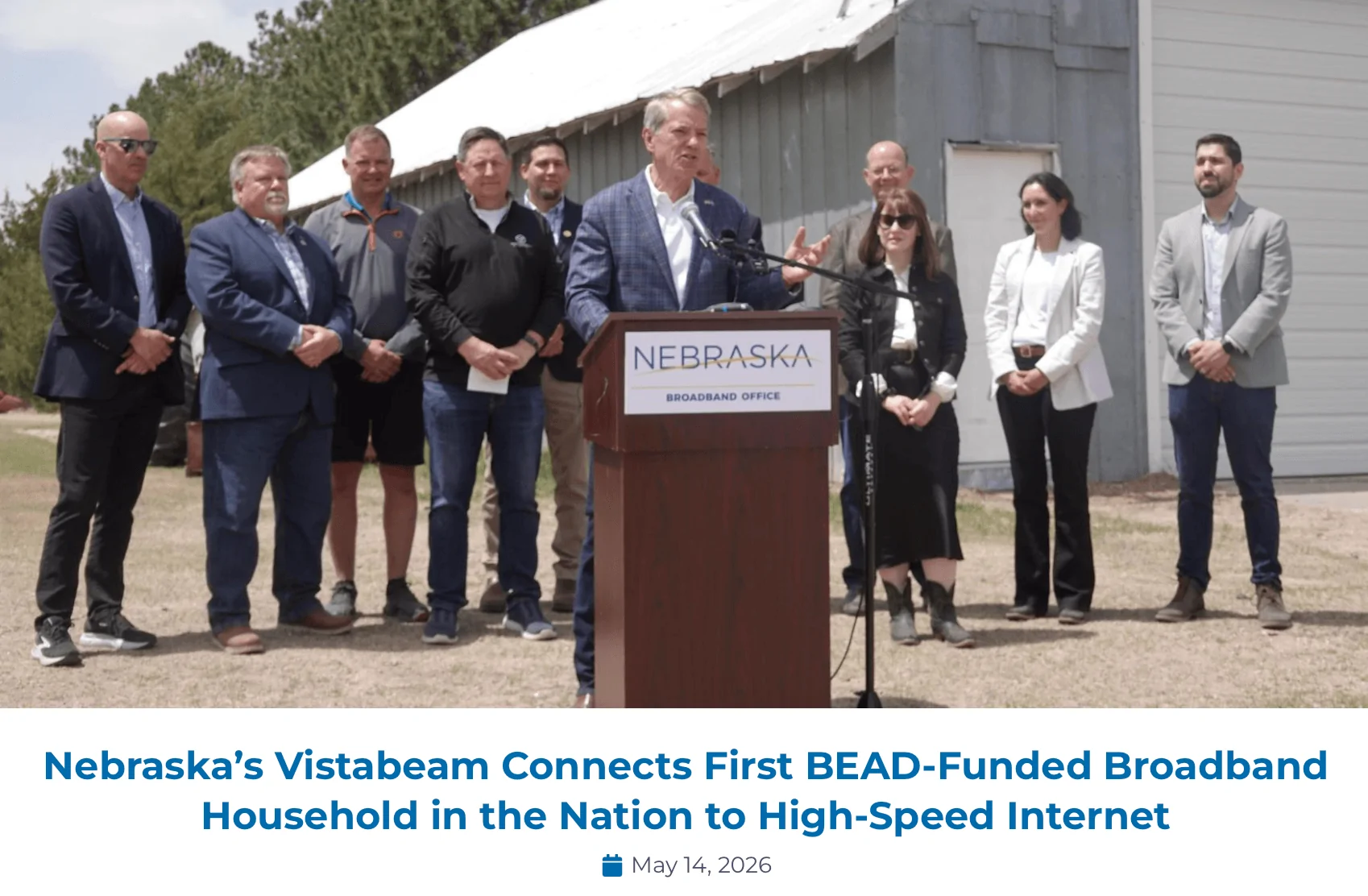
Vistabeam announced the activation of what it says is the first household in the United States connected through funding from the federal Broadband Equity, Access, and Deployment (BEAD) Program. The connection, completed near Ogallala, Nebraska, delivers broadband speeds exceeding 800 Mbps downstream and 200 Mbps upstream, significantly above the BEAD baseline requirement of 100 Mbps/20 Mbps. The deployment used a hybrid architecture combining fiber backhaul with next-generation fixed wireless access (ngFWA) technology from Tarana Wireless and distribution support from WAV.
The project highlights how fixed wireless infrastructure could accelerate portions of the BEAD rollout timeline compared to traditional fiber-only construction models. According to Vistabeam, the connection was completed within days after project approvals cleared. Nebraska’s Broadband Office funded the project under the state’s BEAD allocation administered alongside the National Telecommunications and Information Administration (NTIA). Vistabeam said it also secured BEAD awards in Colorado and Wyoming for additional rural broadband expansion projects. Industry reports estimate the company has won more than $100 million in combined BEAD commitments across the three states.
The deployment comes as states move from BEAD planning phases into live infrastructure rollouts. The project also reflects the growing role of advanced fixed wireless systems in federal broadband programs, particularly in rural geographies where deployment speed and economics remain challenging for full fiber builds. Tarana’s ngFWA platform, which supports both licensed and unlicensed spectrum, has gained traction among rural broadband operators seeking “fiber-class” broadband performance with lower deployment costs and faster activation timelines.
- Vistabeam says the Ogallala deployment is the first reported live household connection funded through the U.S. BEAD program
- Service speeds exceed 800 Mbps download and 200 Mbps upload
- Deployment used Tarana’s ngFWA fixed wireless platform
- Nebraska awarded Vistabeam funding for three tower upgrades totaling approximately $423,375 to serve 93 locations
- Vistabeam has also secured BEAD funding for projects in Colorado and Wyoming
- The deployment combines fiber infrastructure with fixed wireless last-mile access
- NTIA Administrator Arielle Roth and Nebraska Governor Jim Pillen participated in a launch event near Ogallala
- Tarana says its ngFWA technology is now deployed by more than 300 service providers across 24 countries
“BEAD is officially here, and we’re making history today,” said Matt Larsen, CEO of Vistabeam. “BEAD was created to connect unserved and underserved people, and today Vistabeam is proud to deliver high-quality, high-speed internet to a previously-underserved family, creating a world of possibilities for our Nebraska neighbors, showing that with the right tools and a capable team, connection can happen in a matter of days.”
🌐 Analysis: The first live BEAD-funded household connection represents an important operational milestone for the $42.45 billion federal broadband initiative, which has faced criticism over deployment delays since its creation under the 2021 Infrastructure Investment and Jobs Act. The Nebraska deployment also underscores how hybrid architectures combining fiber and fixed wireless may become increasingly important as states attempt to accelerate rural broadband coverage while managing costs and permitting timelines.
🌐 The project further strengthens Tarana Wireless’ position within the U.S. rural broadband ecosystem. Tarana has increasingly aligned itself with operators pursuing BEAD opportunities, including deployments with Nextlink and other regional providers. The broader policy debate around BEAD technology neutrality — including the role of fixed wireless and satellite alongside fiber — continues to shape competitive dynamics among broadband vendors, rural ISPs, and infrastructure providers.