
NTT has made a significant advancement in the field of optical technology by successfully controlling both the polarization and wavefront of light during high harmonic generation, a process of wavelength conversion using intense lasers. This achievement, which was previously challenging, utilizes the unique properties of solid-state crystals to precisely manage light’s characteristics. The research offers a foundational guideline for developing new optical technologies with potential applications in spectroscopy, laser processing, optical manipulation, and optical communications.
The breakthrough was made possible by understanding how the atomic arrangement within solid-state crystals influences the behavior of light during wavelength conversion. NTT researchers used the symmetry inherent in these crystals to control the polarization and wavefront of the generated light, which is essential for advancing various optical applications. This discovery could lead to more accurate optical measurements and faster, more efficient optical devices, particularly in fields that demand high precision and speed.
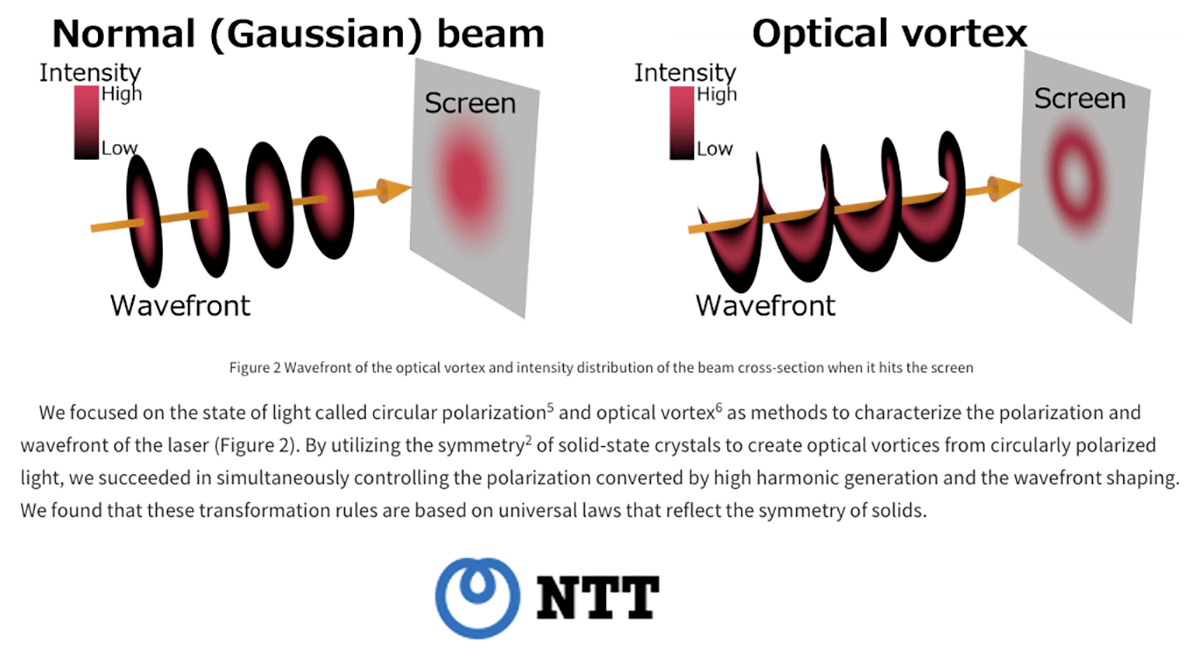
In their experiments, the researchers generated circularly polarized light and optical vortices by focusing a femtosecond laser on a solid-state crystal. They observed variations in the spatial shape of the harmonic beam based on the wavelength and polarization component, demonstrating the ability to selectively control the light’s properties according to specific conversion laws. This advancement is expected to revolutionize the use of light in applications such as optical tweezers, microspectroscopy, and advanced optical communications.
The law discovered by NTT provides a universal framework for determining how light’s polarization and wavefront can be controlled during wavelength conversion using solid-state crystals. This insight is expected to play a crucial role in the future development of optical technologies, enabling the generation of light with specific properties that were previously difficult to achieve using conventional methods.
The findings were published in the American scientific journal Science Advances on August 2, 2024, and were supported by a Grant-in-Aid for Scientific Research from the Japan Society for the Promotion of Science.
Key Points:
• Breakthrough in Light Control: NTT successfully controlled the polarization and wavefront of light in high harmonic generation using solid-state crystals.
• New Optical Guidelines: The research offers a guideline for controlling light in optical technologies, with potential applications in various fields such as spectroscopy and laser processing.
• Utilization of Crystal Symmetry: The breakthrough was achieved by leveraging the symmetry of solid-state crystals to manage light’s characteristics during wavelength conversion.
• Experimental Success: Researchers generated circularly polarized light and optical vortices using a femtosecond laser, demonstrating selective control over light properties.
• Impact on Optical Technologies: This discovery could revolutionize optical measurements, improve high-speed optical devices, and enable new applications in fields requiring precise control of light.
• Potential Applications: The findings could lead to advancements in optical tweezers, microspectroscopy, advanced optical communications, and laser processing.
• Published Research: The findings were published in Science Advances and supported by the Japan Society for the Promotion of Science.
“This breakthrough will enable new applications in optical technology, providing a foundation for more advanced and precise tools in various scientific and industrial fields.”
https://group.ntt/en/newsrelease/2024/08/21/240821a.html