
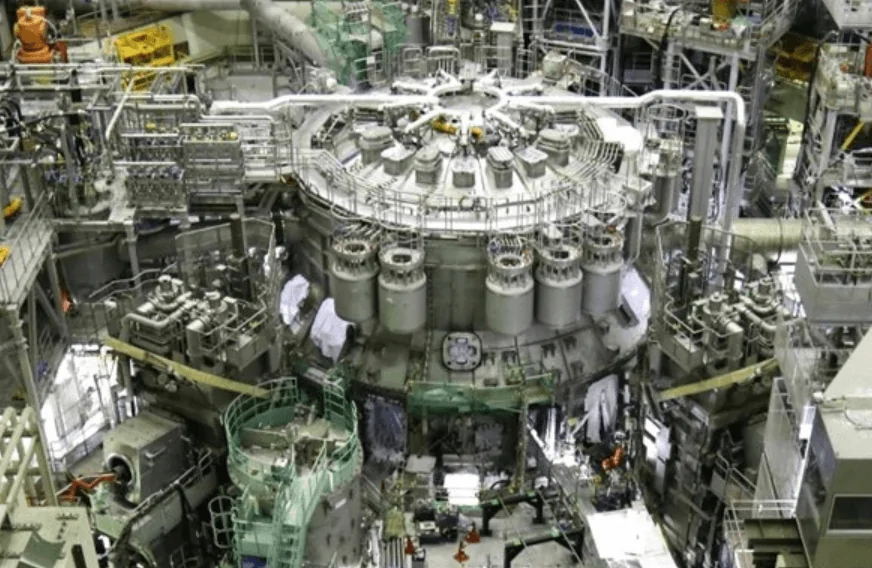
Japan’s National Institutes for Quantum Science and Technology and NTT have demonstrated ultra-low latency, deterministic communications capable of supporting real-time plasma prediction and control in fusion systems. The joint effort achieved cyclic data exchanges at intervals below 100 microseconds—establishing a new benchmark for control-network performance in large-scale scientific infrastructure.
The technology was implemented in the control system of JT-60SA, where distributed control computers must exchange diagnostic and actuation data across distances of up to 400 meters. The system supports transmission of ~1 kB datasets—representative of fusion diagnostic payloads—within strict timing windows, enabling predictive control loops to operate within the instability growth timescales of high-pressure plasma. Conventional Ethernet-based approaches have struggled to meet these combined requirements for latency, determinism, distance, and payload size.
At the core of the architecture is an ultra-high-frequency deterministic communication stack optimized for periodic data exchange. Instead of dynamically negotiating communication parameters for each transmission, the system predefines control information and embeds it into acknowledgment cycles, eliminating per-cycle overhead. Combined with Time-Sensitive Networking (TSN) techniques to control packet scheduling and mitigate jitter, the system delivers consistent microsecond-scale latency. The work aligns with NTT’s IOWN initiative, which targets high-capacity, low-latency optical-centric infrastructure for next-generation computing and communications.
- Demonstrated deterministic communication cycles below 100 microseconds for fusion control workloads
- Validated performance over ~400 meter distances between distributed control systems
- Achieved reliable transfer of ~1 kB diagnostic datasets within strict timing constraints
- Eliminated per-cycle communication overhead via precomputed control signaling
- Leveraged TSN-based scheduling to minimize latency variation (jitter)
- Designed as a scalable control-network architecture for future fusion systems including ITER and DEMO-class reactors
“By establishing deterministic, ultra-high-frequency communication within the fusion control network, we have created a foundation for real-time predictive control of plasma instabilities, which is essential for sustained fusion operation,” the organizations stated.
🌐 Analysis
This work highlights a critical but often underemphasized bottleneck in advanced infrastructure: deterministic, real-time communications at scale. While fusion provides the use case, the underlying innovation—microsecond-level, jitter-controlled networking across distributed compute systems—maps directly to emerging AI infrastructure requirements, particularly in tightly coupled scale-up architectures and real-time inference pipelines.
NTT’s IOWN initiative has increasingly focused on optical transport, photonics-electronics convergence, and deterministic networking, positioning it alongside broader industry efforts such as Time-Sensitive Networking in industrial Ethernet and ultra-low latency fabrics in AI clusters. Comparable requirements are emerging in AI training systems, where synchronization across thousands of accelerators demands predictable latency and bounded jitter.