NVIDIA is introducing a new data pipeline architecture centered on its BlueField-4 DPU platform, aimed at eliminating one of the most persistent constraints in large-scale AI systems: inefficient data movement between storage, memory, and GPUs.
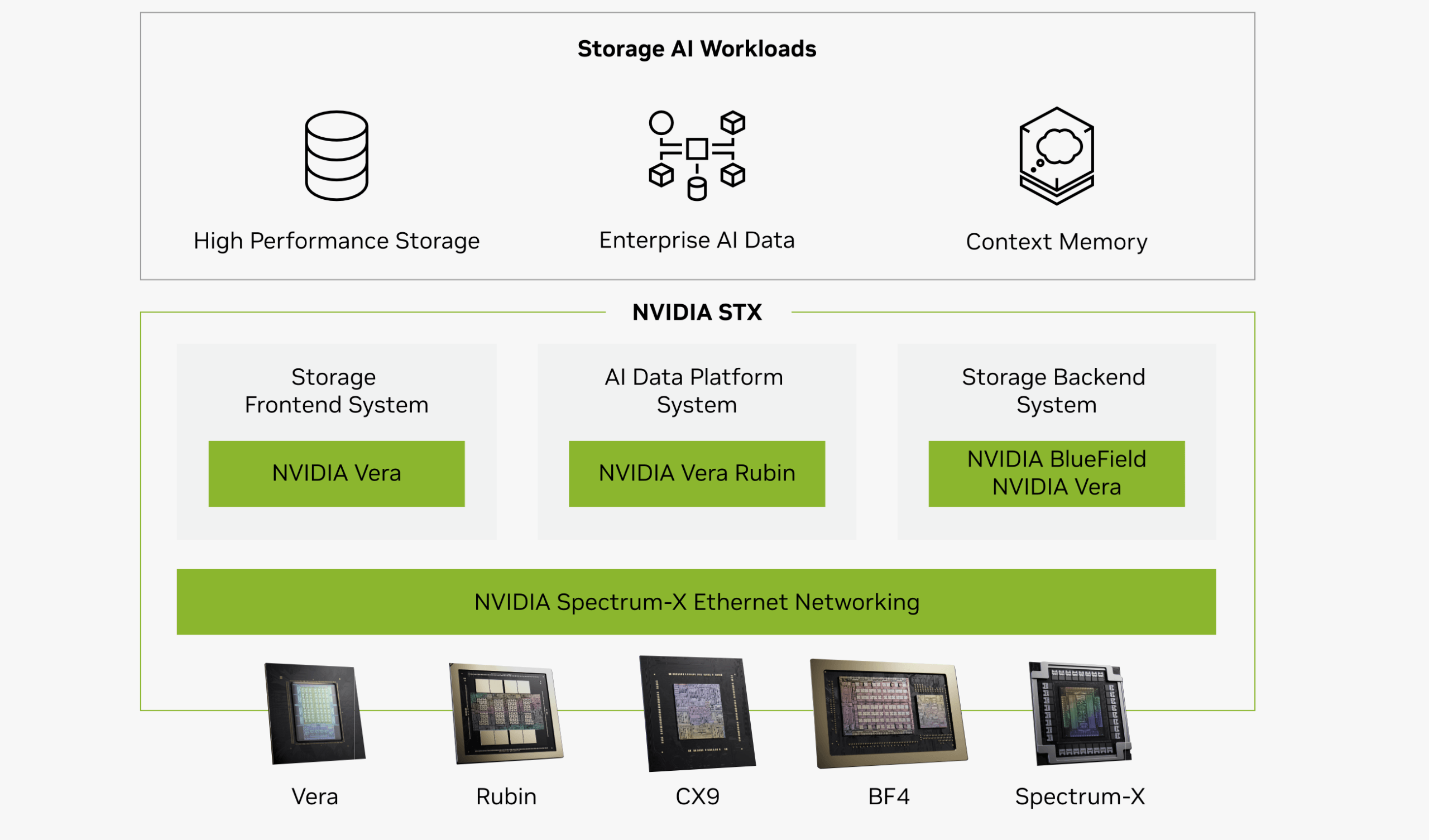
The new architecture, referred to as BlueField-4 STX, is designed to accelerate data access for inference and agentic AI workloads by tightly integrating storage, networking, and memory operations with GPU compute. Rather than relying on traditional host-based data paths, the approach uses DPUs to offload and orchestrate data movement directly, enabling faster delivery of model weights, context, and key-value (KV) cache data to GPUs.
The shift comes as AI infrastructure increasingly moves beyond training into large-scale inference, where workloads are dominated by memory access patterns, context expansion, and token generation rather than raw compute. In these environments, GPUs are often underutilized due to delays in data delivery, especially when working with large language models that require rapid access to distributed datasets and memory pools.
NVIDIA’s BlueField-4 STX architecture addresses this by combining high-speed networking, direct NVMe access, and memory-aware data orchestration within the DPU. The goal is to reduce latency, improve throughput, and increase effective GPU utilization across AI clusters. The platform also supports advanced data services such as prefetching, caching, and direct data placement, which are increasingly important for multi-step reasoning and agentic workflows.
The announcement aligns with NVIDIA’s broader push to define the “AI factory” as a fully integrated system, where compute, networking, storage, and software are co-designed to maximize end-to-end performance. In this model, DPUs play a central role as the control point for data movement, security, and infrastructure offload.
Key points
• NVIDIA introduced the BlueField-4 STX architecture to optimize AI data pipelines
• Designed to accelerate inference and agentic AI workloads
• Uses DPUs to offload and orchestrate data movement from CPUs
• Integrates high-speed networking, NVMe storage access, and memory-aware operations
• Targets improved GPU utilization by reducing data delivery bottlenecks
• Supports advanced data services such as caching, prefetching, and direct placement
🌐 Analysis
This announcement highlights a major shift in AI infrastructure design priorities. For the past several years, the industry has focused heavily on scaling GPU performance and increasing interconnect bandwidth. However, as models grow larger and inference workloads become more complex, the limiting factor is increasingly how quickly data can be delivered to those GPUs.
In many real-world deployments, GPUs spend a significant portion of time idle, waiting for data from storage systems or memory tiers. This inefficiency becomes more pronounced with large context windows, retrieval-augmented generation, and agentic AI workflows, all of which require frequent access to distributed data sources.
By moving data orchestration into the DPU layer, NVIDIA is effectively repositioning the data pipeline as a first-class component of AI infrastructure. This has broader implications for the industry. Vendors competing in AI infrastructure will need to address not only compute performance, but also how efficiently they manage data movement across the system.
The introduction of BlueField-4 STX also reinforces the growing importance of DPUs as a strategic control point. Beyond networking acceleration, DPUs are evolving into infrastructure processors that handle storage access, security enforcement, and workload orchestration. This positions them as a key layer in next-generation AI data centers.
Looking ahead, the competitive landscape is likely to expand beyond GPUs and optical interconnects to include data pipeline architectures, memory hierarchies, and storage integration. NVIDIA’s move suggests that the next phase of AI infrastructure innovation will be defined by how well systems can feed data to increasingly powerful compute engines.