OIF Accelerates AI Scale-Up Interconnect Alignment with New COI and Energy Efficient Interfaces Framework
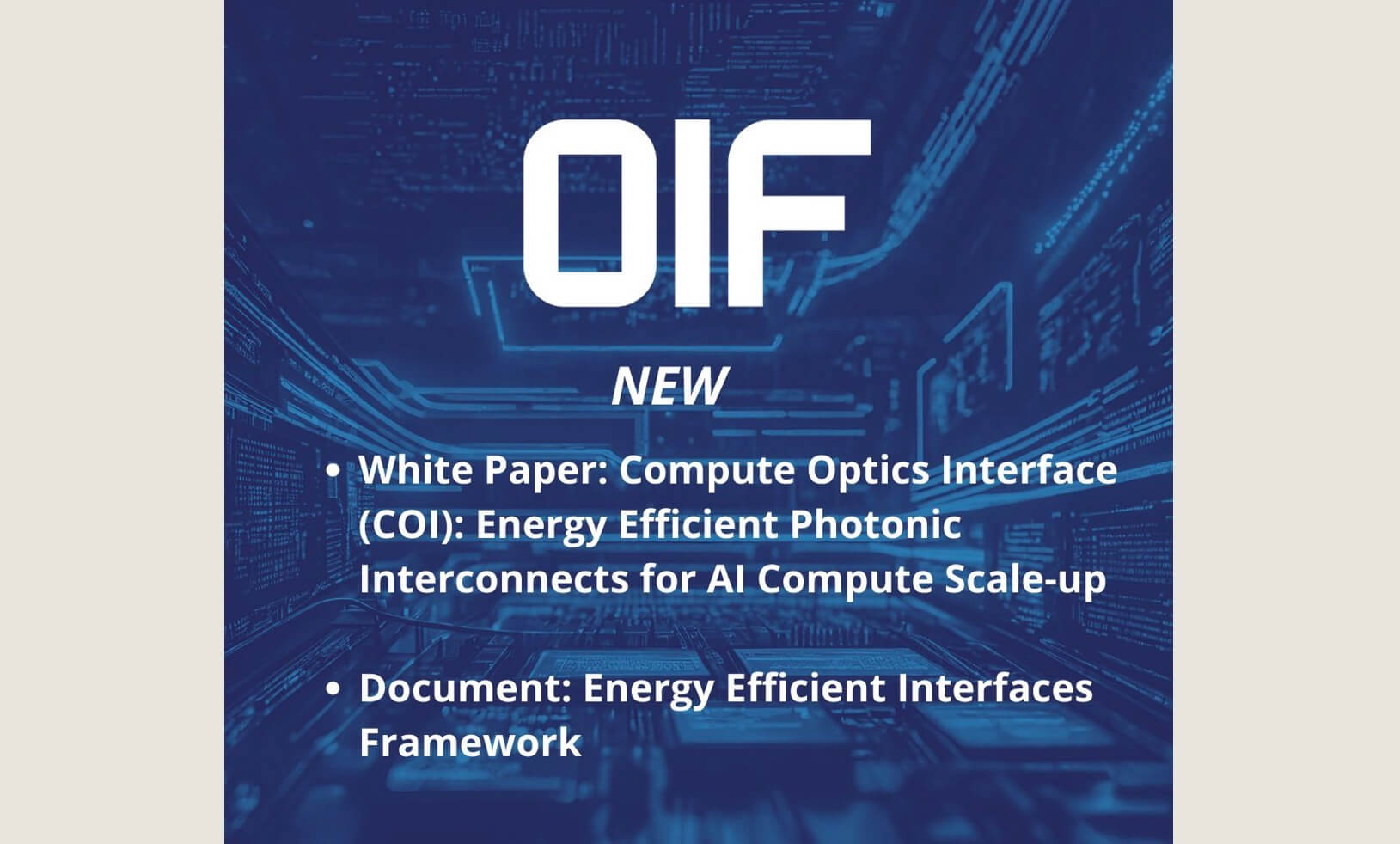
OIF published two new technical documents aimed at accelerating industry alignment on AI scale-up interconnect architectures. The Energy Efficient Interfaces (EEI) Framework document and the Compute Optics Interface (COI) white paper reflect hyperscaler-driven requirements for next-generation AI clusters that demand higher bandwidth density, lower latency, and improved energy efficiency.
AI model scaling continues to push system architects toward larger, tightly coupled compute fabrics that must move massive volumes of data across GPUs, accelerators, and memory pools. In response, OIF’s COI white paper analyzes where optical interconnects provide measurable energy and density advantages in scale-up environments. The paper examines co-packaged optics, chiplet-based approaches, on-board optics, and pluggable modules, while comparing interface models including non-retimed, transmit-retimed, fully retimed, and die-to-die (D2D) implementations. It also evaluates modulation schemes and the tradeoffs between electrical and optical interfaces across performance, latency, radix, thermal constraints, reliability, and cost.
The companion EEI Framework expands beyond OIF’s 2022 co-packaging framework to address the broader interconnect landscape inside AI compute clusters. It reviews retiming strategies, link training, protocol impacts, latency considerations, compliance testing, management interfaces, and emerging form factors. Together, the documents provide system designers with a structured decision framework to evaluate interoperability pathways as AI infrastructure design cycles compress and scale-up architectures evolve.
• COI white paper focuses on photonic interconnects for AI scale-up environments
• Compares co-packaged, chiplet-based, on-board and pluggable optical implementations
• Evaluates non-retimed, transmit-retimed, fully retimed and D2D interface strategies
• Assesses electrical vs. optical tradeoffs across bandwidth density, power, latency, reliability and cost
• EEI Framework expands solution space beyond 2022 co-packaging model
• Addresses interoperability opportunities, link training, compliance, management interfaces and form factors
• Incorporates hyperscaler-driven performance and efficiency targets
“As AI infrastructure cycles compress, hyperscalers can’t wait for the ecosystem to catch up — they need clarity on interconnect options now, while architectures are still taking shape,” said Jeff Hutchins, OIF Physical & Link Layer Working Group Energy Efficient Interfaces Vice Chair (Ranovus). “By capturing hyperscaler-driven requirements and connecting the real tradeoffs across bandwidth density, power, thermal limits, latency, radix, reliability and cost, these publications give the industry a shared, practical foundation to make faster, better-aligned decisions as AI compute scale-up architectures evolve.”
🌐 Analysis: OIF’s focus on scale-up interconnects reflects the industry shift from traditional pluggable optics toward tightly integrated photonic architectures designed for AI accelerator clusters. The publication arrives as hyperscalers evaluate co-packaged optics, chiplet-based photonics, and die-to-die interconnect strategies alongside parallel efforts at IEEE and other standards bodies. By framing COI and EEI as decision tools rather than prescriptive specifications, OIF positions itself as a coordination layer amid rapid architectural experimentation.
🌐 We’re tracking the latest developments in networking silicon. Follow our ongoing coverage at: https://convergedigest.com/category/semiconductors/