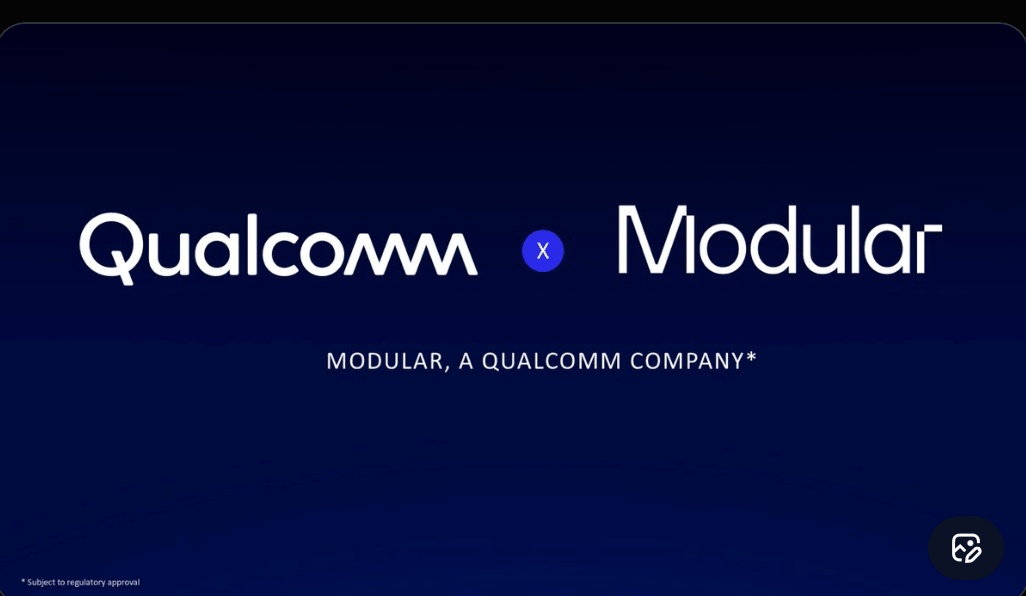
Qualcomm announced an agreement to acquire Modular, a startup founded by compiler and AI infrastructure pioneer Chris Lattner. The transaction is designed to strengthen Qualcomm’s software foundation for generative and agentic AI while accelerating its push beyond edge devices into data center AI infrastructure. Financial terms were not disclosed.
The deal combines Qualcomm’s silicon portfolio with Modular’s AI-native software platform, which enables AI models to run efficiently across CPUs, GPUs, NPUs, and custom accelerators without requiring developers to rewrite applications for each hardware target. Qualcomm said the acquisition will help create a more open, developer-friendly AI ecosystem spanning devices, edge infrastructure, and cloud environments while improving performance-per-watt and deployment flexibility across heterogeneous computing platforms.
Modular has emerged as a significant software innovator in the AI infrastructure market through technologies including the Mojo programming language and the MAX inference platform. Its software stack was designed to address one of the industry’s growing challenges: deploying AI workloads efficiently across increasingly diverse compute architectures. Qualcomm believes the combination will strengthen its relationships with developers, model creators, hyperscalers, and enterprises while supporting its broader strategy to deliver AI infrastructure from endpoint devices to large-scale data centers.
“This acquisition marks a pivotal moment not just for Qualcomm, but for the AI industry,” said Cristiano Amon. “As agentic AI scales across data centers and edge environments, the industry is moving toward disaggregated, multi-vendor architectures that demand a more open and modern software foundation.”
Chris Lattner, co-founder and CEO of Modular, said the company was founded on the belief that AI requires a more open and efficient software foundation capable of spanning diverse hardware environments. He said joining Qualcomm provides the scale needed to accelerate that vision and broaden AI deployment across the industry.
The transaction is expected to close during the second half of 2026, subject to customary regulatory approvals and closing conditions.
Analysis 🌐
Qualcomm’s acquisition of Modular is one of its most strategically significant AI infrastructure moves to date. While Qualcomm has traditionally been associated with smartphones, edge AI, and wireless technologies, the company has increasingly signaled ambitions to become a broader AI computing platform provider spanning devices, enterprise edge deployments, and data centers.
The acquisition addresses a key industry challenge: software portability across heterogeneous AI hardware. As enterprises deploy AI across CPUs, GPUs, NPUs, custom ASICs, and edge devices, developers increasingly seek abstraction layers that reduce hardware-specific optimization work.
For Qualcomm, Modular provides:
• A developer-centric AI software platform and ecosystem.
• Enhanced support for heterogeneous compute environments.
• Stronger positioning in data center AI inference.
• Closer engagement with model developers and hyperscalers.
• Additional differentiation against vertically integrated AI stacks.
The move also reflects a broader industry trend toward open, hardware-agnostic AI software layers. Rather than forcing customers into a single accelerator architecture, vendors increasingly recognize the need to support mixed environments where workloads may move between cloud GPUs, enterprise servers, AI PCs, edge gateways, and embedded systems.
If Qualcomm successfully integrates Modular’s technology into its expanding AI portfolio, the company could strengthen its position as a provider of end-to-end AI infrastructure spanning smartphones, PCs, automotive systems, industrial platforms, edge servers, and future AI data center deployments.
Profile: Modular AI Infrastructure Software Company Acquired by Qualcomm Updated: June 24, 2026 | |
| Company | Modular Inc. |
| Headquarters | Los Altos, California (Silicon Valley) |
| Founded | 2022 |
| Founders | Chris Lattner and Tim Davis |
| Employees | ~130 prior to Qualcomm acquisition announcement |
| Total Funding | ~$380 Million raised before acquisition |
| Latest Valuation | ~$1.6 Billion (2025 funding round) |
| Reported Acquisition Value | ~$4 Billion in Qualcomm stock (reported) |
| Flagship Technology | Mojo programming language for AI and high-performance computing |
| Inference Platform | MAX Platform for AI inference optimization, deployment and serving |
| Core IP | Compiler technology, MLIR-based optimization, heterogeneous runtime software, hardware abstraction layers, and AI deployment orchestration |
| Key Value Proposition | Build AI applications once and deploy across multiple hardware platforms without rewriting code |
| Supported Hardware | CPUs, GPUs, NPUs, custom AI ASICs, edge accelerators, and data center infrastructure |
| Strategic Mission | Reduce dependence on proprietary AI software stacks and enable portable AI infrastructure |
| Notable Customers | Reported relationships with Amazon, Oracle, Inworld AI, and multiple semiconductor vendors |
| Industry Position | Viewed as one of the leading efforts to create a viable alternative to NVIDIA CUDA-centric AI software workflows |
| Technology Heritage | Built by the creator of LLVM, Clang, Swift, MLIR, and former engineering leader at Apple, Google, Tesla and SiFive |
| Why Qualcomm Bought It | Strengthens Qualcomm’s software stack for data center AI, improves AI portability across heterogeneous infrastructure, and expands its ability to compete in edge-to-cloud AI computing. |
Qualcomm Acquires Modular AI-Native Software Platform for Edge-to-Cloud AI Infrastructure Updated: June 24, 2026 | |
| Acquirer | Qualcomm, expanding its AI software and data center strategy. |
| Target | Modular Inc., developer of a unified AI-native software platform. |
| Founder | Chris Lattner, creator of LLVM and Swift, and CEO of Modular. |
| Strategic Goal | Create an open, developer-friendly AI software foundation spanning devices, edge systems, and data centers. |
| Core Technology | Unified software platform that enables AI workloads to run efficiently across CPUs, GPUs, NPUs, and custom ASICs. |
| Developer Benefit | Build once and deploy across heterogeneous compute environments without rewriting software for each accelerator. |
| AI Focus | Generative AI, agentic AI, inference optimization, orchestration, and distributed AI deployment. |
| Data Center Impact | Strengthens Qualcomm’s ability to support AI inference and orchestration across cloud and hyperscale infrastructure. |
| Industry Trend | Supports the shift toward disaggregated, multi-vendor AI architectures where software portability is becoming critical. |
| Why It Matters | AI infrastructure is increasingly constrained by efficiency and deployment complexity rather than raw compute capability alone. |
| Competitive Positioning | Enhances Qualcomm’s ability to compete in AI infrastructure by pairing energy-efficient silicon with a hardware-agnostic software stack. |
| Expected Close | Second Half 2026, subject to regulatory approvals and customary closing conditions. |