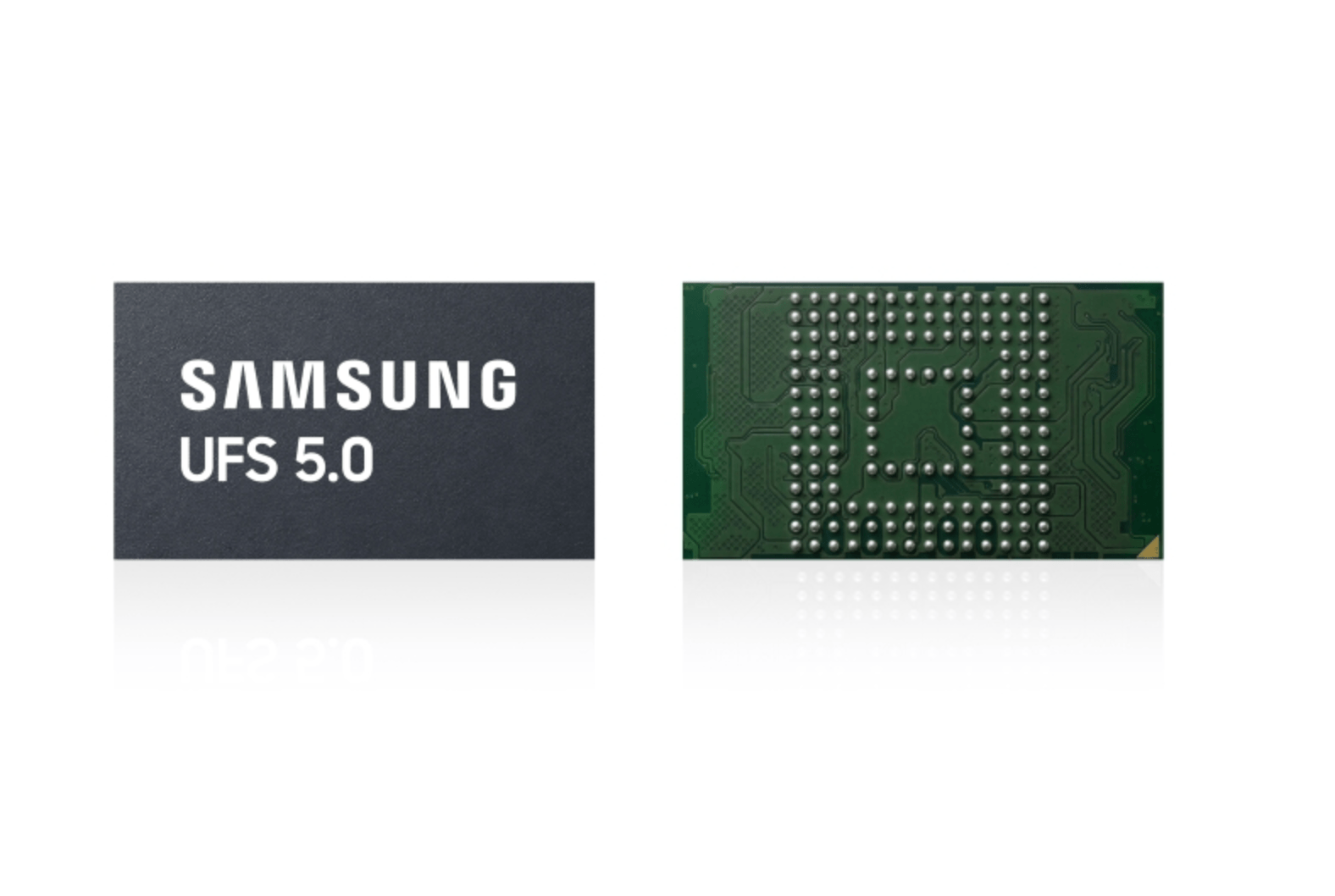
Samsung Electronics introduced what it describes as the industry’s first Universal Flash Storage (UFS) 5.0 solution, delivering sequential read speeds of up to 10.8 GB/s and sequential write speeds of up to 9.5 GB/s. Built on the latest JEDEC UFS 5.0 embedded storage specification, the new flash storage targets next-generation smartphones, XR headsets, wearables, and other edge AI devices that increasingly execute large language models locally rather than relying on cloud processing. Samsung plans to begin mass production during the fourth quarter of 2026 in capacities of up to 1 TB.
The company says the new UFS 5.0 architecture more than doubles the performance of its previous UFS 4.1 generation while improving power efficiency by over 40%. Samsung attributes the efficiency gains to new clock-gating and multi-voltage techniques that reduce energy consumed during data transfers. The higher throughput is designed to reduce storage latency and accelerate movement of AI model parameters, application assets, and multimedia data between storage and processors, improving responsiveness for on-device generative AI workloads.
Samsung also reduced the physical package dimensions to 7.5 × 13 × 0.9 mm (0.30 × 0.51 × 0.035 inches), making the device approximately 16.7% smaller than its predecessor. The reduced footprint gives OEMs additional board space for larger batteries, sensors, or thermal solutions while enabling thinner designs for AI smartphones and extended reality devices. Samsung expects UFS 5.0 to become a foundational storage platform for future AI-enabled mobile products.
| Samsung UFS 5.0 Next-Generation Embedded Flash Storage for On-Device AI Updated: June 2026 | |
| Company | Samsung Electronics Memory Business |
| Product | UFS 5.0 Universal Flash Storage |
| Standard | Latest JEDEC UFS 5.0 embedded memory interface |
| Sequential Read | Up to 10.8 GB/s |
| Sequential Write | Up to 9.5 GB/s |
| Performance Increase | More than 2× faster than Samsung’s previous UFS 4.1 generation |
| Power Efficiency | More than 40% improvement using clock-gating and multi-voltage technologies |
| Package Size | 7.5 × 13 × 0.9 mm (0.30 × 0.51 × 0.035 inches), approximately 16.7% smaller than its predecessor |
| Maximum Capacity | Up to 1 TB |
| Target Applications | AI smartphones, AI PCs, wearables, XR headsets and other edge AI devices |
| Key Technologies | Clock gating, multi-voltage architecture, optimized embedded NAND controller, ultra-compact package |
| AI Benefits | Reduced storage latency, faster loading of LLMs, quicker application launches, improved multitasking and longer battery life for on-device AI workloads |
| Availability | Mass production begins Q4 2026 |
| Why It Matters | Storage bandwidth is becoming a critical component of AI system performance. Samsung’s UFS 5.0 significantly raises embedded storage throughput while reducing power consumption, helping future mobile platforms execute increasingly sophisticated AI models locally with lower latency and improved user experience. |
“In the era of on-device AI, storage devices are evolving into a key driver defining AI experiences. As we successfully move beyond the development stage of the industry’s first UFS 5.0 solution, Samsung is setting a new standard for storage on the go and will continue to drive innovation for the next-generation mobile platform market,” said Jangseok Choi, Head of Memory Product Planning at Samsung Electronics.
🌐 Analysis
On-device AI is placing new emphasis on storage subsystem performance rather than compute alone. As mobile AI models continue to grow in size, higher sequential bandwidth, lower latency, and improved power efficiency become increasingly important for minimizing inference delays and maximizing battery life. UFS 5.0 represents another step toward balancing AI accelerators, LPDDR memory, and non-volatile storage as integrated components of the mobile AI platform.
Samsung continues to expand its leadership across the AI memory stack, spanning HBM, LPDDR, NAND flash, and embedded storage. The introduction of UFS 5.0 complements broader industry efforts to optimize end-device AI performance while reducing dependence on cloud inference, particularly for smartphones, AI wearables, and XR systems.
🌐 We’re tracking the latest developments in networking silicon. Follow our ongoing coverage at: https://convergedigest.com/category/semiconductors/