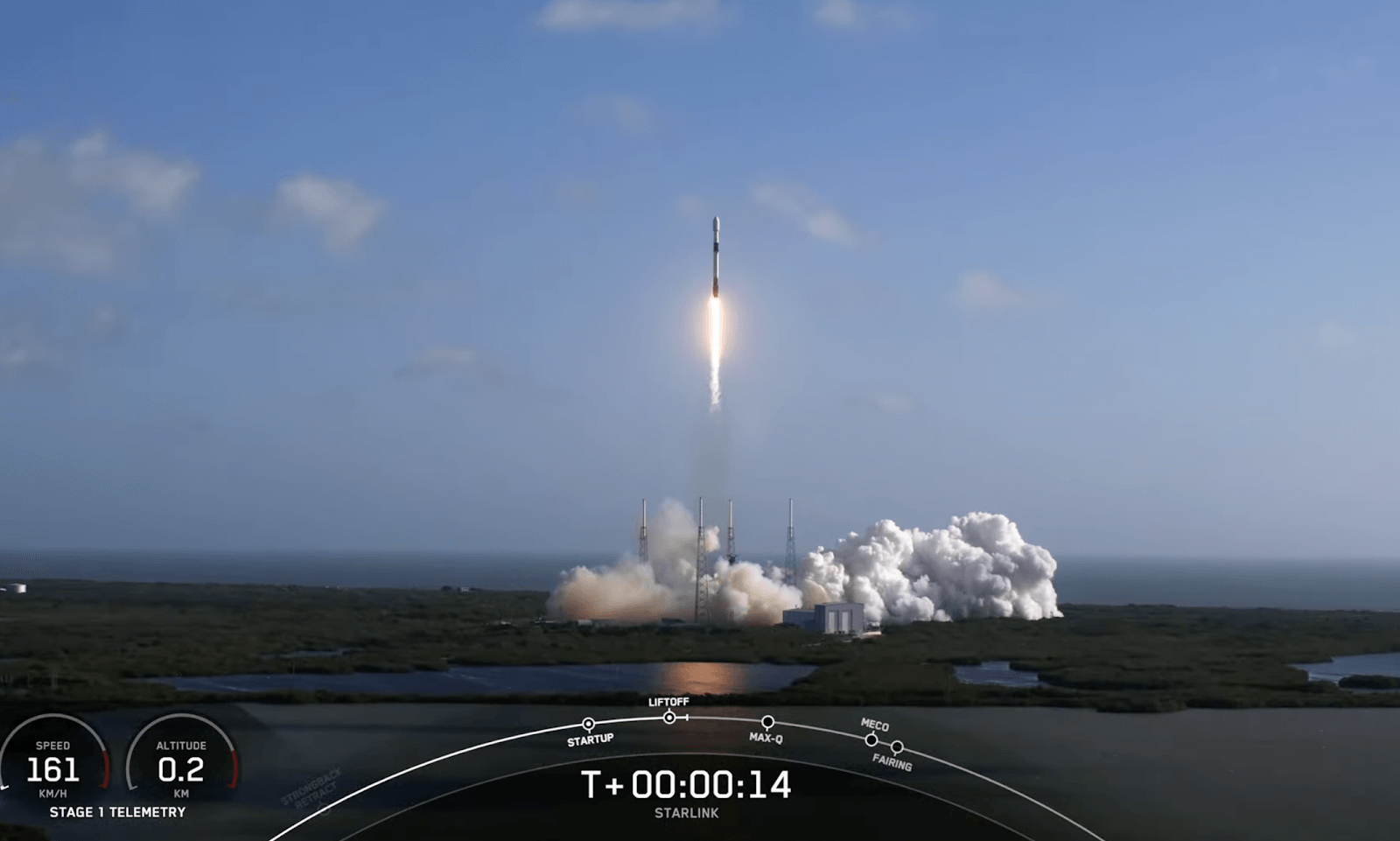
SpaceX expects to launch the first 60 satellites for its Starlink LEO constellation this week.
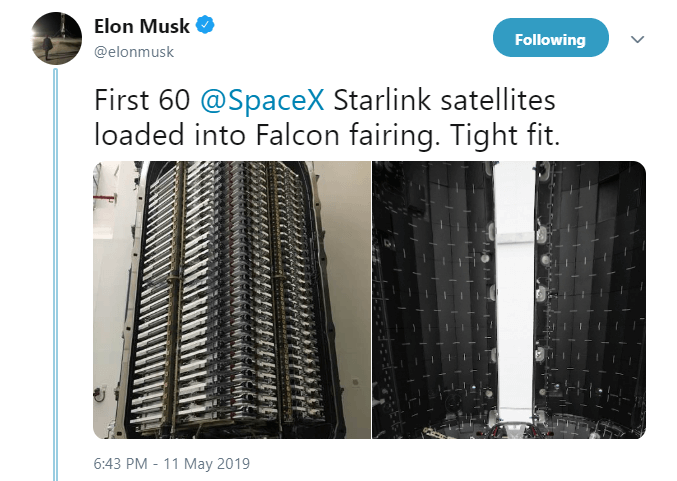
In a tweet, Elon Musk disclosed that six launches of 60 satellites each are needed for “minor coverage” and 12 launches of 60 satellites each are needed for “moderate” coverage. The accompanying photo reveals an extremely tight packing of photos into the Falcon fairing.
SpaceX has disclosed plans to deploy as many as 12,000 satellites in three, low earth orbit (LEO) shells. Cost estimates for full deployment approach $10 billion.

In November 2018, the FCC granted authority to SpaceX to construct, deploy, and operate a new very-low-Earth orbit constellation of more than 7,000 satellites using V-band frequencies. This is in addition to the authorization granted in March 2018. The FCC also granted SpaceX’s request to add the 37.5-42.0 GHz, and 47.2-50.2 GHz frequency bands to its previously authorized NGSO constellation. SpaceX now has the flexibility to provide both diverse geographic coverage and the capacity to support a wide range of broadband and communications services for residential, commercial, institutional, governmental, and professional users in the United States and globally.
FCC approves SpaceX’s NGSO Satellite System
The FCC voted authorized SpaceX to construct, deploy, and operate a proposed non-geostationary orbit (NGSO) satellite system comprising 4,425 satellites for the provision of fixed-satellite service (FSS) around the world.
In July 2016, OneWeb was granted approval to build a similar constellation of MEO satellites.
 Two months ago, SpaceX successfully launched the Low Earth Orbit (LEO) PAZ observation satellite on behalf of Hisdesat and two satellites of its own. Tintin A & B are the first two demonstration satellites for SpaceX’s planned Starlink broadband satellite service. Both were successfully deployed into polar orbit and are communicating with Earth stations.
In regulatory filing, SpaceX has revealed that its initial system will consist of 4,425 satellites operating in 83 orbital planes (at altitudes ranging from 1,110 km to 1,325 km). The system will require associated ground control facilities, gateway earth stations, and end-user earth stations. The system will use Ka- and Ku-Band spectrum. SpaceX has separately filed for authority to operate in the V-Band, where the company has proposed an additional constellation of 7,500 satellites operating even closer to Earth. To implement the system, SpaceX will utilise the availability of significantly more powerful computing and software capabilities. On the launch broadcast for the PAZ satellite, SpaceX said quite a bit of development work remains ahead on its satellite constellation plans