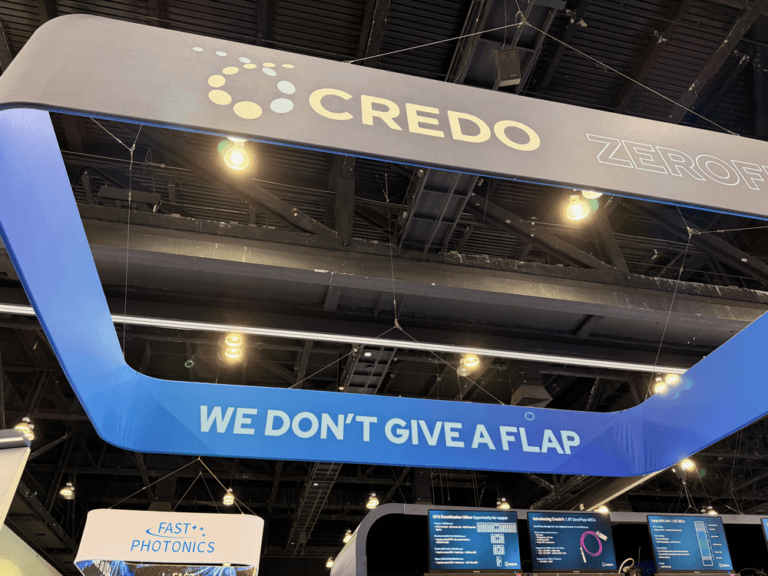
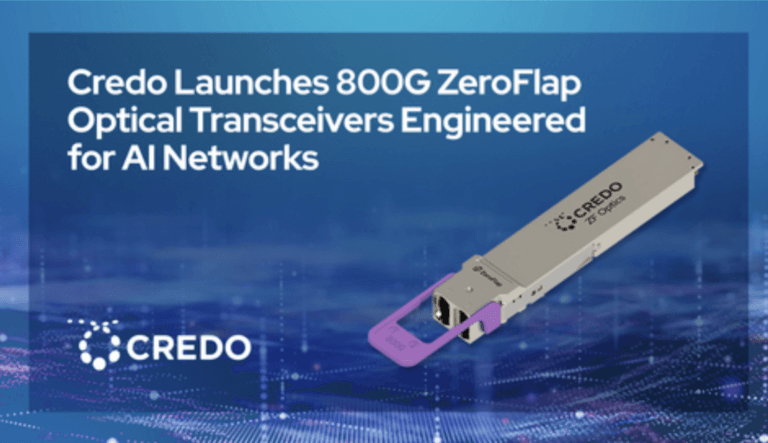
TensorWave teamed up with Credo Technology Group to deploy Credo’s ZeroFlap (ZF) Active Electrical Cables (AECs) and optical transceivers across TensorWave’s next-generation AMD-based AI cluster builds. Credo said the design target centers on faster “time to first token,” higher utilization, and improved uptime for large-scale training and inference workloads.
The companies framed interconnect reliability as a scaling constraint as GPU clusters grow and fabrics run hotter, denser, and closer to operational limits. Credo said its ZeroFlap AECs and optics integrate with its PILOT telemetry platform for monitoring and fault isolation, and it cited “100 million hours MTBF” along with claims of “up to 1,000 times” better reliability versus legacy approaches.
The collaboration fits TensorWave’s positioning as an AMD-exclusive AI cloud provider that has raised significant capital to expand AMD Instinct GPU capacity and related infrastructure. In its 2025 Series A announcement, TensorWave said it raised $100 million co-led by Magnetar and AMD Ventures, with participation from Maverick Silicon, Nexus Venture Partners, and Prosperity7, and it cited plans tied to a large Instinct MI325X-based training cluster.
- Credo: ZeroFlap (ZF) Active Electrical Cables (AECs) and ZeroFlap optical transceivers, plus PILOT telemetry management integration
- TensorWave: future AI cluster builds standardizing on Credo interconnect and optics to reduce deployment friction and increase tokens per hour via higher uptime and utilization
- Stated performance/ops goals: faster physical deployment-to-first-token timelines and production-grade reliability at scale
- Broader company context: TensorWave’s disclosed Series A syndicate includes Magnetar, AMD Ventures, Maverick Silicon, Nexus Venture Partners, and Prosperity7
“At TensorWave, we are building large-scale, AMD-exclusive AI infrastructure designed for production from day one. As cluster sizes grow, network reliability becomes just as critical as GPU performance. Credo’s ZeroFlap AECs and Optics help us reduce deployment friction, accelerate time to first token, and maintain high cluster utilization, ensuring our customers can train and deploy models with confidence at scale.”
🌐 Analysis: TensorWave sits in a fast-forming “GPU cloud specialist” tier competing for AI labs and enterprise training runs; its AMD-exclusive posture also aligns with AMD’s stated push to broaden cloud availability for Instinct and strengthen the surrounding ecosystem of platforms, partners, and deployments. Interconnect/telemetry choices like Credo’s AEC+optics stack reflect a broader industry move to treat fabric reliability and observability as first-order capacity multipliers—especially as operators compare NVIDIA-centric platforms (and their networking stacks) against AMD-based clusters that need comparable uptime, tooling, and operational maturity.