
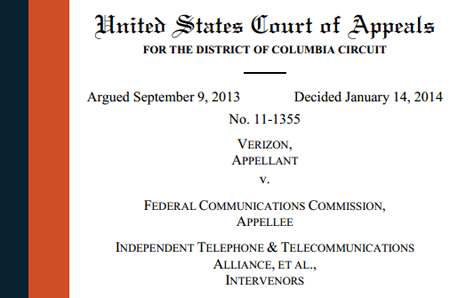
 The United States Court of Appeals for the D.C. Circuit ruled that the FCC overstepped its boundaries in setting Net Neutrality rules that compel broadband providers to treat all Internet traffic the same regardless of source.
The court found that even though the FCC has general authority to regulate the Internet, it has previously chosen to classify broadband providers in a manner that exempts them from treatment as common carriers and the Communications Act expressly prohibits the Commission from regulating them as such. The court therefore decided to vacate portions of the Open Internet Order because broadband providers do not have to meet common carrier obligations.
The court concludes that “the requirements imposed by the Open Internet Order subject broadband
providers to common carrier treatment. If they do, then given the manner in which the Commission has chosen to classify broadband providers, the regulations cannot stand.”
The court did not address Verizon’s additional complaint that the Order violates the First Amendment and constitutes an uncompensated taking.
In response to the ruling, FCC Chairman Thomas Wheeler issued the following statement: “The D.C. Circuit has correctly held that ‘Section 706 . . . vests [the Commission] with affirmative authority to enact measures encouraging the deployment of broadband infrastructure’ and therefore may ‘promulgate rules governing broadband providers’ treatment of Internet traffic.’ I am committed to maintaining our networks as engines for economic growth, test beds for innovative services and products, and channels for all forms of speech protected by the First Amendment. We will consider all available options, including those for appeal, to ensure that these networks on which the Internet depends continue to provide a free and open platform for innovation and expression, and operate in the interest of all Americans.”
In Decemcer 2010, the FCC approved new Open Internet rules governing the management of Internet traffic, with the three Democrats on the commission voting in favor of the measure and the two Republicans voting against.
Key elements of the Open Internet Order included:
Rule 1: Transparency — A person engaged in the provision of broadband Internet access service shall publicly disclose accurate information regarding the network management practices, performance, and commercial terms of its broadband Internet access services sufficient for consumers to make informed choices regarding use of such services and for content, application, service, and device providers to develop, market, and maintain Internet offerings.
Rule 2: No Blocking — A person engaged in the provision of fixed broadband Internet access service, insofar as such person is so engaged, shall not block lawful content, applications, services, or non-harmful devices, subject to reasonable network management. A person engaged in the provision of mobile broadband Internet access service, insofar as such person is so engaged, shall not block consumers from accessing lawful websites, subject to reasonable network management; nor shall such person block applications that compete with the provider’s voice or video telephony services, subject to reasonable network
Rule 3: No Unreasonable Discrimination — A person engaged in the provision of fixed broadband Internet access service, insofar as such person is so engaged, shall not unreasonably discriminate in transmitting lawful network traffic over a consumer’s broadband Internet access service. Reasonable network management shall not constitute unreasonable discrimination.
Significantly, “reasonable network management” was defined as follows: “A network management practice is reasonable if it is appropriate and tailored to achieving a legitimate network management purpose, taking into account the particular network architecture and technology of the broadband Internet access service. Legitimate network management purposes include: ensuring network security and integrity, including by addressing traffic that is harmful to the network; addressing traffic that is unwanted by users (including by premise operators), such as by providing services or capabilities consistent with a user’s choices regarding parental controls or security capabilities; and by reducing or mitigating the effects of congestion on the network.” The FCC rules go on to say that “Pay for Priority” delivery of packets on wireline broadband networks is likely to run afoul of the “no unreasonable discrimination” clause because it would represent a significant departure from current practices.
Mobile broadband was largely exempt from the “reasonable network management” clause, as the document acknowledges that this market is an earlier-stage platform than fixed broadband, and it is rapidly evolving.