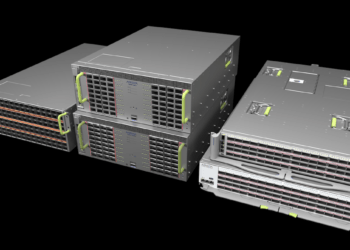
Arista Networks announced the formation of the XPO (eXtra-dense Pluggable Optics) Multi-Source Agreement (MSA), an industry initiative aimed at defining a next-generation pluggable optical module optimized for large-scale AI infrastructure. The specification introduces a 12.8 Tbps liquid-cooled optics module designed to dramatically increase bandwidth density while supporting the thermal and power requirements of modern AI data centers.
The XPO module targets the rapidly escalating interconnect requirements of AI training clusters, where GPU and accelerator fabrics require far greater bandwidth density than traditional pluggable optics can provide. The design integrates a native liquid-cooling cold plate within the module, allowing the platform to dissipate up to 400 watts per module and enabling significantly higher port density on network switches. According to Arista, the architecture supports up to 204.8 Tbps of switching capacity per Open Compute rack unit, representing roughly a 4× increase in front-panel density compared with 1.6T OSFP optics.
The XPO specification aims to preserve the flexibility and serviceability advantages of pluggable optics while enabling the next generation of AI fabrics. The MSA supports a wide range of optical technologies and interface architectures—including fully retimed, half-retimed, and linear optical interfaces—and accommodates multiple optical standards such as SR, DR, FR, LR, and ZR/ZR+, along with emerging technologies like coherent-lite and RF-microwave links. Alongside Arista’s announcement, several companies issued their own statements confirming participation in the XPO MSA ecosystem and outlining plans to develop compatible modules and optical engines. These include Lightmatter, Eoptolink, and TeraHop, each highlighting the role of XPO in enabling higher-density optical interconnects for hyperscale AI infrastructure and upcoming demonstrations at OFC 2026 in Los Angeles.
• Defines a 12.8 Tbps pluggable optical module optimized for AI networking
• Enables 204.8 Tbps front-panel switch density per OCP rack unit
• Integrates native liquid cooling with support for up to 400 W per module
• Designed to support AI scale-up, scale-out, and scale-across fabrics
• Supports retimed, half-retimed, and linear optical interface architectures
• Compatible with multiple optical reach standards including SR, DR, FR, LR, and ZR/ZR+
• Built to enable a multi-vendor ecosystem through an open MSA model
“The unprecedented growth in AI fabric bandwidth and the transition to liquid cooling requires a new generation of pluggable optics modules,” said Andreas Bechtolsheim, Chief Architect at Arista Networks. “XPO solves this challenge by providing fundamental improvements in density, cooling capability and reliability for pluggable optics modules.”
Companies joining the effort also underscored the need for open standards to support next-generation AI interconnects. Lightmatter, which develops photonic interconnect technologies for AI infrastructure, said participation in the XPO MSA will help accelerate deployment of high-density optical networking platforms.
“AI infrastructure is driving unprecedented requirements for bandwidth density and power efficiency,” said Nick Harris, CEO of Lightmatter. “Open industry standards such as XPO are critical to enabling a scalable ecosystem of interoperable optical technologies that can support the next generation of AI data centers.”
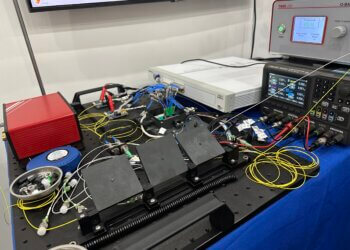
Eoptolink and TeraHop likewise announced plans to support the specification with 12.8 Tbps XPO optical modules, including demonstrations of ultra-high-density pluggable optics designed for liquid-cooled AI networking platforms.
🌐 Analysis
The XPO initiative reflects the rapid shift in data-center networking driven by large-scale AI clusters, where conventional pluggable optics such as QSFP-DD and OSFP are approaching limits in both power and bandwidth density. By combining liquid-cooled packaging with extreme front-panel density, XPO offers a path to extend the pluggable optics ecosystem rather than replacing it with fully co-packaged optics architectures.
The initiative also arrives amid intense innovation across AI optical interconnects, including co-packaged optics from companies such as Ayar Labs and photonic interconnect engines from Lightmatter and others. If broadly adopted, XPO could serve as an intermediate step between today’s pluggable optics and the more integrated photonic architectures expected to support the next generation of AI clusters.