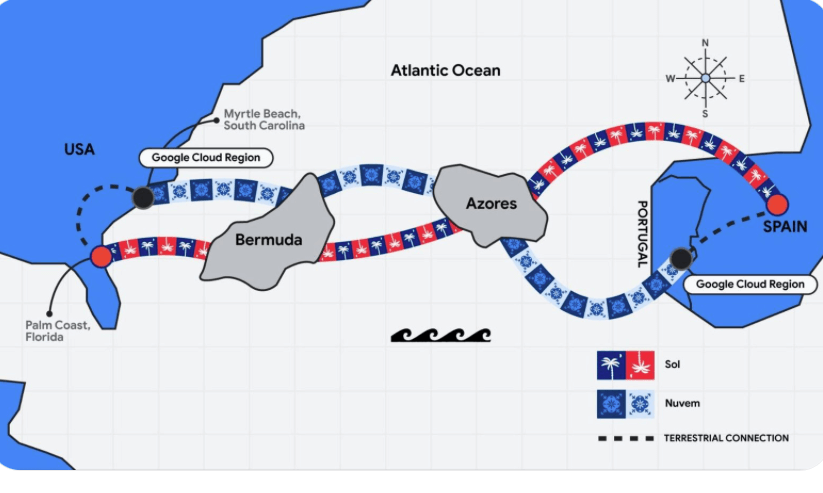
Google Cloud has unveiled plans for Sol, a new transatlantic subsea cable system that will connect Palm Coast, Florida to landing points in Bermuda, the Azores, and Santander, Spain. The Sol system complements the previously announced Nuvem cable and completes a unique cross-Atlantic infrastructure by providing terrestrial interconnection across all landing countries, enhancing global cloud and AI service delivery. It will be the only active subsea cable directly linking Florida and Europe.
Manufactured in the U.S., the Sol cable will contain 16 fiber pairs and is intended to increase capacity, reduce latency, and improve network reliability across the Atlantic corridor. Google will partner with DC BLOX to develop a new cable landing station and connectivity hub in Palm Coast, including a terrestrial link to its cloud region in South Carolina. In Spain, Telxius will provide infrastructure in Santander, supporting integration with Google’s Madrid cloud region. The governments of Portugal, Bermuda, the Azores, and Spain all welcomed the investment as a catalyst for regional innovation and economic development.
Sol joins a growing portfolio of Google’s subsea cables—Nuvem, Firmina, Equiano, and Grace Hopper—strategically positioned to support global AI and cloud demand. With this investment, Google is further establishing digital infrastructure nodes along the Atlantic, particularly in Florida, which now becomes a new connectivity gateway to Europe.
- Sol connects Palm Coast (Florida), Bermuda, the Azores, and Santander (Spain)
- Will be the only operational transatlantic cable from Florida to Europe
- Cable includes 16 fiber pairs; manufactured in the U.S.
- U.S. partner: DC BLOX; Spain partner: Telxius
- Will interconnect with Google’s existing Nuvem cable
- Enhances Google Cloud and AI service delivery across North America and Europe
“Our most intelligent model is now available on Vertex AI… Sol will help meet growing customer demand for Google Cloud and AI services across the U.S., Europe, and beyond.” — Brian Quigley, VP, Global Network Infrastructure, Google Cloud
- Google announced the Nuvem subsea cable project in September 2023 as part of its ongoing expansion of global cloud infrastructure. The Nuvem cable system will connect Portugal, Bermuda, and South Carolina, providing a high-capacity route across the Atlantic to support growing demand for Google Cloud and AI services. Like the Sol cable, Nuvem is designed with 16 fiber pairs and incorporates advanced optical switching technologies to optimize bandwidth efficiency and resiliency. The system will land in South Carolina’s Google Cloud region and interface terrestrially with the Sol cable via the Palm Coast hub, enabling redundant and diversified routing across the Atlantic. Nuvem strengthens Portugal’s position as a digital gateway to Europe while reinforcing Bermuda’s emerging role as a strategic Atlantic cable landing site. The system is expected to become operational in 2026, providing added capacity and lower latency for North American and European users.