
• Home
  • About
  • Events Calendar
  • Blueprint Guidelines
  • Privacy Policy
  • Manage Email Delivery
  • NextGenInfra.io
No Result
View All Result
Converge Digest
Thursday, June 4, 2026
  • Home
  • About
  • Events Calendar
  • Blueprint Guidelines
  • Privacy Policy
  • Manage Email Delivery
  • NextGenInfra.io
No Result
View All Result
Converge Digest
No Result
View All Result

Home » OCP Unveils Universal Link Layer Spec to Boost Chiplet Interoperability

OCP Unveils Universal Link Layer Spec to Boost Chiplet Interoperability

August 5, 2025
in Semiconductors
A A

Open Compute Project (OCP) has released a new Universal D2D Transaction and Link-Layer specification that broadens support to UCIe and other PHY standards, enabling greater silicon diversity in AI and HPC clusters. The specification provides a universal link layer that lets designers tune performance for specialized workloads while maintaining interoperability across different chiplet architectures. This move marks a significant milestone for OCP’s Open Chiplet Economy initiative, which seeks to foster a marketplace of interoperable chiplets and design tools.

The new standard allows mapping of transaction-layer protocols to physical interfaces with low-latency packetization, reducing the need for costly protocol bridges and complex conversions. By supporting extensibility, portability across different process nodes, and scalability to multiple PHY slices and data rates, the specification is designed to accommodate a wide range of markets including AI, data centers, automotive, aerospace, and communications infrastructure. OCP leaders say the ecosystem is now approaching maturity, with chiplet vendors actively contributing to standards and workflows that will further accelerate development.

OCP launched its Chiplet Marketplace in October 2024, providing system-in-package (SiP) designers access to chiplets, manufacturing services, chiplet-aware EDA tools, and reference materials. With the release of this universal link layer specification, OCP strengthens its role in establishing an open and multi-vendor semiconductor ecosystem that can support the performance and economic demands of emerging AI and HPC workloads.

• New OCP specification defines a Universal D2D link layer, now covering UCIe

• Enables customization of chiplet-based designs for specific AI/HPC workloads

• Provides low-latency, low-overhead packetization across multiple PHY standards

• Extensible to native bus protocols for interoperability and portability

• Supports scaling with multiple PHY slices and different data rates

• Builds on the OCP Chiplet Marketplace launched in October 2024

“OCP recognized several years ago that innovation in silicon needed to be amplified, just as the constraints of larger silicon dies were beginning to impede progress,” said Cliff Grossner, Ph.D., Chief Innovation Officer at OCP.

🌐 Why it Matters: Chiplet architectures are becoming central to next-generation AI and HPC systems, but success requires open standards to avoid vendor lock-in and costly integration challenges. By enabling interoperability and silicon diversity, OCP is laying the groundwork for a flexible ecosystem where specialized silicon can be mixed and matched for performance, efficiency, and economic gains.

🌐 We’re tracking the latest developments in networking silicon. Follow our ongoing coverage at: https://convergedigest.com/category/semiconductors/

Tags: OCP
ShareTweetShareSummarizeSummarize
Previous Post

Vertiv Launches OneCore Prefabricated Platform for 50 MW AI Data Centers

Next Post

PCI-SIG Targets 2028 Release of PCIe 8.0 at 256 GT/s

Jim Carroll

Jim Carroll

Editor and Publisher, Converge! Network Digest, Optical Networks Daily - Covering the full stack of network convergence from Silicon Valley

Related Posts

Data Centers

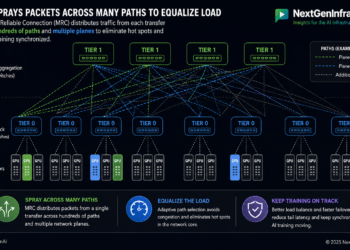
Multipath Reliable Connection (MRC) Redesigns Ethernet for GPU AI Clusters

May 6, 2026
AI Infrastructure

OCP Releases ESUN 1.0 Spec for Ethernet-Based Scale-Up AI Fabrics

March 10, 2026
Data Centers

OCP Power Distribution Project Tackles Safety Gaps in High-Voltage AI Facilities

January 26, 2026
Data Centers

OCP Names Zane Ball CTO, Russ Wunderlich Principal Hardware Engineer

August 13, 2025
Optical

OCP Launches Optical Circuit Switching Subproject

July 21, 2025
All

OCP Welcomes New Board Members from Meta, Microsoft and Intel

February 6, 2025
Next Post

PCI-SIG Targets 2028 Release of PCIe 8.0 at 256 GT/s

Categories

  • 5G / 6G / Wi-Fi
  • AI Infrastructure
  • All
  • Automotive Networking
  • Blueprints
  • Clouds and Carriers
  • Data Centers
  • Enterprise
  • Explainer
  • Feature
  • Financials
  • Last Mile / Middle Mile
  • Legal / Regulatory
  • Optical
  • Quantum
  • Research
  • Security
  • Semiconductors
  • Space
  • Start-ups
  • Subsea
  • Sustainability
  • Video
  • Webinars

Archives

Tags

5G All AT&T Australia AWS Blueprint columns BroadbandWireless Broadcom China Ciena Cisco Data Centers Dell'Oro Ericsson FCC Financial Financials Huawei Infinera Intel Japan Juniper Last Mile Last Mille LTE Mergers and Acquisitions Mobile NFV Nokia Optical Packet Systems PacketVoice People Regulatory Satellite SDN Service Providers Silicon Silicon Valley StandardsWatch Storage TTP UK Verizon Wi-Fi
Converge Digest

A private dossier for networking and telecoms

Follow Us

  • Home
  • About
  • Events Calendar
  • Blueprint Guidelines
  • Privacy Policy
  • Manage Email Delivery
  • NextGenInfra.io

© 2026 Converge Digest - A private dossier for networking and telecoms.

No Result
View All Result
  • Home
  • About
  • Events Calendar
  • Blueprint Guidelines
  • Privacy Policy
  • Manage Email Delivery
  • NextGenInfra.io

© 2026 Converge Digest - A private dossier for networking and telecoms.

This website uses cookies. By continuing to use this website you are giving consent to cookies being used. Visit our Privacy and Cookie Policy.
Go to mobile version