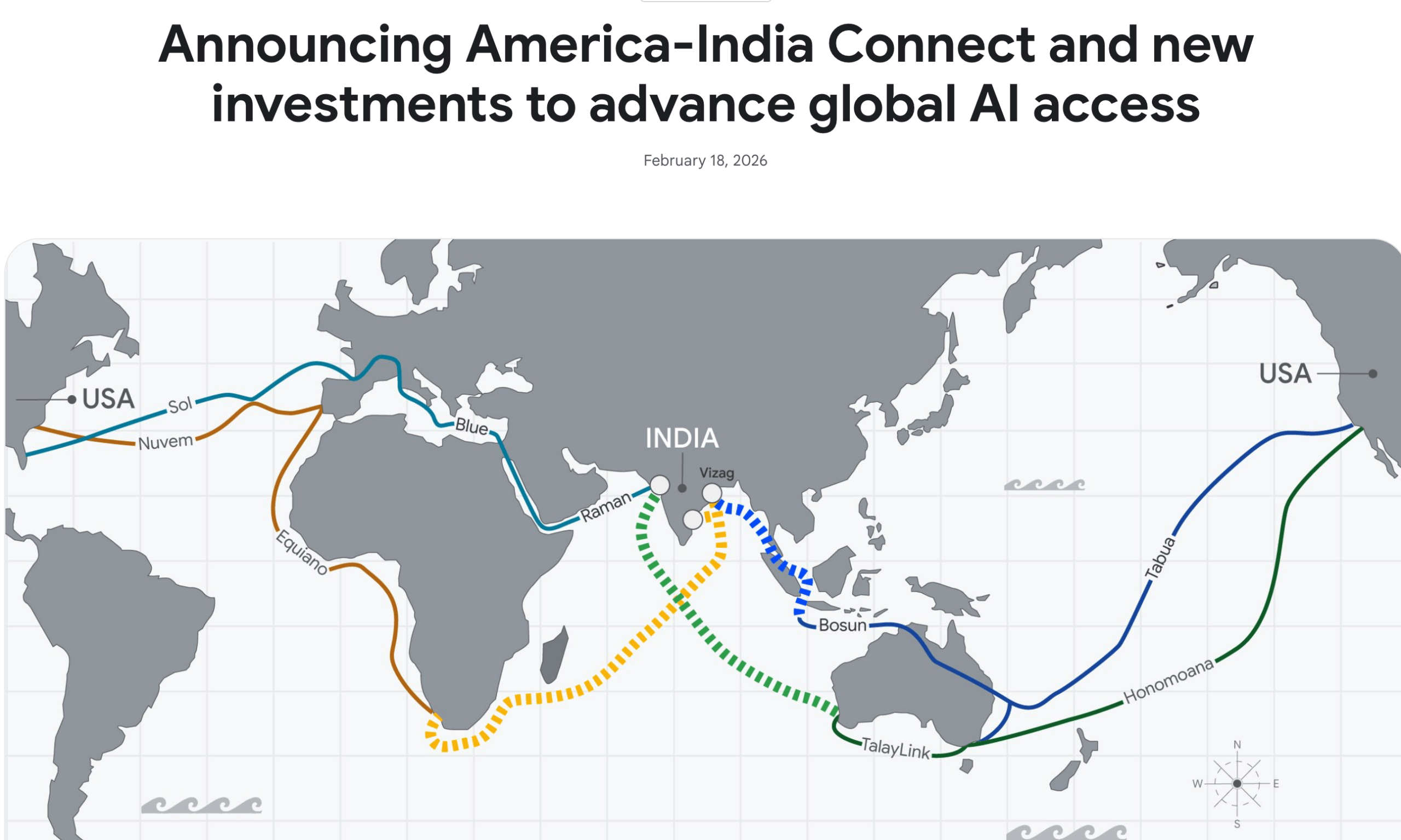
On India’s west coast, Google will deploy a direct fiber path between Mumbai and Western Australia. In combination with the TalayLink subsea cable system and Honomoana subsea cable system, this creates another South Pacific connection between the American west coast and Mumbai. The new route complements existing systems including Blue subsea cable system, Raman subsea cable system, and Sol subseGoogle outlined a sweeping expansion of subsea and terrestrial fiber infrastructure linking the United States and India, backed by a five-year $15 billion AI infrastructure investment in India. The initiative, called America-India Connect, aims to increase network reach, redundancy, and resilience across four continents while supporting AI-driven economic growth and digital access.
The plan establishes a new international subsea gateway in Visakhapatnam (Vizag) on India’s east coast, alongside three new subsea paths connecting India to Singapore, South Africa, and Australia. Four strategic fiber-optic routes will strengthen connectivity between the United States, India, and multiple Southern Hemisphere locations. On the east coast, Google will build a direct fiber path between Vizag and Chennai, linking onward to South Africa. When integrated with the Equiano subsea cable system and Nuvem subsea cable system, the route creates a high-capacity corridor from the American east coast around Africa to Vizag. A second east-coast path connects Vizag to Singapore; combined with the Bosun subsea cable system and Tabua subsea cable system, it establishes a South Pacific route linking the American west coast through Australia to India.a cable system, which together form a corridor from the American east coast through the Red Sea to India. By adding diversity beyond traditional landing points in Mumbai and Chennai, the initiative positions Vizag as a major subsea gateway and strengthens redundancy for a country of more than 1 billion people.
Beyond infrastructure, Google Cloud will support India’s digital skilling efforts through collaboration with Karmayogi Bharat, the Government of India’s digital civil service mission. As the primary cloud partner for the iGOT (Integrated Government Online Training) platform, Google Cloud provides infrastructure serving more than 20 million public servants across 800+ districts. The platform will use AI to digitize legacy training repositories, structure them into searchable knowledge assets, and expand access across more than 18 Indian languages.
- $15 billion AI infrastructure investment in India over five years
- New international subsea gateway in Visakhapatnam (Vizag)
- Three new subsea paths linking India to Singapore, South Africa, and Australia
- Direct fiber routes: Vizag–Chennai–South Africa; Vizag–Singapore; Mumbai–Western Australia
- Integration with Equiano, Nuvem, Bosun, Tabua, TalayLink, Honomoana, Blue, Raman, and Sol cable systems
- Google Cloud infrastructure supporting 20M+ public servants via iGOT Karmayogi platform
- AI-enabled multilingual training content across 18+ Indian languages
“AI is poised to accelerate progress at an unprecedented rate — but only if we democratize access to it from the start,” said Brian Quigley, VP, Global Network Infrastructure, Google Cloud.
🌐 Analysis: Google’s expanded subsea footprint reflects the growing link between AI infrastructure strategy and global fiber topology. As hyperscalers scale AI training and inference across regions, diversified cable landings and South Pacific routes reduce geopolitical and physical risk while improving latency profiles between the U.S., India, Africa, and Australia. The investment also aligns with India’s broader push to position itself as a digital and AI hub, as cloud providers compete to anchor long-term capacity through owned and consortium cable systems.
🌐 We’re tracking the latest developments in subsea cable infrastructure, policy, and deployments. Follow our ongoing coverage at: https://convergedigest.com/category/subsea/
🌐 We’re launching the “Data Center Networking for AI” series on NextGenInfra.io and inviting companies building real solutions—silicon, optics, fabrics, switches, software, orchestration—to share their views on video and in our expert report. To get involved, send a note to [email protected] or [email protected].