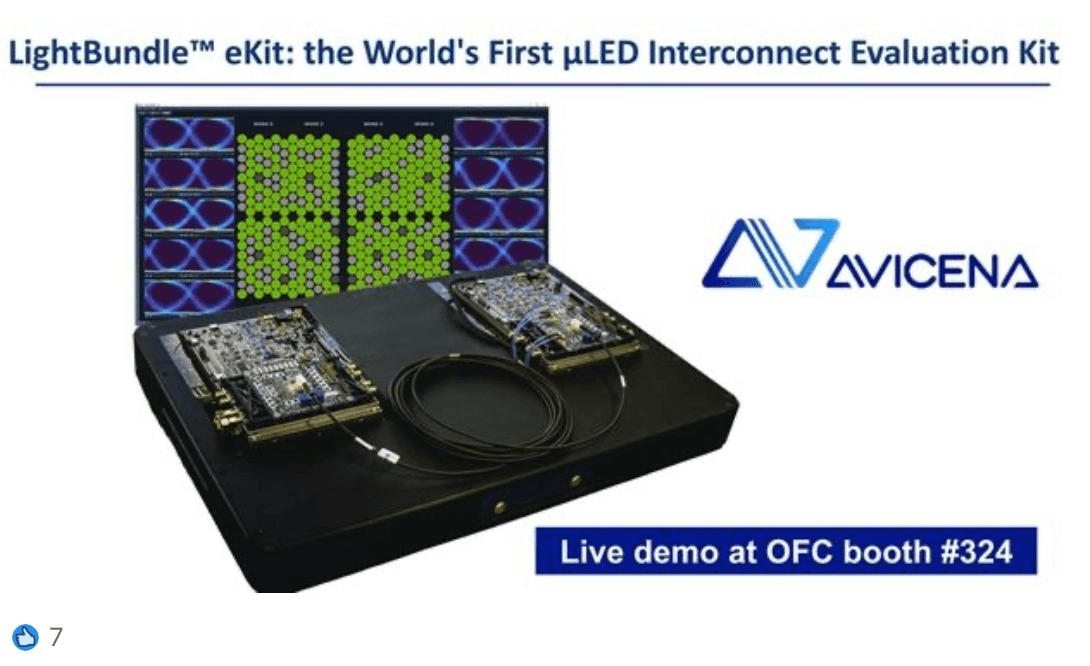
Avicena unveiled the LightBundle™ eKit, an evaluation platform designed to demonstrate microLED-based optical connectivity for next-generation AI infrastructure. The platform integrates ASIC-based transceivers with embedded LEDs, photodetectors, and micro-lens arrays connected through a multi-core fiber bundle. Avicena said the system allows hyperscalers and system architects to test optical links intended to address bandwidth, reach, routing, and energy constraints associated with copper interconnects in large AI clusters.
AI clusters now scale to tens of thousands of accelerators, creating growing demand for high-bandwidth links between compute, memory, and switching fabrics. Avicena positions microLED optical interconnects as an alternative to both copper and traditional laser-based optical technologies. By eliminating lasers, the architecture targets lower energy per bit, higher reliability at elevated temperatures, and greater bandwidth density for short-reach links used in AI scale-in and scale-up topologies.
The LightBundle eKit provides engineers with a hardware and software environment to evaluate microLED optical I/O performance. The system includes host interface boards, reference drivers, diagnostics, and a GUI-based testing platform to analyze signal integrity, link budgets, crosstalk, and bit-error-rate performance. Avicena plans to demonstrate the platform at OFC 2026 in Los Angeles.
- Supports 320 microLED data channels operating up to 3.5 Gbps
- 256 active channels plus 64 spare channels for redundancy
- Up to 896 Gbps link throughput planned (512 Gbps demonstrated)
- Raw BER better than 10⁻9 without forward error correction at 512 Gbps
- Optical reach options of 5 meters and 10 meters
- Designed for evaluation of die-to-die, die-to-memory, XPU-to-XPU, and XPU-to-switch interconnects
“LightBundle™ eKit gives system architects the first platform to evaluate microLED optical connectivity. Our customers and partners can now measure bit error rates, optical link budgets, crosstalk performance and power efficiency in their own engineering labs,” said Marco Chisari, CEO of Avicena.
🌐 Analysis
MicroLED optical interconnects represent an emerging category of short-reach optical I/O aimed at replacing copper links inside AI servers and accelerator clusters. Avicena’s approach eliminates lasers entirely, using directly modulated microLED arrays coupled to multi-core fiber bundles. The technology targets high bandwidth density and low energy per bit for die-to-die and rack-scale connections where copper trace reach and power consumption become limiting factors.