Cerebras Systems filed an S-1 registration with the Securities and Exchange Commission (SEC), offering a detailed look at one of the most ambitious alternative architectures in AI infrastructure. The IPO is expected to draw significant attention as investors look for new entrants beyond the dominant GPU ecosystem, particularly as demand for large-scale AI compute continues to accelerate across enterprises, hyperscalers, and research institutions.
The company said OpenAI has agreed to deploy 750 megawatts of Cerebras AI compute under the agreement announced in January 2026, with the two companies also collaborating to co-design future models optimized for Cerebras hardware. In March 2026, Cerebras also launched a multi-year partnership with Amazon Web Services to expand global access to its inference platform, targeting startups, enterprises, and AI-native companies. Together, these agreements signal a shift toward hyperscale AI infrastructure deployments and position Cerebras as a supplier for large, centralized AI compute environments.
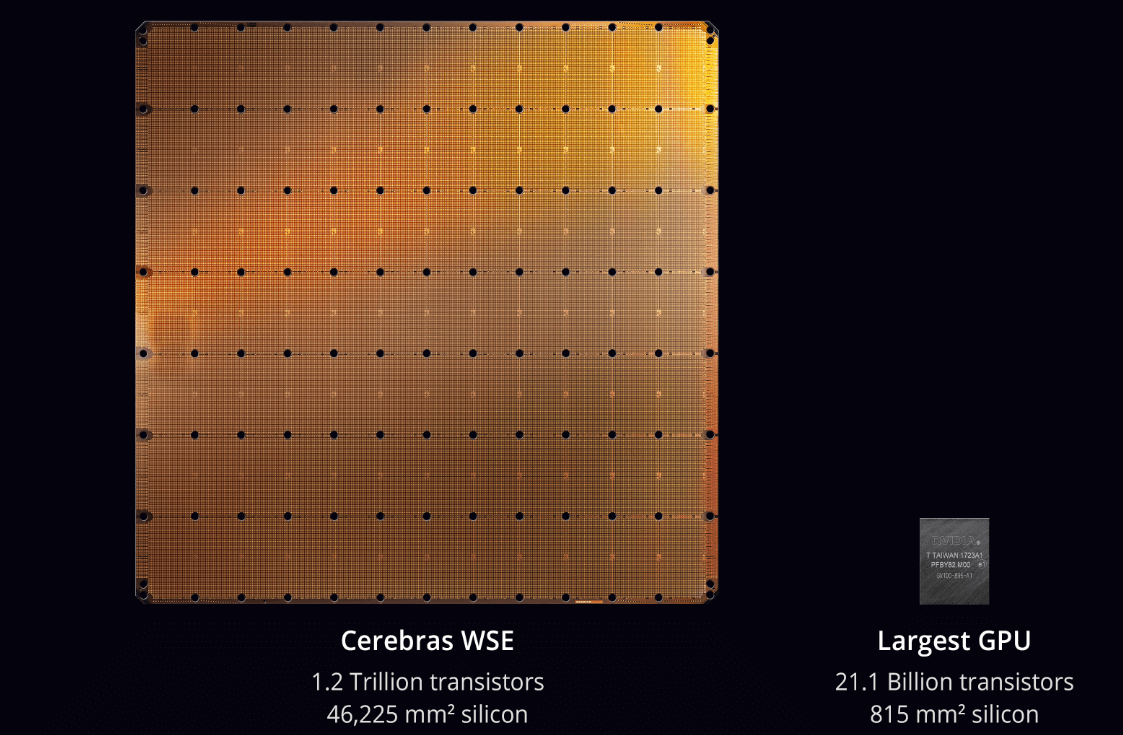
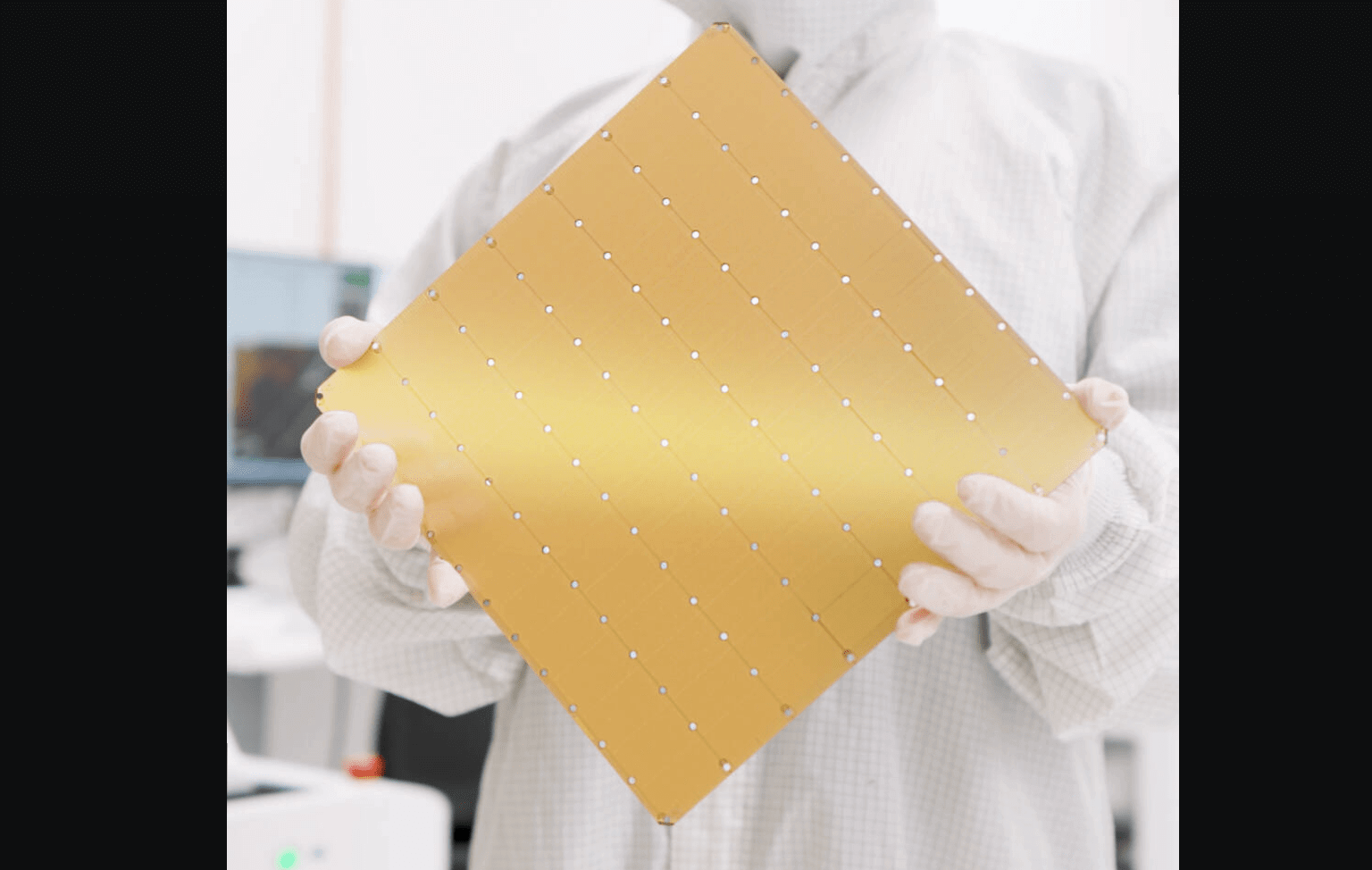
At the core of Cerebras’ platform is the Wafer-Scale Engine (WSE-3), a processor that spans an entire silicon wafer and integrates hundreds of thousands of AI compute cores, on-chip SRAM, and a high-bandwidth interconnect fabric. The company packages this device into its CS-3 system, a fully integrated appliance with power delivery, cooling, and host interfaces. For larger deployments, multiple CS-3 systems are linked via the SwarmX fabric to form SX-1 configurations, which operate as a single logical accelerator. The filing emphasizes a weight-streaming execution model, allowing models larger than on-chip memory to run without traditional distributed parallelism.
The S-1 expands on how Cerebras approaches scaling and performance. By keeping compute and memory within a single silicon domain, the architecture reduces latency and eliminates many of the communication bottlenecks found in GPU clusters. SX-1 systems scale by adding CS-3 nodes while maintaining deterministic performance and avoiding synchronization overhead. The company highlights this as particularly relevant for training large language models, scientific simulations, and other compute-intensive workloads that strain conventional distributed systems.
Cerebras also emphasizes its integrated software stack, which abstracts hardware complexity and supports standard machine learning frameworks. Developers can scale models without rewriting code for distributed environments, reducing engineering overhead. The company positions this simplified programming model as a key advantage for enterprise and research users that lack deep expertise in distributed AI infrastructure.
From a commercial standpoint, Cerebras generates revenue through system sales (CS-3 and SX-1), AI cloud and compute services, and software support. The company targets large enterprises, government organizations, and AI-native firms building foundation models and scientific applications. The filing notes that deployments often involve large-scale configurations, which can result in concentrated customer relationships and variability in revenue timing.
The S-1 also outlines key risk factors, including dependence on a limited number of customers, competition from established AI hardware vendors such as NVIDIA and Advanced Micro Devices, reliance on advanced semiconductor manufacturing, and the need to expand its software ecosystem. The company also highlights the capital-intensive nature of building and deploying wafer-scale systems.
- WSE-3 integrates compute, memory, and interconnect across a full silicon wafer
- CS-3 delivers a fully integrated AI system with power and cooling
- SwarmX fabric enables scaling via weight streaming instead of model partitioning
- SX-1 systems function as modular AI supercomputers with linear scaling
- Deterministic performance reduces variability seen in distributed GPU clusters
- Integrated software stack eliminates need for distributed training code
- Revenue model includes system sales, AI cloud services, and support
- Target customers include enterprises, government labs, and AI-native companies
- Risk factors include customer concentration, manufacturing dependency, and competition
- Competes with GPU clusters and hyperscaler-designed AI accelerators
“By eliminating the inefficiencies of distributed computing, our wafer-scale architecture enables faster time to solution and simplifies the development of large-scale AI models,” the company stated in the filing.
| Profile: Cerebras Systems | |
|---|---|
| Headquarters | Sunnyvale, California, USA |
| Founded | 2015 |
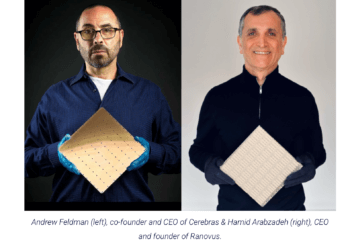
| Founders | Andrew Feldman (CEO), Gary Lauterbach, Michael James, Sean Lie (CTO), Jean-Philippe Fricker |
| Core Technology | Wafer-Scale Engine (WSE) processors integrating compute, memory (SRAM), and interconnect on a single silicon wafer |
| Product Platforms | CS-1, CS-2, CS-3 systems; SX-1 clustered supercomputing configurations |
| Architecture Approach | Single-wafer compute to reduce data movement, latency, and distributed training complexity vs GPU clusters |
| Software Model | Integrated compiler/runtime supporting standard ML frameworks; weight-streaming execution model |
| Primary Use Cases | Large language models, scientific computing, drug discovery, genomics, energy simulations |
| Business Model | AI system sales, cloud-based AI compute services, and software/support offerings |
| Key Customers / Segments | Government labs (e.g., Argonne, Lawrence Livermore), enterprises in pharma and energy, AI-native companies; partnerships include G42 for large-scale AI deployments |
| Major Partnerships | G42 (Condor Galaxy AI supercomputers); collaborations with national labs and enterprise customers |
| Key Milestones | 2019: WSE-1 (first wafer-scale processor) 2021: WSE-2 and CS-2 launch 2022: Andromeda AI supercomputer (~exascale-class system) 2024: WSE-3 and CS-3 introduction 2023–present: Condor Galaxy AI supercomputing network with G42 |
| Funding | Over $1B+ raised from investors including Benchmark, Coatue, Altimeter, Eclipse, and G42 (per public disclosures) |
| Market Position | Alternative AI compute architecture competing with GPU-based systems from NVIDIA and others |
🌐 Analysis: The OpenAI agreement disclosed in the S-1 stands out as one of the largest named AI infrastructure deals associated with an alternative compute architecture. A 750 MW deployment places Cerebras in the same conversation as hyperscale GPU clusters, signaling that wafer-scale systems are being considered for production-scale AI workloads. The addition of an AWS distribution partnership further indicates a dual strategy: large, centralized deployments combined with broader cloud accessibility.
🌐 Analysis: Cerebras’ IPO arrives as the AI infrastructure market expands beyond GPUs into a more heterogeneous landscape that includes custom ASICs and new system architectures. While NVIDIA continues to dominate with tightly integrated GPU platforms, Cerebras is attempting to differentiate by reducing dependence on distributed computing. The company’s success will depend on execution at scale, customer diversification, and continued growth of its software ecosystem.
🌐 Analysis: The significance of the IPO extends beyond Cerebras itself. Public market investors have had limited exposure to pure-play AI infrastructure hardware companies outside of incumbents, and Cerebras represents a test case for whether alternative architectures can gain commercial traction at scale. The company’s combination of large system deals, emerging cloud services, and concentrated customer base highlights both the opportunity and the execution risk as the AI hardware market continues to expand.