
A new multi-source agreement (MSA) focused on expanded beam optical (EBO) connectivity launched this week with backing from a broad coalition of cloud, networking, optical, and semiconductor companies seeking to establish interoperable standards for next-generation AI data center infrastructure. Founding participants include AMD, Arista Networks, Cisco, Meta, Oracle, Molex, TE Connectivity, Sumitomo, viaPhoton, Source Photonics, Senko, Nexthop-ai, Xscape Photonics, Accelink, Aperion, and 3M.
The initiative aims to accelerate adoption of expanded beam optical technology by defining shared specifications for connector interfaces, interoperability, and deployment architectures. Expanded beam optics use lenses to expand and collimate optical signals between fibers, reducing sensitivity to dust and contamination compared to traditional physical-contact connectors. Supporters argue the approach could simplify operations and improve reliability as hyperscale AI clusters scale toward significantly higher fiber counts and bandwidth densities.
The MSA emerges as AI infrastructure operators confront mounting operational challenges tied to optical connectivity, including connector cleaning, link failures, deployment complexity, and maintenance overhead. Oracle, serving as co-chair of the initiative, specifically cited connector hygiene and operational bottlenecks as major constraints in scaling AI networks. The coalition stated that the first technical working group has already begun developing an initial connector specification, while the MSA remains open to additional ecosystem participants.
| Profile: Expanded Beam Optical (EBO) MSA | |
|---|---|
| Organization Type | Multi-source agreement (MSA) |
| Mission | Develop open, interoperable specifications for expanded beam optical connectivity in AI infrastructure |
| Technology Focus | Expanded beam optical connectors for high-density optical interconnects |
| Key Advantages Claimed | Improved reliability, reduced contamination sensitivity, easier maintenance, simplified deployment, and scalability |
| Primary Target Market | Hyperscale AI data centers and cloud infrastructure |
| Founding Participants | AMD, Arista Networks, Cisco, Meta, Oracle, Molex, TE Connectivity, Sumitomo, viaPhoton, Senko, Source Photonics, Nexthop-ai, Xscape Photonics, 3M, Accelink, Aperion |
| Current Activity | Developing first connector specification through technical working groups |
| Operational Problems Addressed | Connector contamination, link reliability, optical maintenance complexity, AI cluster deployment scaling |
| Future Applications | Rack-scale optical fabrics, high-density AI clusters, optical backplanes, next-generation AI network architectures |
| Website | ebomsa.org |
“The increasing bandwidth density and scale of AI networks are driving the need for a highly resilient Layer 1, which today relies on multi-fiber physical contact connectors,” said Rajagopal Subramaniyan, senior vice president of OCI networking at Oracle. “Strict connector hygiene requirements slow network builds and add operational overhead for ongoing link triage. Expanded beam technology can overcome these bottlenecks, enabling more resilient cluster topologies and future rack-scale optical architectures.”
🌐 Analysis: Explaining Expanded Beam Optics
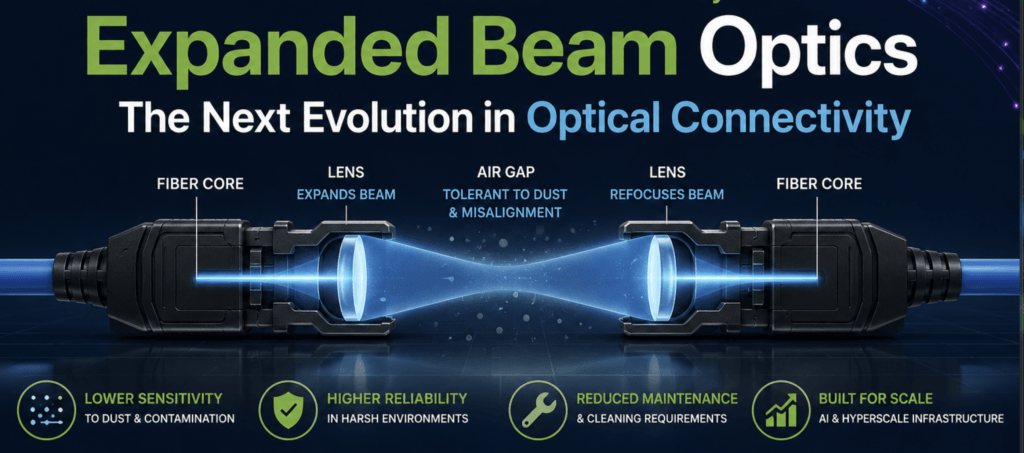
Expanded beam optics is a fiber-optic connection technique that uses tiny lenses to expand and collimate the light beam before it crosses a connector interface. Instead of two fiber cores physically touching each other — as in conventional physical-contact (PC) fiber connectors — the light travels across a small air gap between aligned optical elements.
In traditional fiber connectors such as LC, MPO, or MTP, the glass fiber ends must align with extreme precision and remain exceptionally clean. Even microscopic dust particles can block or scatter the light because the optical mode field is extremely small, typically around 9 microns for single-mode fiber. This is why hyperscale operators spend considerable effort on “connector hygiene,” inspection, and cleaning procedures.
Expanded beam optical (EBO) connectors reduce this sensitivity by enlarging the beam diameter before transmission across the connector interface. The larger beam is less affected by small contaminants, scratches, vibration, or slight misalignment.
Conceptually:
Traditional physical-contact fiber:
Fiber core → direct glass-to-glass contact → fiber core
Expanded beam optics:
Fiber core → lens expands beam → air gap → receiving lens refocuses beam → fiber core
Here’s the key engineering tradeoff:
| Characteristic | Physical Contact Fiber | Expanded Beam Optics |
|---|---|---|
| Optical Coupling | Direct fiber contact | Lens-based free-space coupling |
| Sensitivity to Dust | Very high | Much lower |
| Cleaning Requirements | Frequent | Reduced |
| Insertion Loss | Typically lower | Slightly higher |
| Mechanical Tolerance | Tight | More forgiving |
| Typical Legacy Markets | Telecom/datacom | Military, aerospace, industrial |
| Emerging AI Data Center Role | Current dominant approach | Potential future high-scale architecture |
From our archives
July 2021 – Webinar: Expanded Beam Optics
How do you ensure the reliability of a fiber connection to a switch at very high line rates or once co-packaged optics (CPO) solutions come to market? Dust is always a concern, especially at 400G and above, when even a small contamination can lead to magnified disruptions. Reliable optical interconnects are key! The latest OSFP 4.0 spec introduces support for Expanded Beam Optical (EBO) technology, opening up new possibilities.
This webinar explores what makes the Expanded Beam concept unique for fiber optic connectors, how EBO contributes to increasing operational reliability, and the wide range of applications for which EBO can be used.
🌐 We’re tracking the latest developments in networking silicon. Follow our ongoing coverage at: https://convergedigest.com/category/semiconductors/