Wind River announced that its high-speed pattern matching software is able to achieve a benchmark of over 36 Gbps on Intel Atom processors and exceeding 280 Gbps on high-end Intel Xeon–based platform.
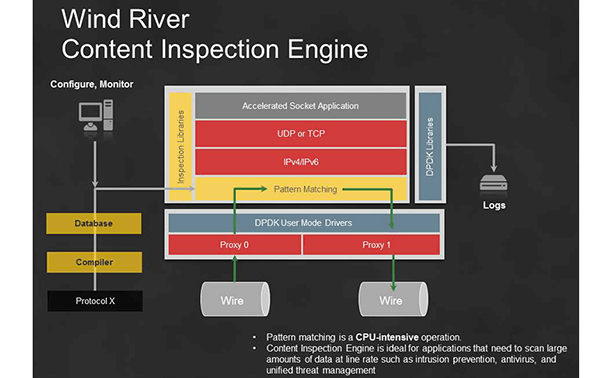
 The Wind River Content Inspection Engine provides the high-speed pattern matching that enables security appliance vendors to scale security performance and intelligence across the network from low-end to high-end platforms. Software pattern matching on Intel architecture enables the optimized performance and scalability needed for resource-intensive Network Function Virtualization (NFV) applications. The Content Inspection Engine, which runs entirely in software, is a high-speed embedded software pattern matching solution that can match large groups of regular expressions against blocks or streams of data. The engine can also search for multiple patterns simultaneously, even when the streams of data are scattered in different memory locations.
Wind River said its Content Inspection Engine, also sold as Hyperscan, now delivers pattern matching throughput of over 36 Gbps on the Intel Atom processor C2000 series, using tier-1 original equipment manufacturer (OEM) IPS patterns to scan real-world HTTP traffic. It is a pattern matching library designed to drop into a vendor’s system software release and be used for an entire product line, without requiring any additional software or hardware resources. With scanning performance on high-end Intel Xeon–based platforms exceeding 280 Gbps, these benchmarks demonstrate Content Inspection Engine’s ability to deliver scalable performance, making it an ideal pattern matching technology for low-end to high-end security platforms and NFV-based solutions.
“These latest benchmarks validate how software can transform processor real estate into scalable security performance,” said Paul Senyshyn, vice president of communication platforms at Wind River. “Wind River Content Inspection Engine delivers streamlined integration and scalability that is compelling for equipment manufacturers. We are encountering considerable traction from customers embracing the benefits of high speed pattern matching, including a steady stream of new evaluations worldwide.”
 In September 2013, Intel agreed to acquire Sensory Networks, a start-up which specializes in pattern matching and acceleration software technology, for approximately US$20 million. Sensory Networks developed “HyperScan” high-speed, L4-L7 pattern matching software that accelerates deep packet inspection applications running on Intel processors. The company was founded in Sydney Australia and was headed by Sab Gosal.
In 2012, Sensory reported that its HyperScan library delivers DPI throughput of 160Gbps with linear scalability, based on an intensive benchmark of HyperScan on a dual-socket platform (8-core, 16 threads per socket) using the new Intel Xeon processor E5-2600 family and Intel C604 chipset, scanning against a tier-1 commercial IPS signature set.