• Home
  • About
  • Events Calendar
  • Blueprint Guidelines
  • Privacy Policy
  • Manage Email Delivery
  • NextGenInfra.io
No Result
View All Result
Converge Digest
Sunday, June 7, 2026
  • Home
  • About
  • Events Calendar
  • Blueprint Guidelines
  • Privacy Policy
  • Manage Email Delivery
  • NextGenInfra.io
No Result
View All Result
Converge Digest
No Result
View All Result

Home » Australian researchers achieve 44.2 Tbps from a single light source.

Australian researchers achieve 44.2 Tbps from a single light source.

May 25, 2020
in Optical
A A

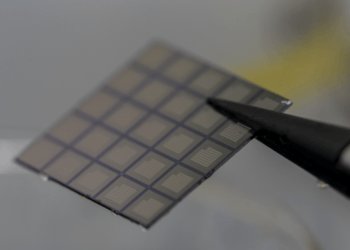
Researchers from Monash, Swinburne and RMIT universities in Australia have tested a single light source delivering 44.2 Tbps.

The research, which is published in the journal Nature Communications, tested a device that replaces 80 lasers with one single piece of equipment known as a micro-comb.

The ultra-high data transmission occurred over 75 km of standard optical fibre using the single integrated chip source over the C-band at 1550 nm with a spectral efficiency of 10.4 bits s−1 Hz−1. Micro-comb spacing of 48.9 GHz enabled the use of 64 QAM – quadrature amplitude modulated.

Professor Moss, Director of the Optical Sciences Centre at Swinburne, says: “In the 10 years since I co-invented micro-comb chips, they have become an enormously important field of research.

“It is truly exciting to see their capability in ultra-high bandwidth fibre optic telecommunications coming to fruition. This work represents a world-record for bandwidth down a single optical fibre from a single chip source, and represents an enormous breakthrough for part of the network which does the heaviest lifting. Micro-combs offer enormous promise for us to meet the world’s insatiable demand for bandwidth.”


https://www.swinburne.edu.au/news/latest-news/2020/05/australian-researchers-record-worlds-fastest-internet-speed-from-a-single-optical-chip.php

Tags: AcademiaAustraliaOptical
ShareTweetShareSummarizeSummarize
Previous Post

Crehan: Server-class Ethernet adapter market up 30% YoY in Q1

Next Post

KT brings 5G to warehouse carts

Staff

Staff

Related Posts

AI Infrastructure

IREN Plans 800MW Data Center in South Australia

June 3, 2026
Subsea

Google and Telstra Partner on Australian Fibre and Subsea Infrastructure for the AI Era

June 2, 2026
Semiconductors

Syenta Raises $26 Million to Tackle AI Chip Packaging

April 21, 2026
AI Infrastructure

Sharon AI Builds 8K B300 GPU Cluster in Australia

April 2, 2026
AI Infrastructure

Rebellions Raises $400M for Modular AI Inference Systems

April 1, 2026
Optical

NYU Researchers Discover Hybrid Liquid-Crystal Material 

November 8, 2025
Next Post

KT brings 5G to warehouse carts

Please login to join discussion

Categories

  • 5G / 6G / Wi-Fi
  • AI Infrastructure
  • All
  • Automotive Networking
  • Blueprints
  • Clouds and Carriers
  • Data Centers
  • Enterprise
  • Explainer
  • Feature
  • Financials
  • Last Mile / Middle Mile
  • Legal / Regulatory
  • Optical
  • Quantum
  • Research
  • Security
  • Semiconductors
  • Space
  • Start-ups
  • Subsea
  • Sustainability
  • Video
  • Webinars

Archives

Tags

5G All AT&T Australia AWS Blueprint columns BroadbandWireless Broadcom China Ciena Cisco Data Centers Dell'Oro Ericsson FCC Financial Financials Huawei Infinera Intel Japan Juniper Last Mile Last Mille LTE Mergers and Acquisitions Mobile NFV Nokia Optical Packet Systems PacketVoice People Regulatory Satellite SDN Service Providers Silicon Silicon Valley StandardsWatch Storage TTP UK Verizon Wi-Fi
Converge Digest

A private dossier for networking and telecoms

Follow Us

  • Home
  • About
  • Events Calendar
  • Blueprint Guidelines
  • Privacy Policy
  • Manage Email Delivery
  • NextGenInfra.io

© 2026 Converge Digest - A private dossier for networking and telecoms.

No Result
View All Result
  • Home
  • About
  • Events Calendar
  • Blueprint Guidelines
  • Privacy Policy
  • Manage Email Delivery
  • NextGenInfra.io

© 2026 Converge Digest - A private dossier for networking and telecoms.

This website uses cookies. By continuing to use this website you are giving consent to cookies being used. Visit our Privacy and Cookie Policy.
Go to mobile version