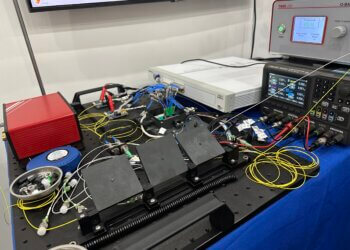

Researchers from the California Institute of Technology have developed a silicon-based photonic chip platform that guides light with efficiencies approaching those of optical fiber, enabling extremely low-loss optical circuits across a wide spectral range from visible to telecom wavelengths. The work will be presented by Kellan Colburn at the Optical Fiber Communication Conference and Exhibition (OFC) 2026 in Los Angeles.
The technology uses a CMOS-compatible fabrication process that integrates germanium-doped silica—an optical fiber material known for very low absorption—onto a semiconductor chip. The approach enables large optical mode areas on-chip, allowing near-perfect optical coupling between the chip and standard optical fiber while reducing thermal noise that can degrade laser coherence. Researchers demonstrated optical quality factors exceeding 180 million in ring resonators, corresponding to waveguide losses below 0.1 dB/m in the telecom band. The platform operates across wavelengths from 458 nm in the visible spectrum to 1550 nm in the telecom band.
The team used the platform to demonstrate several advanced photonic devices, including dispersion-engineered soliton microcombs, Brillouin lasers, and self-injection-locked semiconductor lasers with linewidths on the order of 10 Hz. In one demonstration, a millimeter-scale device converted low-cost multimode diode lasers with linewidths above 100 GHz into highly stable single-mode lasers. The approach improved coherence by more than 20 dB (roughly 100×) compared with previous visible-wavelength results.
- Silicon photonic platform based on germanium-doped silica fabricated using CMOS-compatible processes
- Operates across wavelengths from 458 nm (visible) to 1550 nm (telecom)
- Waveguide losses below 0.1 dB/m in the telecom band, approaching fiber-optic performance
- Ring resonators demonstrated optical quality factors above 180 million
- Supports large optical mode areas enabling efficient coupling between chip and optical fiber
- Demonstrated devices include soliton microcombs, Brillouin lasers, and self-injection-locked semiconductor lasers
- Millimeter-scale device converted multimode diode lasers (>100 GHz linewidth) into ultra-stable lasers (~10 Hz linewidth)
“This work demonstrates how ultralow-loss germanosilica integrated circuits enable fiber-class waveguide performance on chip,” said Takashi Matsui, OFC program chair at NTT.
🌐 Analysis: Ultralow-loss integrated photonics represents a major research focus as the industry attempts to bring fiber-class optical performance onto semiconductor platforms. Advances in silicon photonics are increasingly important for AI infrastructure, quantum networking, and high-precision sensing, where stable multi-wavelength light sources and low-loss optical routing are essential. Research programs at institutions such as Caltech, MIT, and industry labs at companies including Intel, Cisco, and NTT continue to push integrated photonics toward lower loss and broader wavelength operation, with the long-term goal of integrating lasers, amplifiers, and photonic processing functions onto a single scalable platform.
🌐 We’re tracking the latest developments in AI infrastructure, optical networking, and photonic interconnects. Follow our ongoing coverage at: https://convergedigest.com/category/ai-infrastructure/