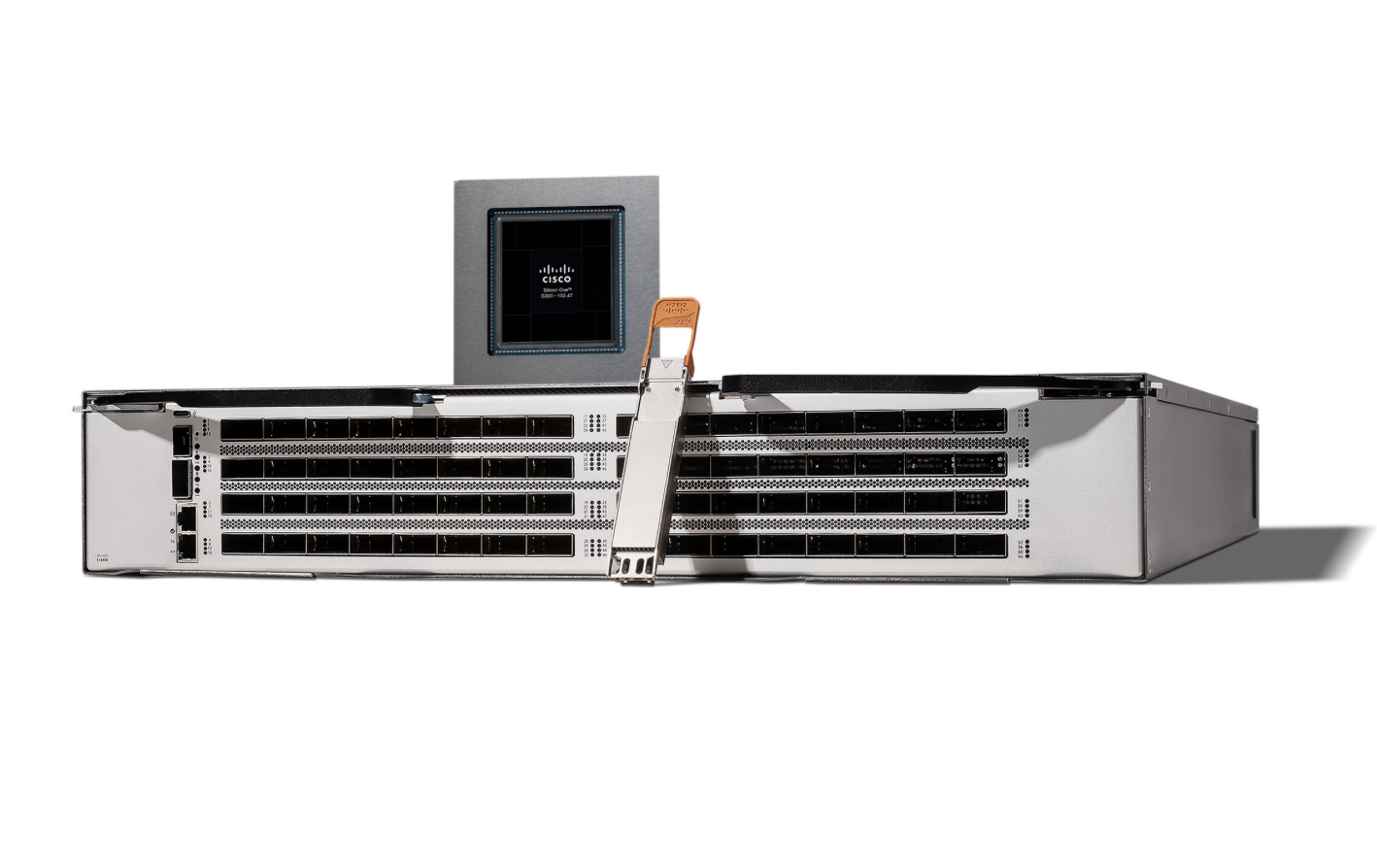
Cisco introduced a new generation of AI-focused data center networking platforms built around its 102.4 Tbps Silicon One G300 switch silicon. The launch targets the next phase of AI infrastructure buildouts as enterprises, neoclouds, service providers, and sovereign cloud operators deploy large-scale training and inference clusters under tighter power, cost, and operational constraints.
Cisco’s new Nexus 9000 and Cisco 8000 systems bring 102.4 Tbps switching capacity to both fixed and modular Ethernet platforms, with options for full liquid cooling. Cisco says the liquid-cooled designs, combined with new high-density optics, enable nearly 70% gains in energy efficiency while supporting higher rack power densities and faster AI job completion times through improved network utilization.
Alongside the hardware, Cisco expanded Nexus One with a unified management plane designed to simplify AI fabric deployment and operations across on-premises and cloud environments. Enhancements include job-aware observability that correlates network telemetry with GPU workloads and forthcoming native integration with Splunk to support compliance-sensitive and sovereign deployments.
- Silicon One G300: 102.4 Tbps switch silicon designed for massive AI clusters, supporting training, inference, and agentic workloads with up to 33% higher network utilization and 28% faster job completion times versus non-optimized designs.
- Cisco Nexus 9000 & Cisco 8000 systems: New fixed and modular platforms powered by G300, available in air-cooled and 100% liquid-cooled configurations to support extreme power and thermal requirements.
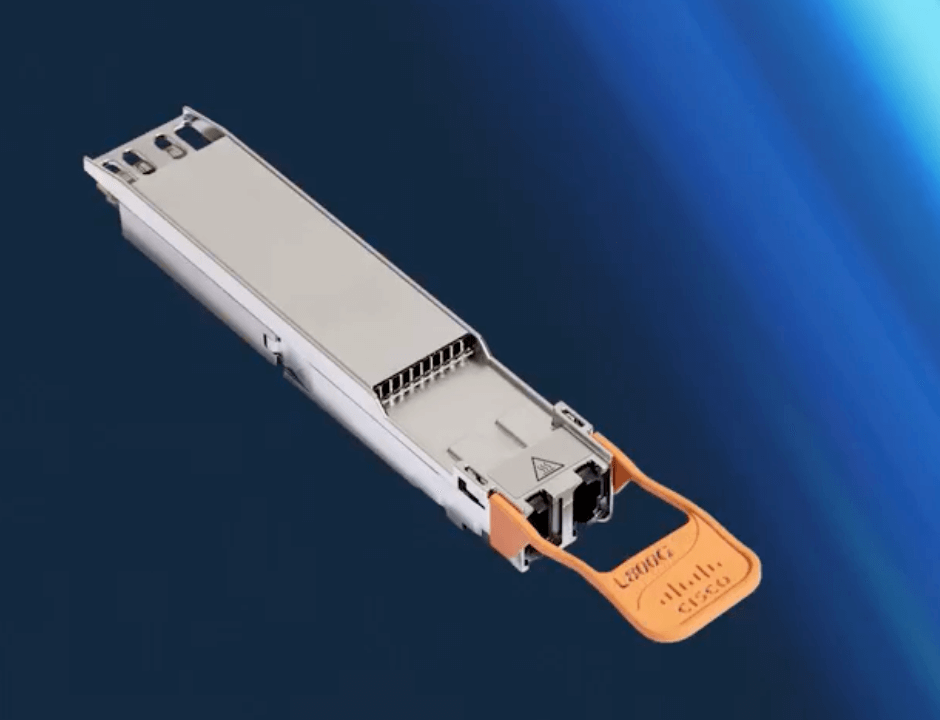
- Advanced optics: Support for 1.6T OSFP modules and 800G Linear Pluggable Optics (LPO), reducing optical module power by up to 50% and overall switch power by roughly 30%.
- Expanded P200 portfolio: New Silicon One P200-based systems and 28.8T line cards extend scale-across, DCI, and core routing capabilities using a common architecture.
- Nexus One upgrades: Unified fabric management, API-driven automation, AI job observability, and upcoming native Splunk integration for in-place analytics.
🌐 Analysis
Cisco’s Silicon One strategy reflects a deliberate shift away from discrete, product-specific ASICs toward a unified, programmable silicon portfolio that can scale across AI back-end networks, data center fabrics, DCI, core routing, and service provider architectures. By positioning Silicon One as a common hardware foundation—spanning G-series devices for AI scale-up and scale-out, and P-series devices for scale-across and routing—Cisco aims to reduce architectural fragmentation while allowing customers to deploy a consistent operational model across multiple network roles.
The G300 extends this strategy into the AI back-end, where network behavior increasingly affects GPU utilization, job completion time, and overall cluster economics. Features such as fully shared packet buffering, path-aware load balancing, and integrated telemetry signal Cisco’s intent to treat the network as a deterministic, performance-managed component of the AI compute stack rather than a best-effort transport layer. This aligns with a broader industry trend in which Ethernet-based AI fabrics must compete not only on raw bandwidth, but also on congestion control, failure recovery, and observability at scale.
Strategically, Silicon One also supports Cisco’s push toward long-lived infrastructure investments. High programmability and post-deployment feature upgrades allow Cisco to adapt systems to emerging AI traffic patterns, new optical speeds, and evolving security requirements without forcing wholesale hardware replacement. Combined with tighter integration into Nexus One, Cisco is effectively using Silicon One to anchor a vertically integrated approach—linking silicon, systems, optics, and operations software—while still positioning Ethernet as an open, standards-based alternative to more tightly coupled proprietary AI interconnects.
Quoted in the Cisco press release:
“As AI adoption moves beyond hyperscalers and scales across enterprises, neoclouds, and sovereign environments, network architecture is becoming a defining constraint on performance, cost, and sustainability. Cisco’s approach—combining high-performance silicon, liquid-cooled systems, advanced optics, and integrated operations—speaks directly to the next phase of AI infrastructure, where maximizing GPU utilization, improving energy efficiency, and simplifying operations are critical to realizing real economic value from AI at scale.” – Matt Eastwood, SVP, Enterprise Infrastructure and Datacenter Group, IDC
“Silicon One G300 represents a transformational leap in networking silicon, finely tuned for the demands of large-scale AI clusters. By significantly boosting network utilization, more GPU tokens are generated per hour. AI networking is critical in reshaping the economics and performance expectations for AI data centers. Back-end scale-out networks will rapidly move to 1.6T and be a key driver to push the Ethernet data center switch market above $100B a year.” – Alan Weckel, Founder and Technology Analyst, 650 Group
“Networking has been the fundamental constraint to scaling AI. Cisco has emerged as an important player in advancing high-speed, efficient Ethernet solutions, and the 102.4T Silicon One G300 is a clear proof point of that progress. At this scale, networking directly determines how much AI compute can actually be utilized.” – Dylan Patel, Founder, CEO, and Chief Analyst, SemiAnalysis