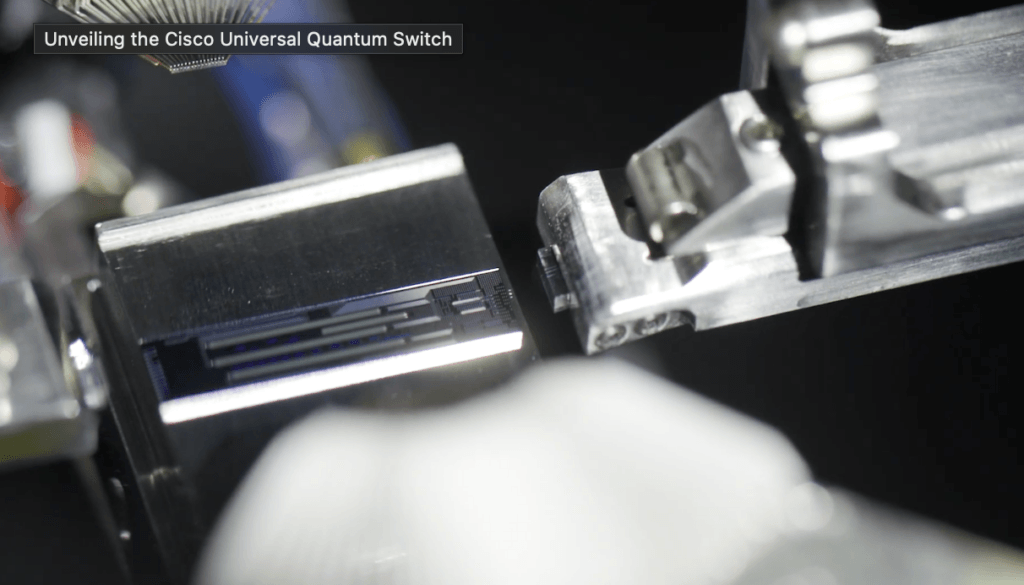
Cisco introduced a working research prototype of its Universal Quantum Switch, designed to interconnect quantum systems across vendors and encoding modalities while preserving fragile quantum information. The system operates at room temperature over standard telecom fiber, targeting a fundamental bottleneck in scaling quantum computing beyond isolated systems into distributed, networked architectures.
The prototype centers on a patented conversion engine that translates between multiple quantum encoding schemes—including polarization, time-bin, frequency-bin, and path—without collapsing the quantum state. In proof-of-concept experiments, Cisco reported less than 4% degradation in quantum state fidelity and entanglement, sub-nanosecond switching speeds (~1 ns), and power consumption below 1 milliwatt. Critically, the switch does not measure the quantum signal during routing, avoiding state collapse—an issue that prevents classical switching approaches from being applied to quantum systems. Initial validation has been completed with polarization encoding, with additional modalities slated for further testing.
Cisco frames the switch as the missing network layer required to scale quantum computing from thousands to millions of qubits. Rather than relying solely on larger monolithic quantum systems, the company emphasizes a distributed model where multiple quantum processing units (QPUs) and sensors interconnect over a network. The Universal Quantum Switch enables this by converting incoming quantum signals into a neutral internal modality for routing, then outputting them in the format required by the destination system. This approach also reduces the need for dense point-to-point connectivity—for example, a fully meshed 1,000-node quantum data center would otherwise require roughly 500,000 individual links—while enabling shared access to expensive resources such as entanglement sources and single-photon detectors.
- Designed to interconnect quantum computers and sensors across vendors and architectures
- Supports polarization, time-bin, frequency-bin, and path encoding modalities
- Converts between entanglement and encoding schemes without measuring or collapsing the quantum state
- Demonstrated less than 4% degradation in quantum state fidelity and entanglement
- Achieves sub-nanosecond electro-optic switching, about 1 nanosecond
- Operates at room temperature with no cryogenic requirements
- Runs over standard telecom fiber at existing wavelengths
- Consumes less than 1 milliwatt of power
- Enables resource pooling for detectors and entanglement sources across the network
- Reduces complexity versus point-to-point quantum interconnects
- Extends interoperability across heterogeneous QPUs and sensors
- Forms part of Cisco’s broader quantum stack, including entanglement chips and a network-aware compiler
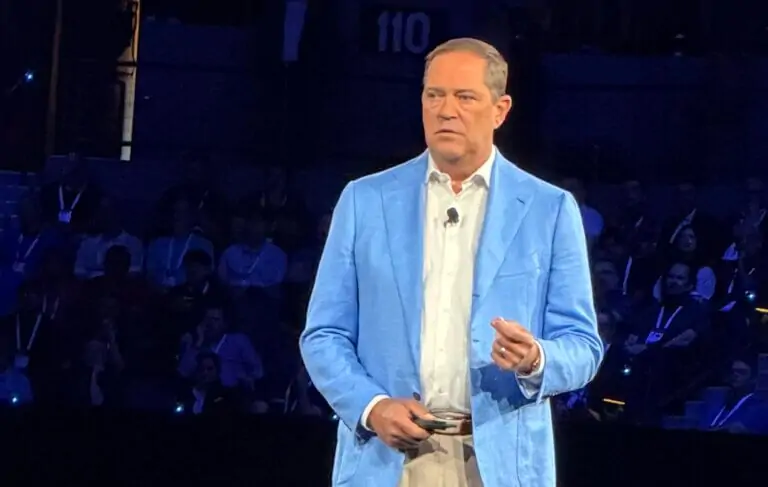
“Reaching this milestone is a pivotal moment for our quantum program and a testament to the transformative potential of quantum networking,” said Vijoy Pandey, SVP/GM of Outshift at Cisco. “We’ve long recognized that connecting quantum systems is the key to achieving true scalability, and now we’ve taken a critical step toward making that vision a reality.”
🌐 Analysis: Cisco is focusing on a critical architectural constraint in quantum computing: interoperability across heterogeneous hardware platforms. While vendors such as IBM and emerging players like Qunnect emphasize qubit scaling, entanglement distribution, and repeaters, Cisco is targeting the switching and routing layer. The ability to translate between encoding modalities without measurement introduces a potential abstraction layer analogous to packet switching in classical networks—an essential step if quantum computing evolves toward distributed, multi-node architectures.
🌐 Analysis: The design choices—room-temperature operation, compatibility with existing telecom fiber, and resource pooling—signal an effort to align quantum networking with current data center and carrier infrastructure. However, the system remains an early-stage prototype. Scaling to production environments will depend on advances in loss management, quantum error correction, and standardization across vendors. If validated beyond lab conditions, Cisco’s approach could influence emerging quantum networking frameworks and consortia focused on interoperability and network-layer design.