The FCC outlined a proposal for a New Citizens Broadband Radio Service in 3.5 GHz band.

The idea would be to designate 3.5 GHz spectrum as an “innovation band” for exploring new methods of spectrum sharing and promote a diverse array of network technologies, with a focus on relatively low-powered applications.
The FCC is proposing a three-tier authorization framework under which existing primary operations – including authorized federal users and grandfathered FSS earth stations – would
make up the Incumbent Access tier and would receive protection from harmful interference. The Citizens Broadband Radio Service would be divided into Priority Access and General Authorized Access (GAA) tiers of service, each of which would be required to operate on a non-interference basis with the Incumbent Access tier. The FCC is also proposing that any party that meets basic eligibility requirements under the Communications Act be eligible to hold a PAL or, when authorized, operate a CBSD on a GAA basis in the Citizens Broadband Radio Service.
The FCC noted that this proposed three-tier framework enjoys significant support from a diverse group of commenters, including AT&T, Google, Public Knowledge, and the Open Technology Institute at the New America Foundation. Others, including CTIA – The Wireless Association (CTIA), NSN, and Qualcomm have argued that a two-tier framework that would prohibit or segregate GAA users would be a more efficient way to manage the 3.5 GHz Band.
 Under the FCC proposal, in place of fixed channel assignments, a Spectrum Access System (SAS) would dynamically assign bandwidth within given geographic areas to Priority Access Licensees and GAA users. The SAS would ensure that Priority Access Licensees have access to allotted 10 megahertz channels and that GAA users are provided access to at least 50 percent of the band. However, the exact spectral location of any given authorization, whether Priority Access or GAA, would not be fixed. For example, a licensee might have Priority Access rights for a single PAL, but the specific channel location assigned to that user would be managed by the SAS and could be reassigned from time to time (e.g., from 3550-3560 MHz to 3630-3640 MHz). Individual GAA users would be assigned available bandwidth of a size and spectral location determined by the SAS (e.g., from 3550-3556 MHz or 3662-3673 MHz).
http://www.fcc.gov/document/proposes-creation-new-citizens-broadband-radio-service-35-ghz
Additional background:
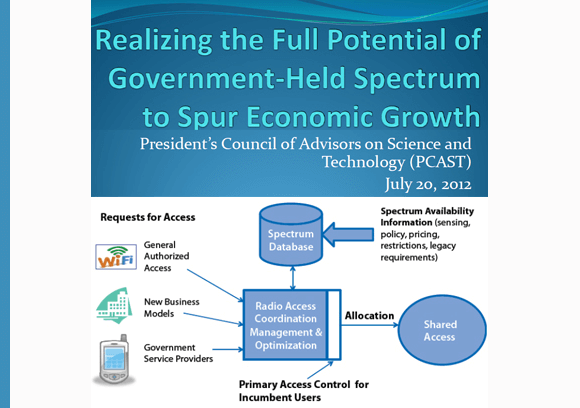
In July 2012, the President’s Council of Advisors on Science and Technology (PCAST) issued a report identifying 1,000 MHz of federal spectrum for sharing with the private sector.
U.S. federal policy should shift in favor “Shared-Use Spectrum Superhighways” instead the current plan which is to first clear federal users from specific bands and then auction this spectrum for the exclusive use of the highest bidder, according to a new report issued by
A Presidential memorandum issued in June 2010 requires that 500 MHz of spectrum to be made available for commercial use within 10 years. However, a recent NTIA Study found that clearing just one 95 MHz band will take 10 years, cost $18 billion, and cause significant disruption. Moreover, the net revenue for the Treasury from the last successful auction of 45 MHz realized a net income of just a few hundred million a year ($5.3 billion total).
The PCAST report said its vision of shared spectrum is viable using existing technologies and is not dependent on cognitive or “smart” radios. Instead, a geo-location database could be used the share spectrum much like how the FCC is using managing TV bands. The TV Whitespaces system could be used as a model. Technical standards would need to be implemented for coexistence of transmitters and receivers to enable flexible sharing.