Intel Corporation reported fourth-quarter and full-year 2025 financial results, closing the year with Q4 revenue of $13.7 billion, down 4% year-over-year, and full-year revenue of $52.9 billion, flat compared with 2024. Fourth-quarter GAAP EPS attributable to Intel was $(0.12), while non-GAAP EPS reached $0.15. For the full year, GAAP EPS was $(0.06) and non-GAAP EPS totaled $0.42. Intel noted that year-over-year comparisons were not adjusted for the deconsolidation of Altera, which closed in the third quarter of 2025.
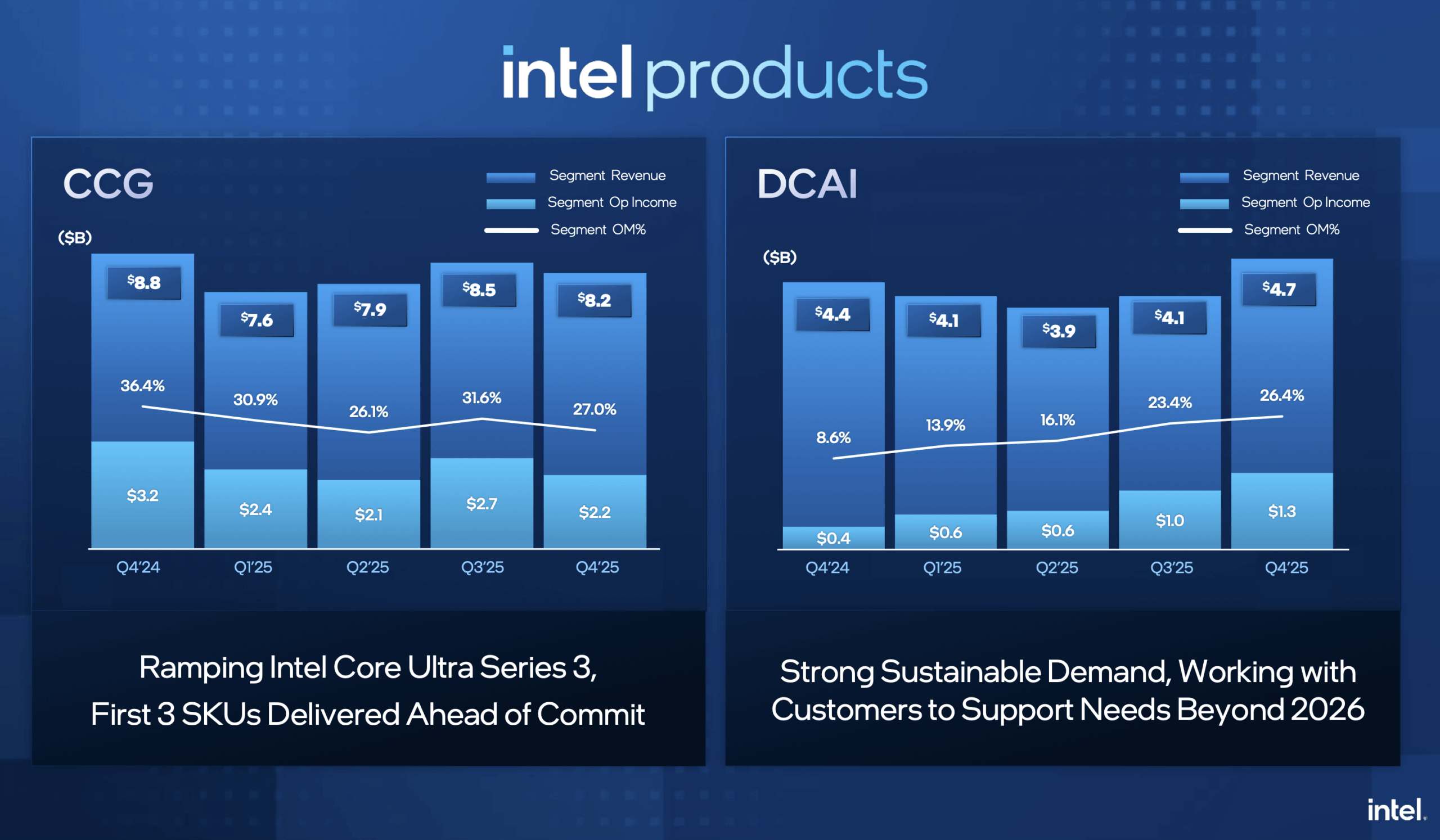
Data Center and AI (DCAI) emerged as a relative bright spot, with Q4 revenue of $4.7 billion, up 9% year-over-year, and full-year revenue of $16.9 billion, up 5%. Client Computing Group (CCG) revenue declined 7% in the quarter to $8.2 billion and fell 3% for the year to $32.2 billion. Intel Foundry revenue rose 4% year-over-year in Q4 to $4.5 billion and increased 3% for the full year to $17.8 billion, supported by continued ramp of Intel 18A manufacturing in Arizona and Oregon. Intel generated $4.3 billion in operating cash flow in Q4 and $9.7 billion for the full year.
Looking ahead, Intel forecast first-quarter 2026 revenue of $11.7 billion to $12.7 billion, with GAAP EPS of $(0.21) and non-GAAP EPS of $0.00. Management cited near-term supply constraints, with availability expected to bottom in Q1 before improving in Q2. The company highlighted progress on Intel 18A, new AI PC platforms, and deeper alignment across its data center and AI businesses as it positions CPUs, GPUs, and foundry services for AI-driven demand.
- Q4 2025 revenue: $13.7 billion, down 4% year-over-year
- Full-year 2025 revenue: $52.9 billion, flat year-over-year
- Q4 2025 non-GAAP EPS: $0.15; full-year non-GAAP EPS: $0.42
- DCAI Q4 revenue: $4.7 billion, up 9% year-over-year
- Intel Foundry Q4 revenue: $4.5 billion, up 4% year-over-year
- Q1 2026 revenue outlook: $11.7–$12.7 billion
“Our conviction in the essential role of CPUs in the AI era continues to grow,” said Lip-Bu Tan, Intel CEO. “The introduction of our first products on Intel 18A marks an important milestone, and we’re working aggressively to grow supply to meet strong customer demand.”
CEO Remarks – Data Center & AI Focus
- AI is driving unprecedented semiconductor demand across data centers, networks, enterprise systems, client devices, and the edge, materially expanding Intel’s addressable markets.
- Intel views CPUs as increasingly essential in AI infrastructure, supporting orchestration, inference, edge workloads, and agentic AI as AI usage shifts toward persistent, machine-to-machine interactions.
- Demand for traditional servers remains strong, reinforcing the ramp of Granite Rapids alongside Sapphire and Emerald Rapids platforms.
- Intel centralized its Data Center and AI businesses under a single leadership structure to tightly align CPU, GPU, and platform strategy for AI workloads.
- The company simplified its server roadmap, prioritizing Diamond Rapids, accelerating Coral Rapids, and reintroducing multi-threading into future data center platforms.
- Intel continues close collaboration with NVIDIA on a custom Xeon platform integrated with NVLink to optimize x86 performance for AI host nodes.
- Intel is expanding its custom ASIC strategy to address AI, networking, and cloud workloads, positioning the business to serve large-scale, purpose-built silicon demand.
- Intel shipped its first revenue products on Intel 18A, with improving yields as volume ramps in U.S. fabs, supporting both internal data center products and future foundry customers.
Key points from the Quarterly Conference Call
- Intel said it will not build meaningful 14A capacity until it secures customer volume commitments, limiting near-term 14A spending primarily to technology development and R&D; it expects firmer customer decisions in the second half of 2026 through the first half of 2027.
- Intel said Q1 gross margin pressure comes from lower revenue against a fixed-cost base and a larger share of Panther Lake in mix while its cost structure remains below the corporate average; the company expects Panther Lake costs to improve as yields and throughput rise.
- Intel said 34.5% non-GAAP gross margin at the Q1 midpoint is not acceptable and the near-term internal goal is to restore gross margin to 40% before setting a higher target.
- Intel said Q1 guidance sits at the low end of typical seasonality and demand would be above seasonal levels if the company had sufficient supply.
- Intel said it met strong demand in the second half of 2025 using intra-quarter production and finished-goods inventory, but finished-goods inventory has fallen to about 40% of peak, making Q1 a more constrained, “hand-to-mouth” shipping environment.
- Intel said it is shifting mix toward data center where possible while continuing to support client OEMs; within client, it plans to prioritize mid- and high-end products over the low end during the constrained period.
- Intel said it did not plan supply for a large data center unit increase six months ago because customers signaled higher core counts without unit growth, but demand accelerated sharply in Q3–Q4 and now appears to have multi-year duration.
- Intel said advanced packaging could become an early indicator of foundry traction, potentially showing meaningful revenue before large wafer volumes, and management described early engagements as larger than previously expected, including opportunities above $1B.
- Intel said some advanced-packaging customers are willing to prepay to secure capacity, reflecting tight supply and the importance of packaging in AI platforms.
- Intel said 14A work with customers is progressing through PDK 0.5, test-chip planning, IP requirements, pricing, and capacity discussions, with risk production targeted for late 2027 and volume production targeted for 2028.
- Intel said High-NA EUV is targeted for 14A process variants.
- Intel said it will continue supporting Clearwater Forest while focusing server execution on 16-channel Diamond Rapids and accelerating Coral Rapids, with multi-threading positioned as a key performance lever returning in Coral Rapids.
- Intel cited growing pressure on DRAM, NAND, and substrates driven by AI infrastructure build-outs and said allocation discipline matters to avoid shipping CPUs into systems that cannot be completed due to memory shortages.
- Intel said it has secured memory supply for current Lunar Lake forecasts, while noting in-package memory contributes to lower margins for those products.
- Intel said custom ASIC momentum ties to demand for purpose-built silicon that can combine Xeon, ASICs, and advanced packaging, especially for hyperscaler AI, networking, and cloud workloads.