Telefónica opened 2026 with a renewed focus on network infrastructure modernization, AI-driven operations, and portfolio simplification as the company advanced its “Transform & Grow” strategy. The company expanded FTTH coverage to 74.9 million premises passed, increased 5G coverage across core markets to 81%, and continued copper and legacy mobile shutdown programs in multiple regions. Telefónica also highlighted the launch of Europe’s first pan-European federated Edge Continuum initiative with other major European operators, alongside new direct-to-device satellite initiatives and AI-enabled autonomous network operations.
Group revenue reached €8.13 billion in Q1 2026, up 0.8% year-over-year on a constant basis, while adjusted EBITDA rose 1.8% and adjusted OpCFaL increased 2.4%. Spain and Brazil remained the primary infrastructure growth engines. In Spain, Telefónica continued XGS-PON upgrades, expanded edge infrastructure with 13 edge nodes, launched WiFi 7 services, and pushed further into cybersecurity and sovereign cloud initiatives including the Euro-3C project. Brazil accelerated 5G and fiber deployments with CapEx rising 9.6% year-over-year, while FTTH coverage reached 31.5 million premises passed and Vivo Total converged subscribers climbed 33%. Germany emphasized network quality and rural coverage expansion, doubling the number of new mobile sites activated year-over-year during the quarter.
The operator also sharpened its infrastructure strategy through portfolio restructuring and operational automation. Telefónica nearly completed its exit from Hispam markets with the announced sale of Telefónica Mexico following prior divestitures in Argentina, Peru, Uruguay, Ecuador, Colombia, and Chile. The company said 12 Level-4 autonomous network use cases are already operating in production as it adopts Agentic AI architectures for “Zero Touch” network operations. Telefónica also continued data center consolidation efforts, legacy network shutdowns, and energy optimization programs aimed at reducing energy consumption per traffic unit by 95% by 2030 relative to 2015 levels.
- FTTH premises passed: 74.9 million globally, up 6% year-over-year
- Total accesses: 297.9 million, up 5.3% year-over-year
- 5G coverage:
- Spain: 95%
- Germany: 98%
- Brazil: 70%
- UK: 87%
- Telefónica launched a 5G Cyber Defense Center integrated into NATO Digital Foundry initiatives
- Autonomous networking:
- 12 Level-4 autonomous use cases already operating
- Agentic AI architectures introduced for network automation
- Brazil:
- 25 million 5G device users
- FTTH connections up 11.5%
- CapEx/revenue ratio: 13.2%
- Germany:
- Over two new mobile sites activated per day
- Continued 5G and rural expansion investments
- VMO2:
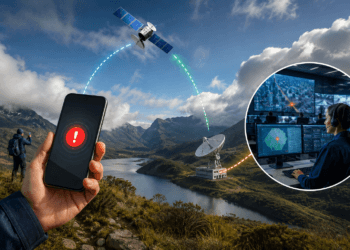
- Launched O2 Satellite service powered by Starlink Direct-to-Cell
- Expanded UK mobile landmass coverage from 89% to 95%
“We delivered solid Q1 results to start into our Transform & Grow plan. We want to transform the Company comprehensively, being more focused, efficient and profitable in a context marked by uncertainty, geopolitical volatility and the emergence of AI,” said Emilio Gayo, COO of Telefónica.
ditional Investor Call Highlights and Infrastructure Themes
- Telefónica said Spain’s Q1 performance exceeded internal expectations, with management forecasting stronger H2 trends across revenue, EBITDA, and cash flow metrics. Drivers include price increases, restructuring savings, ecosystem expansion, and continued B2B IT services growth.
- Spain’s workforce restructuring program contributed only about €20 million in savings during Q1 because most reductions occurred late in the quarter. Telefónica expects approximately €250 million in total annual savings from the initiative during 2026.
- Telefónica indicated that Germany’s underlying business trends remained “very resilient” despite the ongoing 1&1 migration impact. Management expects improved German financial performance in H2 2026 versus H1.
- Telefónica Deutschland emphasized a “value over volume” mobile strategy, including family SIM bundles and convergence offers designed to increase household loyalty rather than maximize standalone mobile ARPU.
- Germany’s convergence strategy increasingly centers on deeper fixed-network integration, multi-line household bundles, and expanded digital home services including TV offerings.
- Management disclosed that Telefónica is participating in Spain’s AI gigafactory consortium process, with a final proposal expected between June and July 2026. Telefónica described its prospective equity participation as minority ownership in the 10–15% range.
- Telefónica executives said any future M&A activity would focus on core markets, core telecom infrastructure assets, measurable synergies, and disciplined capital allocation. The company specifically highlighted network and CapEx synergies as primary drivers in telecom consolidation.
- Executives expressed cautious optimism about Europe’s revised telecom merger guidelines, saying the new framework better recognizes the importance of infrastructure investment and technology development when evaluating consolidation.
🌐 Analysis: Telefónica’s Q1 results underscore how incumbent European operators increasingly position fiber, edge computing, AI automation, and satellite integration as core infrastructure pillars rather than incremental service upgrades. The company’s emphasis on autonomous networking, sovereign cloud infrastructure, and pan-European edge federation aligns with broader European efforts to reduce dependency on U.S. hyperscalers while modernizing telecom infrastructure for AI-driven workloads.
🌐 Telefónica’s aggressive copper retirement and operational simplification also mirror similar moves by BT, Orange, Deutsche Telekom, and Vodafone as operators seek lower energy consumption and leaner network architectures. Meanwhile, the VMO2 Starlink integration and Telefónica’s exploration of direct-to-device satellite services illustrate how NTN and hybrid terrestrial-satellite connectivity are becoming mainstream priorities among Tier-1 operators.