MediaTek tests RedCap interoperability with Keysight
MediaTek completes 5G NR and RedCap interoperability testing using Keysight's solutions, validating Rel-17 features and driving market advancements in 5G technology.
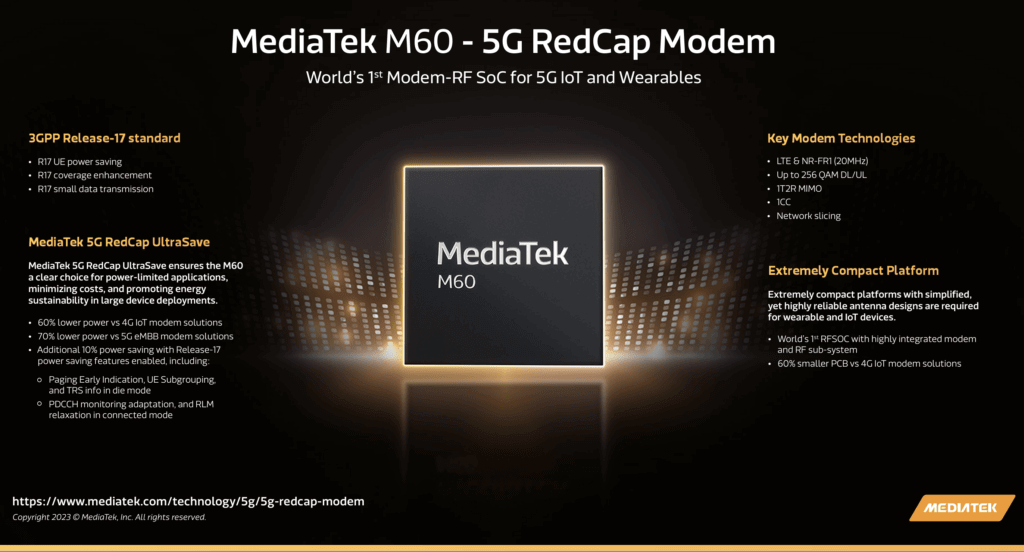
MediaTek completed 5G New Radio (NR) and 5G reduced capability (RedCap) interoperability development testing (IODT) of its 5G modem based on the 3GPP Release 17 (Rel-17) standard using Keysight’s 5G Network Emulation Solutions.
The testing verified early identification, bandwidth part (BWP) definition, user equipment (UE) capability, radio resource management (RRM) relaxation, network control device-synchronization signal block (NCD-SSB), sounding reference signal (SRS) enhancement, extended discontinuous reception (eDRX), and physical uplink control channel (PUCCH) for frequency hopping. The 5G NR IODT validated the chipset supported Rel-17 features including power saving, small data transmission, and NR coverage enhancement.
Dr. Ho-Chi Hwang, General Manager of Wireless Communication System and Partnerships at MediaTek, said: “MediaTek is committed to driving market advancements in 5G NR Rel-17 and RedCap technology. We collaborate with Keysight to develop state-of-the-art 5G modem platforms, fostering a growing ecosystem of 5G device innovators.”
Share this article
Help others discover this reporting.
Editorial responsibility
Jim Carroll
Editor & Publisher
Every article published by Converge Digest is researched, curated, fact-checked and editorially reviewed by Jim Carroll, Editor & Publisher. AI-assisted drafting may be used to accelerate production, but all content is reviewed, refined and approved prior to publication.
You just read about Semiconductors. A name from the archive that helped shape it:
National Semiconductor built Analog integrated circuits, power management, data converters and interface devices. What became of it?
National Semiconductor brought Analog integrated circuits, power management, data converters and interface devices to Semiconductor. That work was distinctive enough to lead to its acquisition by Texas Instruments for US$6.5B. The standalone name now passes into the archive — but the team and technology continue inside Texas Instruments today. One of 430 names here whose work outlived the company.
You just read about Semiconductors. A technology from the archive that helped get us here:
Josephson junction computing served 1970–1983. What ultimately replaced it?
Josephson junction computing superconducting junctions switched in picoseconds at liquid-helium temperatures, aiming at an ultra-fast computer. It has largely passed into history, but the ideas it proved still shape the networks that followed. Its name rests here in the archive. One of 198 technologies here that opened a door and then held it for the next.