Meta is expanding its AI infrastructure through a multiyear, multigenerational partnership with NVIDIA, deploying millions of Blackwell and Rubin GPUs alongside NVIDIA CPUs and Spectrum-X networking across its global data center footprint. The agreement spans on-premises systems and cloud environments and underpins Meta’s long-term roadmap for AI training and inference at hyperscale. The companies will co-design infrastructure across CPUs, GPUs, networking and software to support Meta’s personalization, recommendation and generative AI workloads.
Meta will build hyperscale data centers optimized for both large-scale model training and production inference. The deployment includes NVIDIA GB300-based systems and integration of NVIDIA Spectrum-X Ethernet switches into Meta’s Facebook Open Switching System (FBOSS) platform. Meta has also adopted NVIDIA Confidential Computing for WhatsApp private processing, enabling AI features while protecting user data integrity and confidentiality. The companies plan to extend confidential computing to additional Meta services.
The infrastructure expansion also centers on NVIDIA’s Arm-based Grace CPUs, marking the first large-scale Grace-only deployment. Meta reports improved performance per watt across its production data center applications through joint hardware-software optimization. The partners are collaborating on the next-generation Vera CPU, targeting potential large-scale deployment in 2027. Engineering teams from both companies are engaged in deep codesign efforts to accelerate Meta’s next-generation AI models across its global platforms.
- Deployment of millions of NVIDIA Blackwell and Rubin GPUs across Meta data centers
- Large-scale rollout of NVIDIA Grace CPUs; Vera CPUs targeted for 2027
- Integration of NVIDIA Spectrum-X Ethernet for AI-scale networking
- Unified architecture spanning on-premises and NVIDIA Cloud Partner environments
- Adoption of NVIDIA Confidential Computing for WhatsApp and future Meta services
- Focus on performance per watt and operational efficiency at hyperscale
“No one deploys AI at Meta’s scale — integrating frontier research with industrial-scale infrastructure to power the world’s largest personalization and recommendation systems for billions of users,” said Jensen Huang, founder and CEO of NVIDIA.
🌐 Analysis:
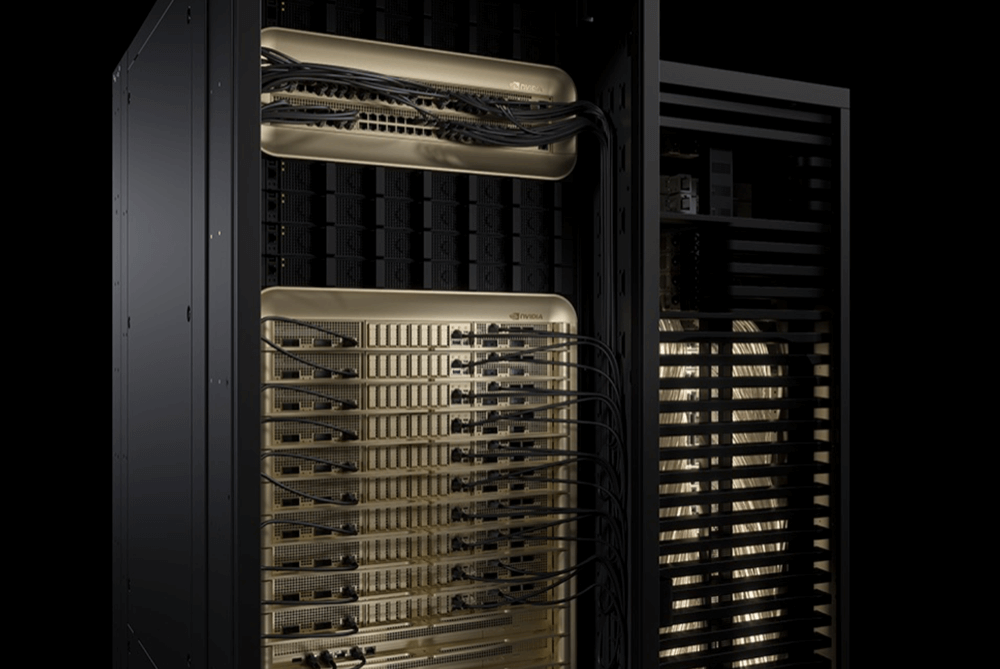
Meta’s decision to align its roadmap with NVIDIA across GPUs, Arm-based CPUs and Ethernet fabric signals a full-stack standardization strategy at rack and cluster scale. By integrating GB300 systems, Grace CPUs and Spectrum-X Ethernet into a unified architecture, Meta reduces integration complexity across training and inference clusters while increasing leverage over software optimization, memory hierarchies and network topology. At rack density levels driven by Blackwell- and Rubin-class accelerators, power delivery, thermal management and east-west bandwidth become co-equal design constraints with raw FLOPS, pushing Meta toward tightly coupled, pre-integrated rack-scale systems rather than loosely assembled component architectures.
The Grace-only deployment also carries broader silicon implications. It expands NVIDIA’s footprint beyond accelerators into host compute, displacing portions of traditional x86 server deployments and strengthening Arm’s role in hyperscale AI infrastructure. Combined CPU-GPU-memory-network co-design enables tighter NUMA alignment, improved memory bandwidth utilization and more deterministic performance across AI workloads. For Meta, that alignment offers performance-per-watt gains that directly affect data center TCO as cluster sizes scale into hundreds of thousands of accelerators.
This partnership unfolds against Meta’s projected multiyear capital expenditure surge tied to AI infrastructure expansion. With annual CapEx running into the tens of billions of dollars and AI buildouts driving a significant share of that spend, rack-level standardization around NVIDIA platforms creates supply-chain concentration but accelerates time to deployment. At hyperscale volumes, decisions on silicon architecture cascade into networking, optics, power distribution, liquid cooling and facility design. Meta’s roadmap therefore reflects not just GPU procurement at scale, but a vertically integrated AI factory model where silicon, rack design, networking fabric and software stack operate as a unified system optimized for throughput, energy efficiency and model iteration velocity.
🌐 We’re tracking the latest developments in AI infrastructure. Follow our ongoing coverage at: https://convergedigest.com/category/ai-infrastructure/