
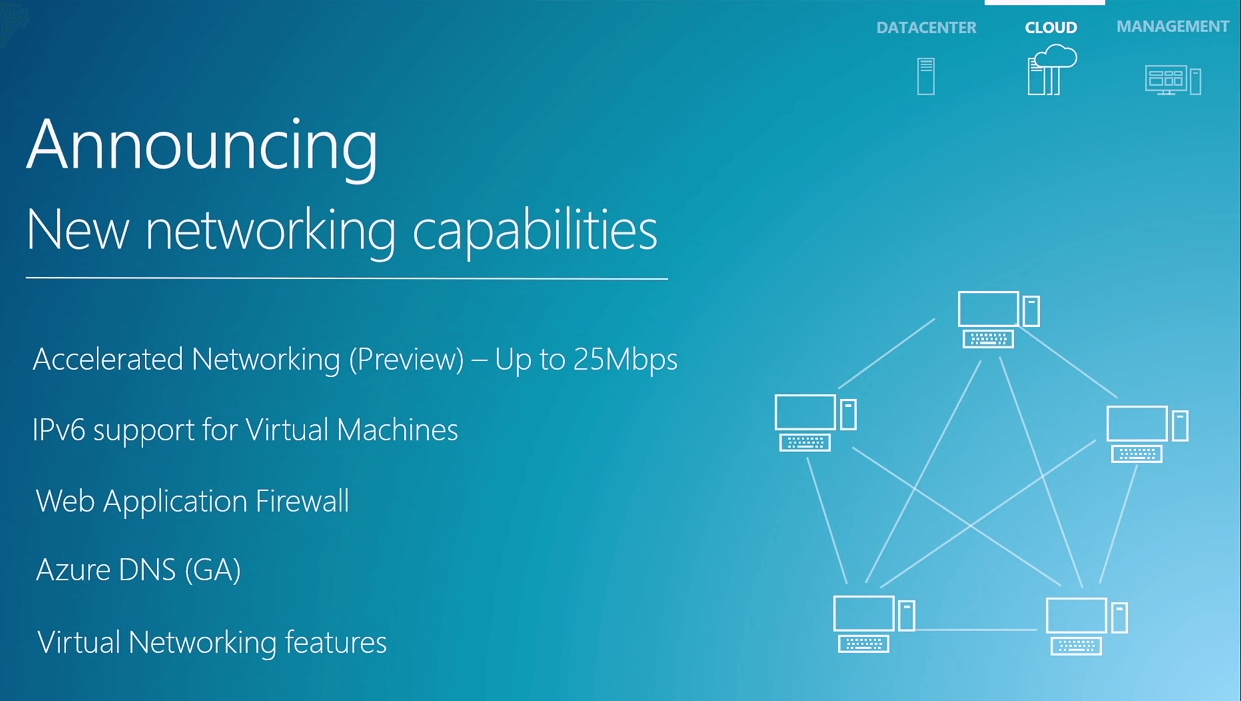
Microsoft rolled out a number networking capabilities for its Azure cloud service, including advancements to its global server fleet that the company says will improve networking bandwidth performance 33% to 50%.
The improvements include hardware technologies such as NVGRE offload, which harnesses the network processing capabilities of the hardware. Windows and Linux VMs will experience these performance improvements while returning valuable CPU cycles to the application.
 Microsoft said its Accelerated Networking provides up to 25 Gbps of throughput and drastically reduces network latency up to 10x.
The new hardware technologies including SR-IOV, which allows VMs to communicate directly to the hardware NIC completely bypassing the Hypervisor’s virtual switch, bringing higher bandwidths and lower latencies, along with reduced jitter and improved Packets Per Second (PPS) performance. With Accelerated Networking, Azure SQL DB In-Memory OLTP transaction performance improved 1.5X.
Additional highlights:

- Azure Storage users will benefit from substantially increased IOPS performance based on these advancements, combined with newly developed storage specific offloads. Hardware now efficiently performs data transfers up to the line rate of the NIC. The roll out for Storage will also complete in 2016.
- General availability of Virtual Network Peering (VNet Peering), which connects Virtual Networks (VNets) in the same region, enabling direct full mesh connectivity. VMs in the peered VNets communicate with each other as if they are part of the same VNet, thus benefiting from high bandwidth and low latency. Hub & Spoke topologies are supported with Transit Routing through gateways. The VNet without a gateway still has cross-premises connectivity via the gateway in the peered VNet. VNet Peering works across subscriptions allowing for simplified service management.
- New UltraPerformance Gateway SKU for ExpressRoute that supports up to 10 Gbps throughput. This is a 5x improvement over the existing ExpressRoute HighPerformance gateway with a 99.95% availability SLA.
- Azure now supports Native IPv6 network connectivity for applications and services hosted on Azure Virtual Machines.
- New Active-Active Virtual Private Network (VPN) Gateway for the High-Performance VPN gateway SKU is recommended for production workloads.
- New Azure Load Balancer configurations, including general availability of multiple VIPs on internal load balancers and new port reuse options across public and internal load balancers.
- Azure will also be previewing multiple IP addresses on a Network Interface Card (NIC) and enabling all NICs on a VM to have a Public IP address on the NIC or through the load balancer.
- GA release of Azure DNS, enabling customers to host domains in Azure DNS and manage DNS records using the same credentials, APIs, tools, billing and support as other Azure services.
- Additional network monitoring and diagnostics capabilities.

https://azure.microsoft.com/en-us/blog/azure-networking-announcements-for-ignite-2016/