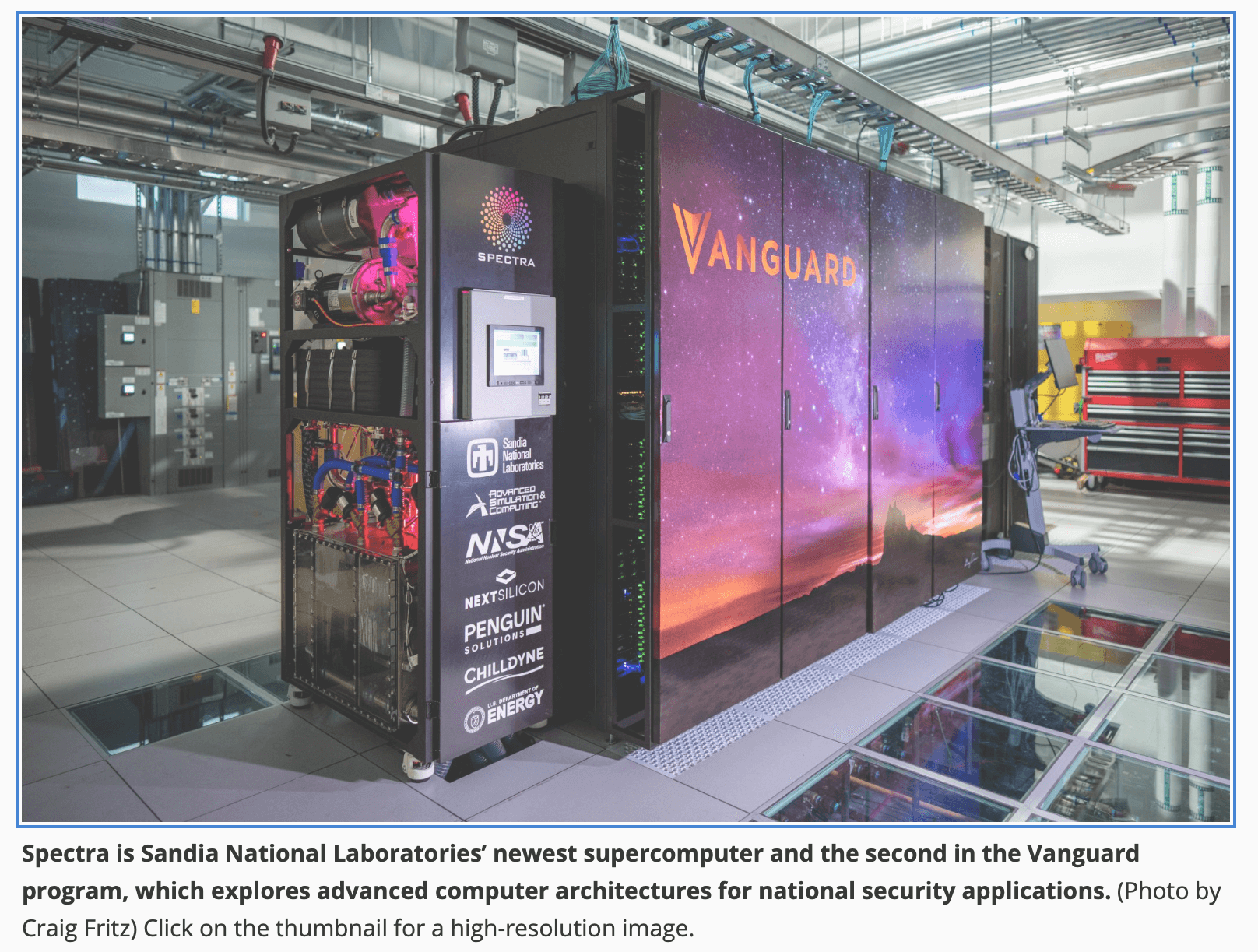
NextSilicon reported that its Spectra supercomputer at Sandia National Laboratories has achieved full system acceptance under Sandia’s Vanguard program, marking a significant milestone for the company’s Maverick-2 accelerator architecture in a U.S. national security computing environment. Spectra is the second system ever deployed under the Vanguard initiative, which evaluates emerging computing architectures against real-world mission workloads before broader deployment decisions. The system supports the National Nuclear Security Administration’s Advanced Simulation and Computing (ASC) program.
Spectra consists of a 64-node cluster equipped with 128 Maverick-2 dual-die accelerators. The system was built in collaboration with Penguin Solutions and deployed at Sandia National Laboratories as part of a multi-lab Vanguard effort that also includes Lawrence Livermore National Laboratory and Los Alamos National Laboratory. According to the company, the cluster successfully ran HPCG, LAMMPS molecular dynamics, and SPARTA Monte Carlo simulations as part of the formal acceptance process. Sandia’s evaluation focused on performance, system stability, and application compatibility under operational conditions.
NextSilicon positions Maverick-2 as an alternative to conventional GPU accelerators by using a runtime-reconfigurable architecture that adapts computational resources to individual workloads. The company said Maverick-2 is now deployed at dozens of customer sites worldwide across HPC, AI, and national security computing environments. Sandia’s acceptance gives the architecture a high-profile validation point within one of the most rigorous U.S. government HPC evaluation programs. For commercial HPC buyers evaluating infrastructure for simulation, mixed-physics modeling, and AI workloads, Spectra offers a real-world reference deployment inside a national laboratory environment.
- Spectra includes 64 compute nodes and 128 Maverick-2 dual-die accelerators
- System built jointly by Sandia, NextSilicon, and Penguin Solutions
- Benchmarks used in acceptance testing included HPCG, LAMMPS, and SPARTA
- Vanguard serves as Sandia’s testbed for evaluating new computing architectures against mission workloads
- Spectra is only the second system deployed under the Vanguard program, following Astra in 2018
- Deployment supports the National Nuclear Security Administration’s ASC program
- NextSilicon is headquartered in Tel Aviv with U.S. offices in Minneapolis
“This outcome is exactly what our process is designed to test, and it gives us a solid basis for continued evaluation of this technology,” said James H. Laros III, senior scientist and Vanguard program lead at Sandia National Laboratories.
| Profile: NextSilicon | |
|---|---|
| Company | NextSilicon |
| Focus | Runtime-reconfigurable accelerators for AI and high-performance computing workloads |
| Flagship technology | Maverick-2 dual-die accelerator |
| Architecture | Runtime-reconfigurable dataflow architecture designed to adapt compute resources to application behavior |
| Target workloads | Algorithmically complex HPC, AI, simulation, molecular dynamics, Monte Carlo, and national security computing workloads |
| Sandia deployment | Spectra supercomputer: 64 compute nodes with 128 Maverick-2 dual-die accelerators |
| Acceptance workloads | HPCG, LAMMPS molecular dynamics, and SPARTA Monte Carlo simulations |
| Program context | Spectra is the second system deployed under Sandia National Laboratories’ Vanguard program, following Astra in 2018 |
| Partners | Sandia National Laboratories and Penguin Solutions |
| Market position | Alternative accelerator architecture for organizations evaluating GPU-adjacent or non-GPU compute options for HPC and AI infrastructure |
| Deployment footprint | Maverick-2 is deployed at dozens of customer sites worldwide, according to the company |
| Headquarters | Tel Aviv, Israel, with U.S. offices in Minneapolis, Minnesota |
🌐 Analysis: Sandia’s acceptance of Spectra gives NextSilicon an important reference point in the evolving market for accelerated HPC infrastructure. National laboratory acceptance programs carry weight because they stress architectures with complex simulation workloads under strict operational requirements. For a newer accelerator company competing in a market dominated by GPU-based systems, successful execution at Sandia provides both technical validation and visibility among HPC buyers evaluating future alternatives.