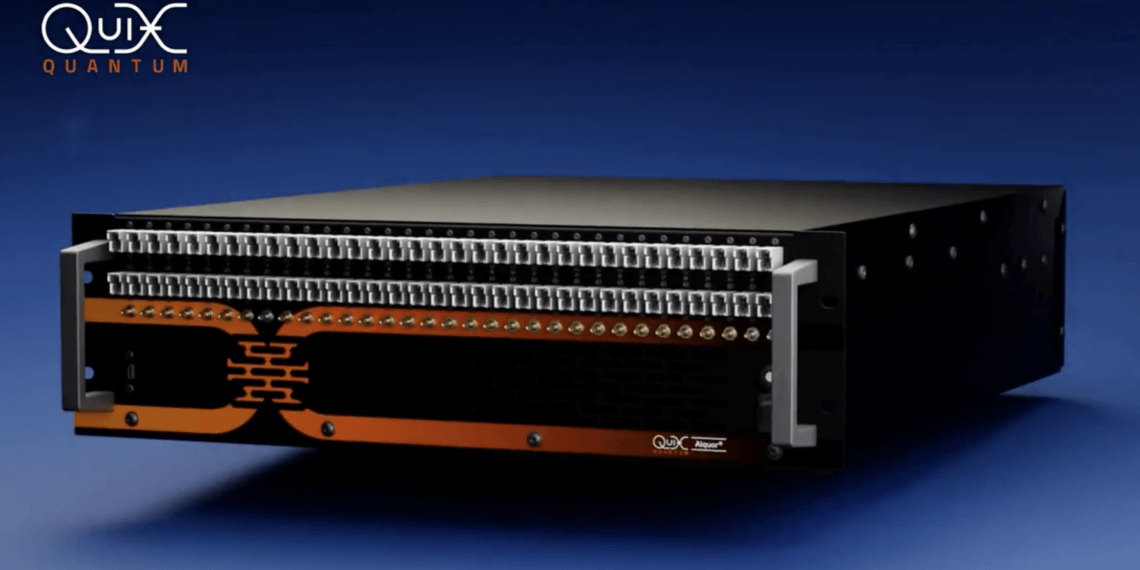
QuiX Quantum introduced PACU, a new rack-mountable Photonic Assembly Control Unit designed to standardize the control layer across its photonic quantum computing platform. The 3U system provides a scalable interface for operating increasingly complex photonic chips and supports the company’s roadmap toward universal quantum computers capable of running a broad range of quantum algorithms.
PACU is built to host photonic assemblies with up to 1,000 low-speed phase shifters and up to 32 high-speed phase shifters. The unit can update all low-speed phase shifters in under 2 milliseconds and includes Ethernet and USB connectivity, air cooling, E2000 optical connectors, overheat protection, and real-time condition feedback between the photonic assembly and the controller. QuiX says the design addresses one of the core engineering bottlenecks in photonic quantum computing: scaling the control infrastructure as photonic chips grow larger and more complex.
The system also reflects QuiX Quantum’s broader strategy of bringing photonic quantum computing into data center and HPC environments rather than keeping it confined to research labs. PACU’s 19-inch rack-compatible form factor, modular photonic assembly interface, and support for hot-swappable replacement are intended to simplify deployment, maintenance, and integration into hybrid quantum-classical computing environments. QuiX builds its systems around integrated silicon nitride photonic chips and positions photonics as the foundation of its universal quantum computing roadmap.
- PACU uses a 3U, 19-inch rack-mount architecture for data center deployment
- Supports up to 1,000 low-speed and 32 high-speed phase shifters
- Sub-2 millisecond update time across low-speed phase shifters
- Includes Ethernet and USB connectivity plus air cooling
- Supports board-to-board connector integration and hot-swappable photonic assemblies
- Designed for future measurement-based photonic quantum computing architectures
- Intended for deployment in hybrid quantum-classical compute environments and HPC systems
“As photonic quantum chips become more capable, the systems around them must scale as well,” said Stefan Hengesbach. “PACU gives us a common control architecture across our photonic platform. It is designed to make our systems more modular, maintainable and ready for integration into larger quantum computing environments.”
| Category | Details |
|---|---|
| Company | QuiX Quantum |
| Founded | 2019 |
| Headquarters | Enschede, Netherlands |
| Focus | Photonic quantum computing hardware based on silicon nitride integrated photonics |
| Flagship Technology | Universal photonic quantum computing systems and programmable quantum photonic processors |
| Processor Specs | Up to 20 optical channels; 2.9 dB loss; >90% transformation fidelity |
| Recognition | Prism Award winner (Quantum Tech category, 2023) |
| CEO | Stefan Hengesbach |
| Technology Approach | Full-stack, fabless photonic quantum computing with modular systems designed for data center and HPC integration |
| Latest Product | PACU – Photonic Assembly Control Unit for scalable photonic system control |
🌐 Analysis: QuiX Quantum takes a different route from many quantum hardware developers by using photons rather than superconducting circuits or trapped ions to encode and process quantum information. From the company’s website, we can glean that the core of its platform are programmable silicon nitride photonic integrated circuits, chosen for their ultra-low optical loss. That low-loss behavior is important because photons must travel through increasingly complex networks of waveguides, interferometers, and phase shifters while preserving quantum coherence. Unlike superconducting platforms that require sub-millikelvin dilution refrigerators, these photonic core processors operate at room temperature, shifting more of the engineering challenge toward optical control, precision tuning, packaging, and system integration.
QuiX has focused heavily on that systems layer. Its photonic processors use reconfigurable interferometric circuits to manipulate light across multiple optical channels, with applications spanning quantum computing, quantum communications, and photonic information processing. The company has also published recent work on hardware-level photonic error mitigation, including techniques to reduce photon indistinguishability errors—an important issue in photonic quantum systems where small variations in timing or wavelength can disrupt interference and entanglement.
The company’s newly introduced Photonic Assembly Control Unit (PACU) fits directly into that roadmap. Deployed as a standardized 3U rack-mountable chassis, PACU provides the scalable electronic and control infrastructure needed to manage hundreds to thousands of tunable photonic elements while maintaining reproducibility and serviceability in enterprise environments.
Strategically, QuiX is positioning photonic quantum computing as a modular, data-center-compatible architecture. Its fabless model combines in-house system design with external European semiconductor foundries, while its optical architecture aligns naturally with fiber-based interconnects used in HPC and communications networks. Standardized instrumentation like PACU represents another step in moving photonic quantum hardware from laboratory prototypes toward deployable infrastructure—where control systems, packaging, and rack integration become just as important as the quantum processor itself.