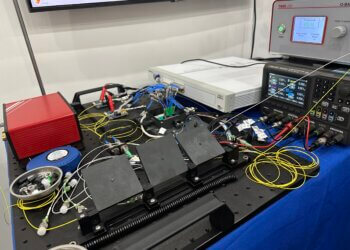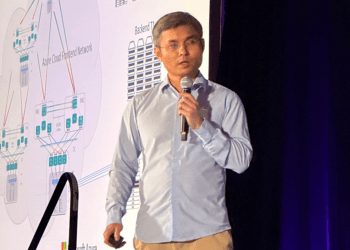

OFC 2026 is underway this week at the Los Angeles Convention Center, bringing together the global optical networking industry at a moment when artificial intelligence infrastructure is reshaping the entire technology stack. The conference runs March 15–19, with the exhibition opening March 17, and organizers expect approximately 16,000 attendees from more than 90 countries.
Even before the show floor opens, a series of major announcements has already set the tone for the event, highlighting how quickly the optical ecosystem is evolving to support large-scale AI data centers.
Run-Up to OFC: Major Industry Announcements
Several developments in the weeks leading up to OFC point to structural changes in the way AI infrastructure networks will be built.
Three new industry consortia have been launched to define optical interconnect architectures for AI systems:
• The Optical Compute Interconnect (OCI) MSA, founded by AMD, Broadcom, Meta, Microsoft, NVIDIA, and OpenAI, to define an open optical scale-up interconnect for AI clusters.
• The XPO MSA, which aims to standardize external laser source architectures for co-packaged optics.
• The Open CPX MSA, formed by companies including Ciena, Coherent, Marvell, Molex, Samtec, and TeraHop to define optical engine specifications for co-packaged and near-package interconnect systems.
Together, these initiatives highlight the industry’s growing push to move optics closer to switching and compute silicon as AI clusters expand to tens of thousands of accelerators.
Another major theme heading into OFC is the rapid transition toward 1.6-terabit optical networking.
Multiple vendors have already announced technologies targeting the next generation of high-speed optical connectivity, including:
• Marvell expanding its portfolio of 1.6T optical DSP platforms aimed at hyperscale data center interconnect.
• Broadcom introducing 400G-per-lane optical DSP technology enabling next-generation 1.6T pluggable transceivers.
• Lightmatter unveiling optical engines designed to support near-package and co-packaged optical architectures for AI infrastructure.
These announcements reflect a broader shift from 800G to 1.6T networking speeds as AI clusters require dramatically higher east-west bandwidth inside hyperscale data centers.
Transport and optical system vendors are also introducing new architectures designed specifically for AI workloads.
Ciena, for example, recently introduced its Hyper-Rail optical architecture, designed to scale data center interconnect networks using multiple parallel optical rails to increase capacity while improving power efficiency. The approach reflects a broader trend in which optical transport technologies traditionally associated with telecom networks are being adapted for hyperscale AI infrastructure.
At the same time, a new generation of startups and semiconductor vendors is developing technologies aimed at integrating optics directly with compute systems.
Companies including Lightmatter, Ayar Labs, Celestial AI, and Avicena are advancing architectures such as optical I/O, co-packaged optics, and alternative optical signaling approaches designed to replace traditional electrical interconnects inside AI clusters.
Key Points
• OFC 2026 runs March 15–19 in Los Angeles
• Exhibition floor opens March 17 and features roughly 700 exhibiting companies
• Organizers expect about 16,000 attendees from more than 90 countries
• AI infrastructure has become the dominant theme across optical networking announcements
• Vendors are focusing heavily on 1.6T optics, co-packaged optics, optical I/O, and AI-optimized networking architectures
“AI-driven network demand is fueling a surge of major product debuts and breakthrough innovations at OFC 2026,” organizers said in announcing the sold-out exhibition and strong participation across the optical ecosystem.
🌐 Analysis
What makes OFC 2026 particularly significant is that it reflects a clear shift in the optical industry’s center of gravity toward AI infrastructure.
Historically, optical networking innovation was driven primarily by telecom carriers and long-haul transport requirements. Today, hyperscale cloud operators and AI infrastructure providers are increasingly shaping the technology roadmap.
The announcements leading up to OFC illustrate this transition. Instead of focusing primarily on long-haul or metro transport, much of the innovation now centers on short-reach, high-bandwidth connectivity inside data centers.
The formation of multiple new MSAs demonstrates how quickly the industry is attempting to standardize new optical interconnect architectures for AI systems. These groups are working to establish open ecosystems around technologies such as co-packaged optics and optical scale-up networks, which could fundamentally change how GPUs, switches, and memory systems are interconnected.
At the same time, the shift toward 1.6T optics marks another key inflection point. AI clusters containing tens of thousands of accelerators generate enormous east-west traffic volumes, requiring much higher bandwidth links than previous generations of cloud infrastructure.
As a result, the optical ecosystem is rapidly evolving toward tighter integration between photonics, semiconductor packaging, and data center networking architectures.
The week’s program begins Monday with the Optica Executive Forum, where industry leaders will discuss the technology and market trends shaping the next generation of optical networking and AI infrastructure. Keynotes and panels at the forum traditionally provide early insight into the strategic priorities of major networking, semiconductor, and photonics companies.
Converge Digest will be reporting from the Optica Executive Forum and throughout OFC 2026, covering major product announcements, industry initiatives, and emerging technology trends across the AI networking ecosystem.