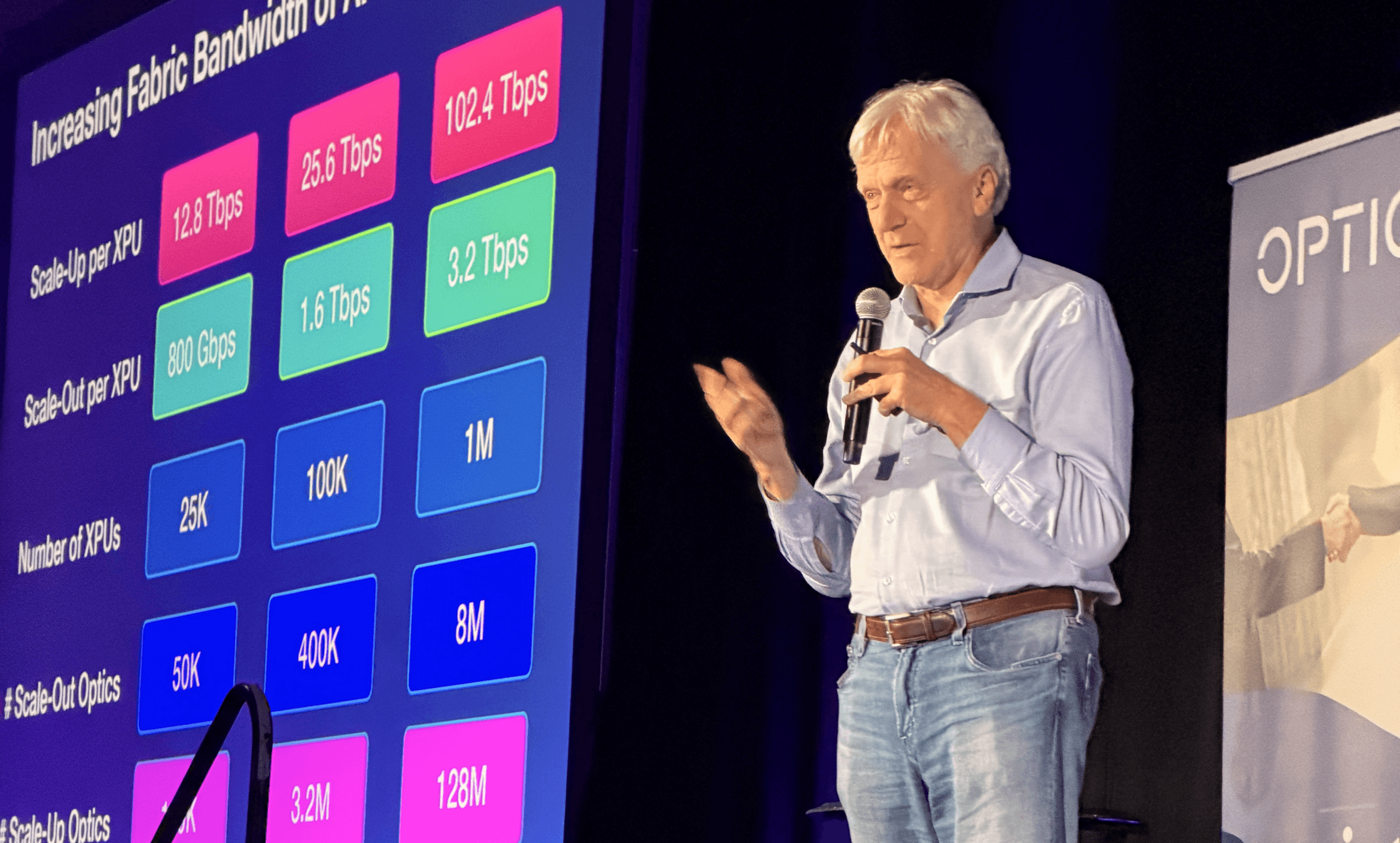
LOS ANGELES — The scale of optical connectivity required for future AI infrastructure may be far larger than the industry currently expects, according to Andy Bechtolsheim, co-founder and CTO of Arista Networks. Speaking at the Optica Executive Forum ahead of OFC 2026, Bechtolsheim argued that rapidly expanding AI clusters could drive demand for billions of optical links annually as GPU counts surge toward the million-node scale.
Bechtolsheim outlined how AI data centers are evolving simultaneously across three dimensions: bandwidth per GPU, the number of GPUs per cluster, and the scale of distributed computing fabrics that connect those clusters together. When those variables are multiplied across the size of emerging AI systems, the resulting connectivity demand grows dramatically. In one projection, a one-million-GPU data center could require millions of scale-up links inside the compute fabric and more than one hundred million scale-out connections linking clusters across the network.
Meeting that demand will require not only higher bandwidth optics but also a dramatic increase in manufacturing scale and efficiency. Bechtolsheim emphasized that future optical infrastructure must achieve lower power consumption, lower failure rates, and higher density while simultaneously scaling production to unprecedented levels. The biggest challenge, he said, may simply be the industry’s ability to manufacture and ship optical components in volumes approaching one billion units per year.
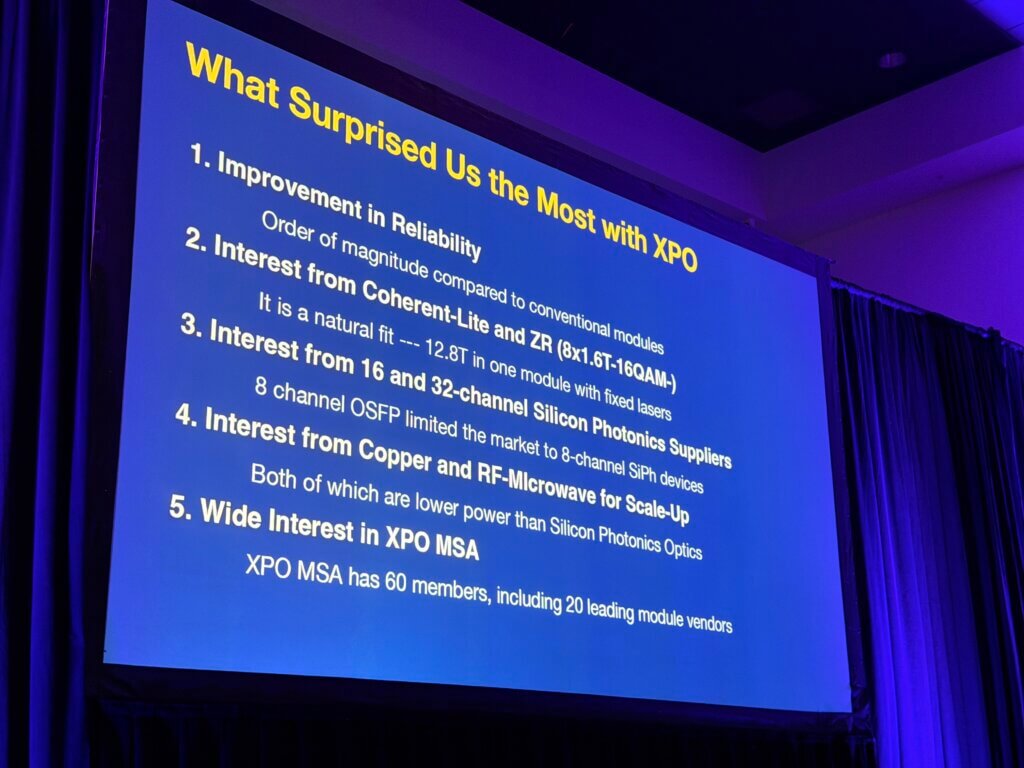
At the same time, Bechtolsheim cautioned that optics alone will not solve every connectivity challenge in AI systems. Short-reach scale-up links inside GPU clusters are still dominated by copper interconnects because of their lower power and lower failure rates at short distances. Technologies ranging from active copper to emerging RF microwave waveguide links may remain important for scale-up networks, while optical technologies will dominate longer-reach connections for scale-out networking between clusters.
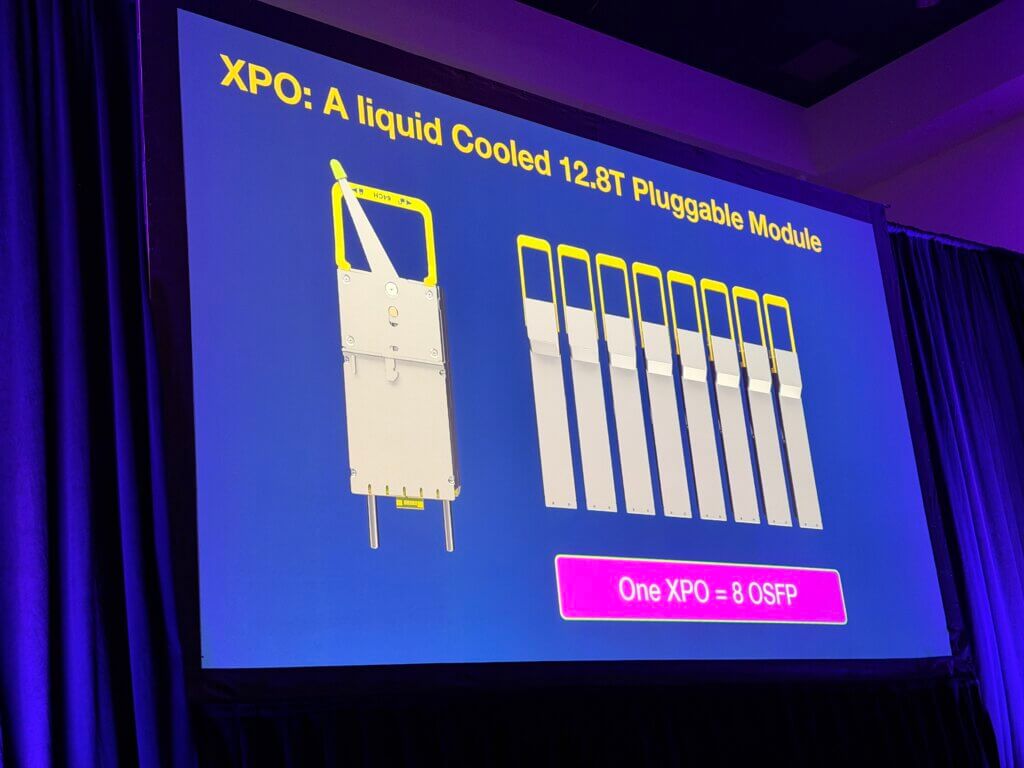
To address the density and cooling challenges of next-generation AI fabrics, Bechtolsheim introduced the concept of XPO (External Pluggable Optics), a liquid-cooled optical module architecture designed to significantly increase port density while reducing the structural footprint of network infrastructure inside AI data centers. By aggregating multiple optical channels into a denser pluggable module, XPO could enable dramatically higher switching capacity within a smaller physical footprint.
Key points highlighted in Bechtolsheim’s presentation:
• AI infrastructure could soon require over one billion optical links annually as GPU clusters scale toward the million-node range
• No single interconnect technology solves every AI networking challenge; copper, RF microwave, and optical links will coexist across different reach requirements
• XPO pluggable modules aggregate the equivalent of eight OSFP modules into a single liquid-cooled form factor
• Future switches could reach roughly 204.8 Tbps in a 1U chassis using XPO, compared with 4U systems using conventional OSFP optics
• Reducing switch racks by roughly 75 percent could significantly lower structural costs, including racks, bus bars, manifolds, and plumbing
• Data center footprint could shrink by roughly 40–50 percent due to denser optical connectivity
• Shorter cable lengths also enable lower-power interconnect technologies for scale-up fabrics
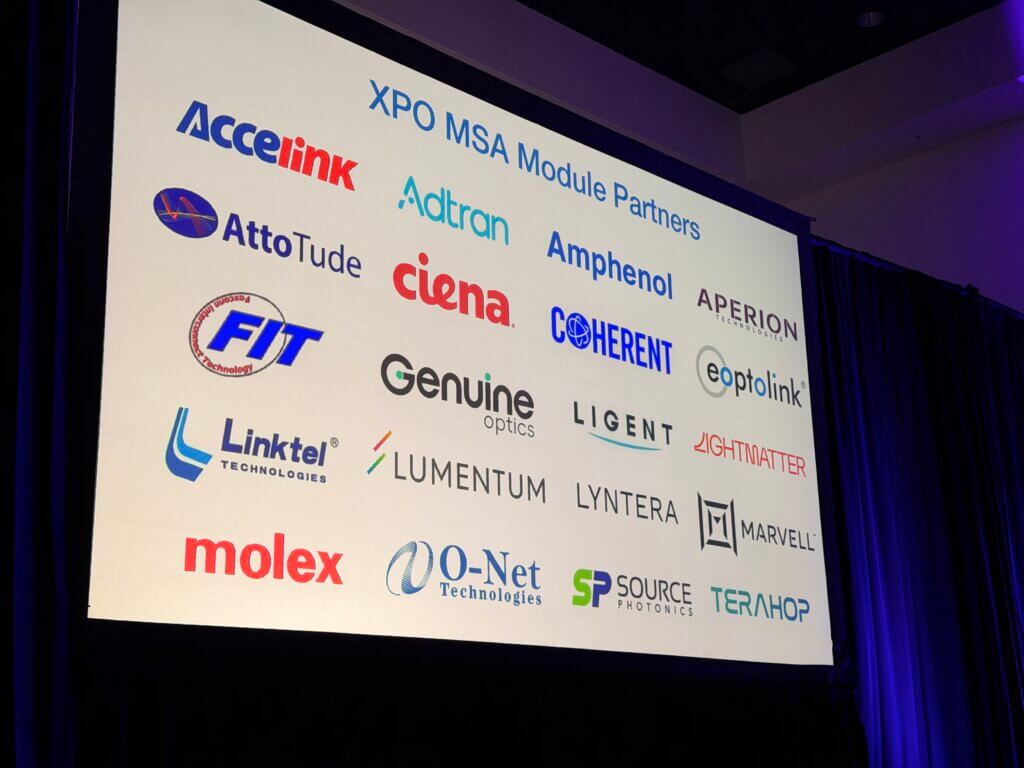
• The newly announced XPO MSA already includes about 60 member companies, including roughly 20 major optical module vendors
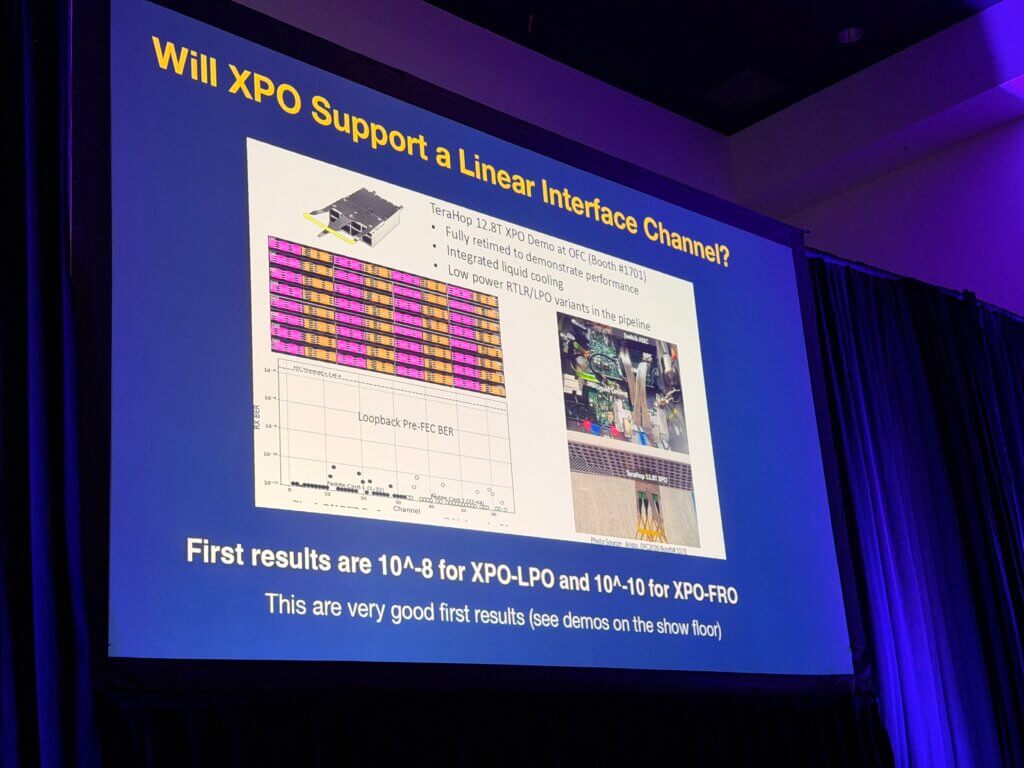
• Early prototype testing demonstrated promising bit-error-rate results for both linear and retimed implementations
“Pluggable optics are essential for innovation,” Bechtolsheim said. “They let the optics timeline evolve independently from the GPU and switch silicon roadmap, so you can plug in whatever technology works best when the system is ready.”