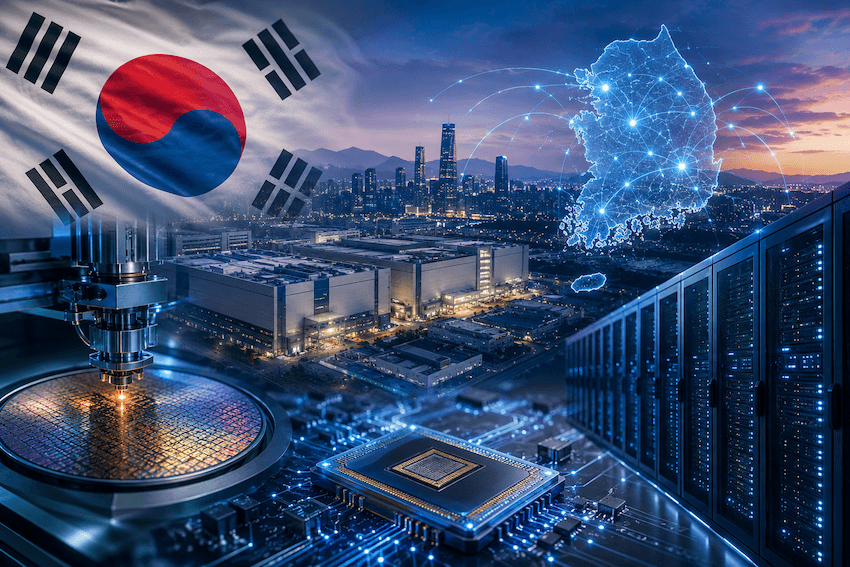
South Korea has launched one of the world’s most ambitious national AI infrastructure initiatives, aligning government policy with unprecedented long-term investments from Samsung and SK Group to strengthen the country’s leadership in semiconductors, AI computing, advanced manufacturing, and digital infrastructure. President Lee Jae-myung described the effort as a “national survival strategy” for the AI era, arguing that future economic competitiveness will depend on controlling the technologies and infrastructure that power artificial intelligence.
The initiative extends well beyond semiconductor manufacturing. Samsung plans to invest approximately 2,655 trillion won (US$1.94 trillion) across AI semiconductors, advanced manufacturing, robotics, batteries, digital infrastructure, and regional technology hubs. The company will expand South Korea’s semiconductor footprint beyond its existing clusters while investing in sovereign AI infrastructure, advanced HBM manufacturing, AI server packaging, digital twin manufacturing, and physical AI. Samsung also outlined investments in energy infrastructure—including renewable energy and hydrogen technologies—to support the growing power requirements of AI computing.
SK Group unveiled a complementary strategy focused on building the nation’s AI computing backbone. The company plans to develop up to 15 GW of AI data center capacity while SK Hynix expands production of AI memory, HBM, advanced packaging, and next-generation semiconductor manufacturing. Together, the initiatives aim to strengthen South Korea’s domestic supply chain from semiconductor fabrication through AI data centers, enabling the country to meet growing global demand for AI infrastructure while reducing dependence on overseas technology platforms.
The government’s broader vision positions South Korea as both a producer of advanced AI hardware and a global provider of AI computing infrastructure. National goals include doubling DRAM production within five years and expanding AI computing capacity to approximately 18.4 GW by 2035. Officials said the strategy will accelerate development of sovereign AI capabilities, robotics, advanced manufacturing, and next-generation digital infrastructure while creating a foundation for long-term economic growth.
South Korea’s National AI Infrastructure Strategy Major investment commitments announced • June 2026 | |
| Combined Investment | 3,755 trillion won (approximately US$2.74 trillion) |
| Samsung Investment | 2,655 trillion won (approximately US$1.94 trillion) across semiconductors, AI infrastructure, robotics, batteries and advanced manufacturing. |
| Semiconductor Expansion | 2,030 trillion won (approximately US$1.48 trillion) dedicated to semiconductor clusters centered on Pyeongtaek, Yongin and additional manufacturing regions. |
| Honam Region | 425 trillion won (approximately US$310 billion) including 400 trillion won (approximately US$292 billion) for a new semiconductor cluster in Gwangju. |
| Samsung AI Infrastructure | Samsung SDS will develop a sovereign AI data center in Haenam and a separate AI data center in Gumi to support national AI computing infrastructure. |
| HBM & Advanced Packaging | Samsung Electronics will construct advanced HBM fabrication facilities in Cheonan and Onyang, while Samsung Electro-Mechanics will establish AI server package substrate production in Sejong. |
| Physical AI & Robotics | Samsung Electronics plans physical AI and humanoid robot manufacturing lines in Gumi, integrating AI into next-generation industrial production. |
| SK AI Data Centers | Up to 15 GW of AI data center capacity planned nationwide, beginning with an initial 5 GW deployment. |
| SK Hynix Roadmap | 1,100 trillion won (approximately US$803 billion) covering AI memory, HBM, NAND, advanced packaging and expanded semiconductor manufacturing capacity. |
| National Goals | Double South Korea’s DRAM production within five years while expanding national AI computing capacity to 18.4 GW by 2035, positioning the country as a global AI infrastructure hub. |
President Lee Jae-myung described the initiative as “a national survival strategy” for the AI era. SK Group Chairman Choi Tae-won said the investments are intended to transform South Korea “from an AI consumer country to an AI exporter.” South Korea has unveiled one of the world’s most ambitious AI infrastructure initiatives, combining government policy with unprecedented long-term investment commitments from Samsung and SK Group to expand semiconductor manufacturing, AI data centers, advanced memory, robotics, and supporting energy infrastructure. President Lee Jae-myung described the program as a “national survival strategy” for the AI era, with corporate investment commitments totaling more than 3,755 trillion won (approximately US$2.74 trillion) over the coming decades across AI infrastructure, semiconductor manufacturing, and advanced technologies.
🌐 Analysis
The headline figures—more than 3,755 trillion won (US$2.74 trillion) in combined long-term investment plans—rank among the largest AI infrastructure announcements ever made. They should, however, be viewed as strategic roadmaps rather than near-term capital expenditure commitments. The plans span many years and encompass future semiconductor fabs, AI data centers, advanced memory production, robotics, energy infrastructure, and manufacturing expansion, all of which remain subject to market conditions, customer demand, financing, and government support.
Even if only a portion of the announced investments ultimately materializes, the strategic direction is clear. South Korea is responding to an increasingly competitive global race to control the physical infrastructure underpinning artificial intelligence. Taiwan continues to expand semiconductor manufacturing through TSMC, the United States is investing heavily through initiatives such as Stargate and new AI data center campuses, while companies including xAI are proposing gigawatt-scale “AI factories” such as the Terafab concept. By combining semiconductor manufacturing, HBM production, advanced packaging, sovereign AI infrastructure, and large-scale compute capacity into a single national strategy, South Korea is signaling that it intends to remain at the forefront of AI infrastructure rather than cede leadership to competing technology ecosystems.