
Starcloud signed a contract with SpaceX’s Starlink to integrate Starlink mini laser terminals into its next-generation satellites, adding optical intersatellite connectivity to its planned orbital compute infrastructure. The agreement covers more than 50 laser terminals across more than 25 satellites, with the first hardware expected to reach orbit within a year.
Each Starcloud satellite will carry two Starlink Mini Laser terminals based on the same optical crosslink technology deployed across SpaceX’s Starlink constellation. Starcloud said the terminals can support up to 25 Gbps of continuous intersatellite connectivity over distances up to 4,000 km (2,485 miles), with higher throughput possible over shorter links. The optical links allow Starcloud satellites to exchange data directly with the Starlink network using lasers, reducing dependence on terrestrial ground station infrastructure for data movement.
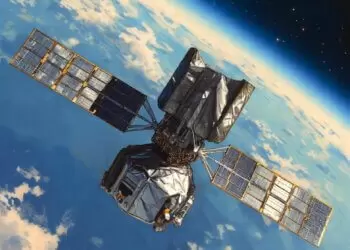
Starcloud positions the Starlink optical layer as a core element of its space-based data center architecture. Its satellite design combines four primary subsystems: solar panels for power generation, radiators for thermal management, GPUs for onboard compute, and laser terminals for networking. The company previously launched Starcloud-1 in November 2025 with an onboard NVIDIA H100 GPU. It says its next spacecraft, Starcloud-2, is scheduled in approximately eight months and will deliver a significant increase in onboard power generation and cooling capacity.
- Contract covers 50+ Starlink Mini Laser terminals across 25+ Starcloud satellites
- First flight hardware is expected on orbit within one year
- Optical links provide up to 25 Gbps intersatellite bandwidth
- Maximum link distance cited at 4,000 km (2,485 miles)
- Supports direct satellite-to-satellite data transfer without routing through ground stations
- Near-term target workloads include weather forecasting, wildfire detection, and Earth observation analytics
- Longer term, Starcloud sees the platform supporting AI inference and training workloads in orbit
“This collaboration with Starlink gives Starcloud satellites continuous, high-bandwidth, low-latency connectivity. That’s what turns individual satellites into a functioning distributed data center,” said Philip Johnston, co-founder and CEO of Starcloud.In this statement, Philip Johnston, the CEO of Starcloud, suggests that the partnership with Starlink allows continuous connectivity for Starcloud’s satellite. Johnston points out that the high-bandwidth and low-latency afforded by this collaboration is what enables their individual satellites to work together as a distributed data center. This, then, essentially allows the satellites to act as servers in the sky, significantly increasing the potential for data transmission and processing capabilities. This union thereby creates a platform for improved data services and communication channels for users worldwide.
🌐 Analysis
The agreement gives Starcloud access to a proven optical networking layer already operating at scale inside SpaceX’s Starlink constellation. While many space infrastructure startups are still developing proprietary optical intersatellite links, Starcloud is leveraging existing Starlink laser technology to accelerate deployment. That reduces technical risk while allowing the company to focus on power generation, thermal management, and compute density aboard its satellites.
The announcement also highlights how orbital infrastructure is beginning to mirror terrestrial AI data center architecture. In Starcloud’s case, solar replaces grid power, radiators replace liquid cooling systems, GPUs provide compute, and optical lasers function as the network fabric connecting distributed nodes. As demand grows for AI compute capacity and terrestrial power availability becomes a constraint in some markets, several emerging companies are exploring space-based compute as a longer-term extension of hyperscale infrastructure.