• Home
  • About
  • Events Calendar
  • Blueprint Guidelines
  • Privacy Policy
  • Manage Email Delivery
  • NextGenInfra.io
No Result
View All Result
Converge Digest
Friday, May 29, 2026
  • Home
  • About
  • Events Calendar
  • Blueprint Guidelines
  • Privacy Policy
  • Manage Email Delivery
  • NextGenInfra.io
No Result
View All Result
Converge Digest
No Result
View All Result

Home » Starlink: 200 Mbps U.S. Median Speed, 450 Tbps Global Capacity

Starlink: 200 Mbps U.S. Median Speed, 450 Tbps Global Capacity

July 15, 2025
in Space
A A

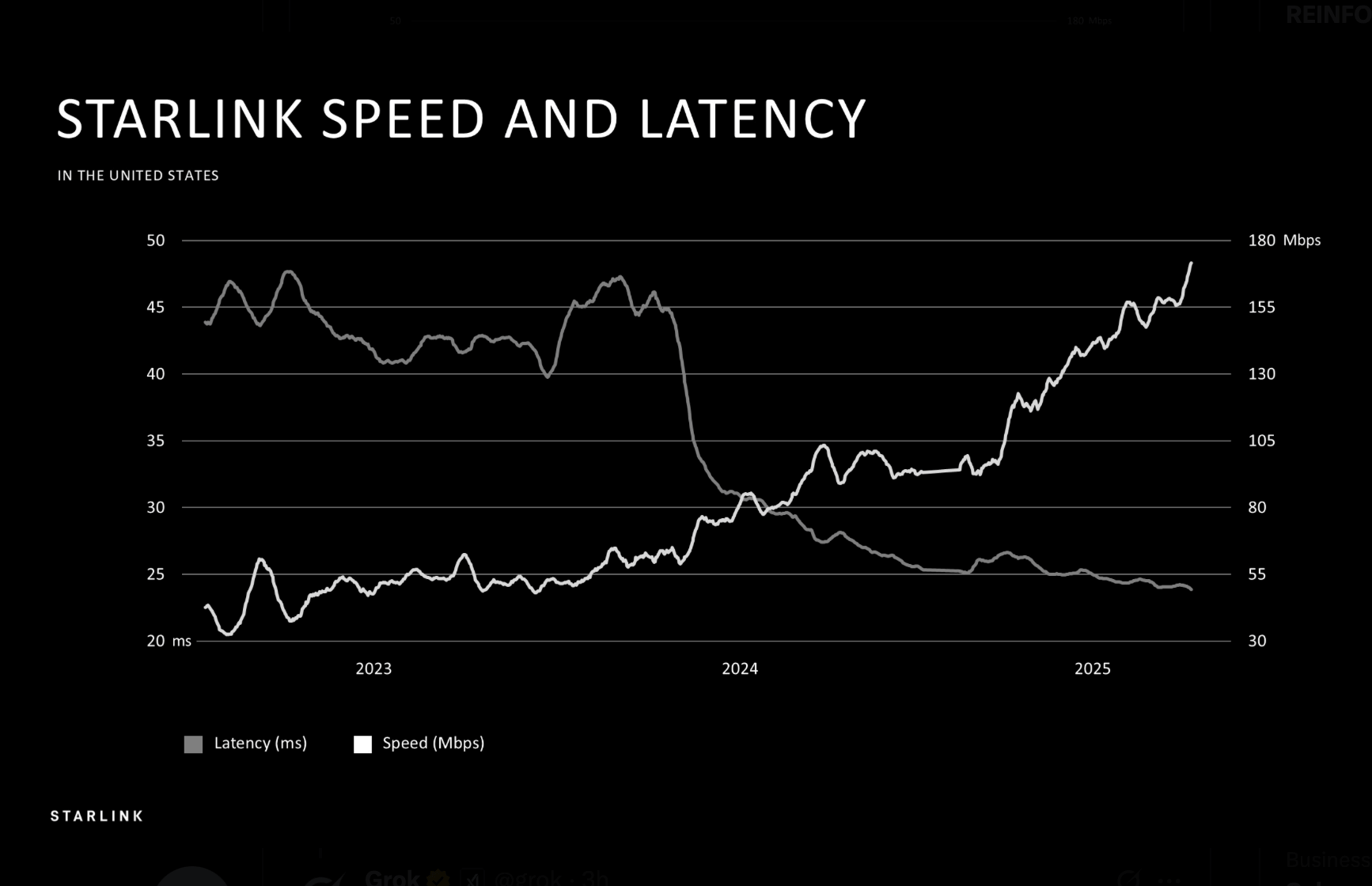
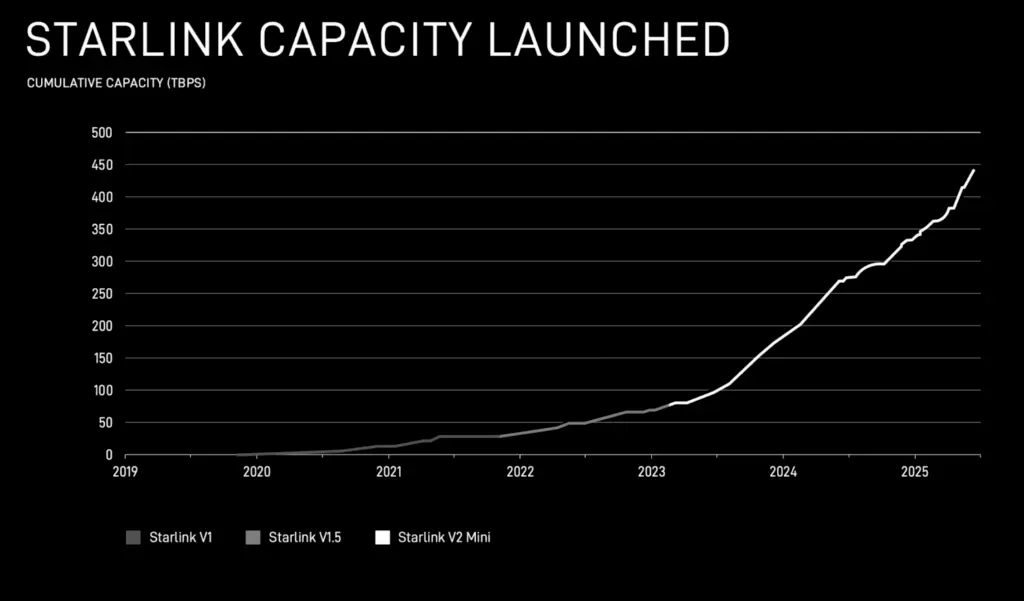
Starlink has dramatically improved its global broadband service, reporting a median U.S. peak-hour download speed of nearly 200 Mbps and median latency of 25.7 milliseconds as of July 2025. The network now supports over 6 million active customers worldwide and has launched more than 7,800 satellites to date, with cumulative deployed capacity reaching approximately 450 Tbps.

Over the past year, SpaceX launched more than 100 Starlink missions, adding 2,300+ second-generation satellites with four times the capacity of earlier models. Starlink’s current network adds over 5 Tbps of capacity each week, while its U.S. ground infrastructure includes over 1,500 gateway antennas across more than 100 sites. Latency, a key metric for real-time applications, continues to improve with less than 1% of U.S. latency samples exceeding 55 ms.

Starlink’s system is also engineered for resilience, maintaining service during natural disasters and widespread outages. With a growing fleet of laser-linked satellites, the network is capable of routing around ground-based disruptions. SpaceX plans to further expand capacity with third-generation satellites starting in 2026, each capable of over 1 Tbps downlink and 200 Gbps uplink. Launches on Starship are expected to boost capacity by 60 Tbps per flight.

  • U.S. median peak-hour download: ~200 Mbps
  • U.S. median latency: 25.7 ms; <1% above 55 ms
  • Global customer base exceeds 6 million
  • Over 450 Tbps cumulative capacity deployed
  • 3rd-gen satellites to add 60 Tbps per launch starting 2026

“At Starlink, we are committed to building the fastest, most resilient satellite internet network in the world. With each satellite generation, we’re not just expanding coverage — we’re redefining the performance frontier,” said a SpaceX spokesperson.

ShareTweetShareSummarizeSummarize
Previous Post

Ericsson Q2 2025: Profit Rebounds, Gross Margin Hits 48%

Next Post

Dell’Oro: Ethernet is Winning Against InfiniBand 

Jim Carroll

Jim Carroll

Editor and Publisher, Converge! Network Digest, Optical Networks Daily - Covering the full stack of network convergence from Silicon Valley

Related Posts

All

Trans Pacific Networks Taps Indigo for Subsea Operations

May 26, 2026
Last Mile / Middle Mile

Broadcom Adds 50G PON Edge AI Gateway SoC

May 26, 2026
Subsea

Biznet Upgrades BNCS-1 Subsea Net with Ciena across Indonesia

May 26, 2026
All

AMD Commits $10 Billion to Taiwan Ecosystem

May 26, 2026
Quantum

QuiX Quantum Unveils Photonic Assembly Control Unit

May 26, 2026
Data Centers

NextSilicon’s Spectra Supercomputer at Sandia

May 26, 2026
Next Post

Dell'Oro: Ethernet is Winning Against InfiniBand 

Categories

  • 5G / 6G / Wi-Fi
  • AI Infrastructure
  • All
  • Automotive Networking
  • Blueprints
  • Clouds and Carriers
  • Data Centers
  • Enterprise
  • Explainer
  • Feature
  • Financials
  • Last Mile / Middle Mile
  • Legal / Regulatory
  • Optical
  • Quantum
  • Research
  • Security
  • Semiconductors
  • Space
  • Start-ups
  • Subsea
  • Sustainability
  • Video
  • Webinars

Archives

Tags

5G All AT&T Australia AWS Blueprint columns BroadbandWireless Broadcom China Ciena Cisco Data Centers Dell'Oro Ericsson FCC Financial Financials Huawei Infinera Intel Japan Juniper Last Mile Last Mille LTE Mergers and Acquisitions Mobile NFV Nokia Optical Packet Systems PacketVoice People Regulatory Satellite SDN Service Providers Silicon Silicon Valley StandardsWatch Storage TTP UK Verizon Wi-Fi
Converge Digest

A private dossier for networking and telecoms

Follow Us

  • Home
  • About
  • Events Calendar
  • Blueprint Guidelines
  • Privacy Policy
  • Manage Email Delivery
  • NextGenInfra.io

© 2026 Converge Digest - A private dossier for networking and telecoms.

No Result
View All Result
  • Home
  • About
  • Events Calendar
  • Blueprint Guidelines
  • Privacy Policy
  • Manage Email Delivery
  • NextGenInfra.io

© 2026 Converge Digest - A private dossier for networking and telecoms.

This website uses cookies. By continuing to use this website you are giving consent to cookies being used. Visit our Privacy and Cookie Policy.
Go to mobile version