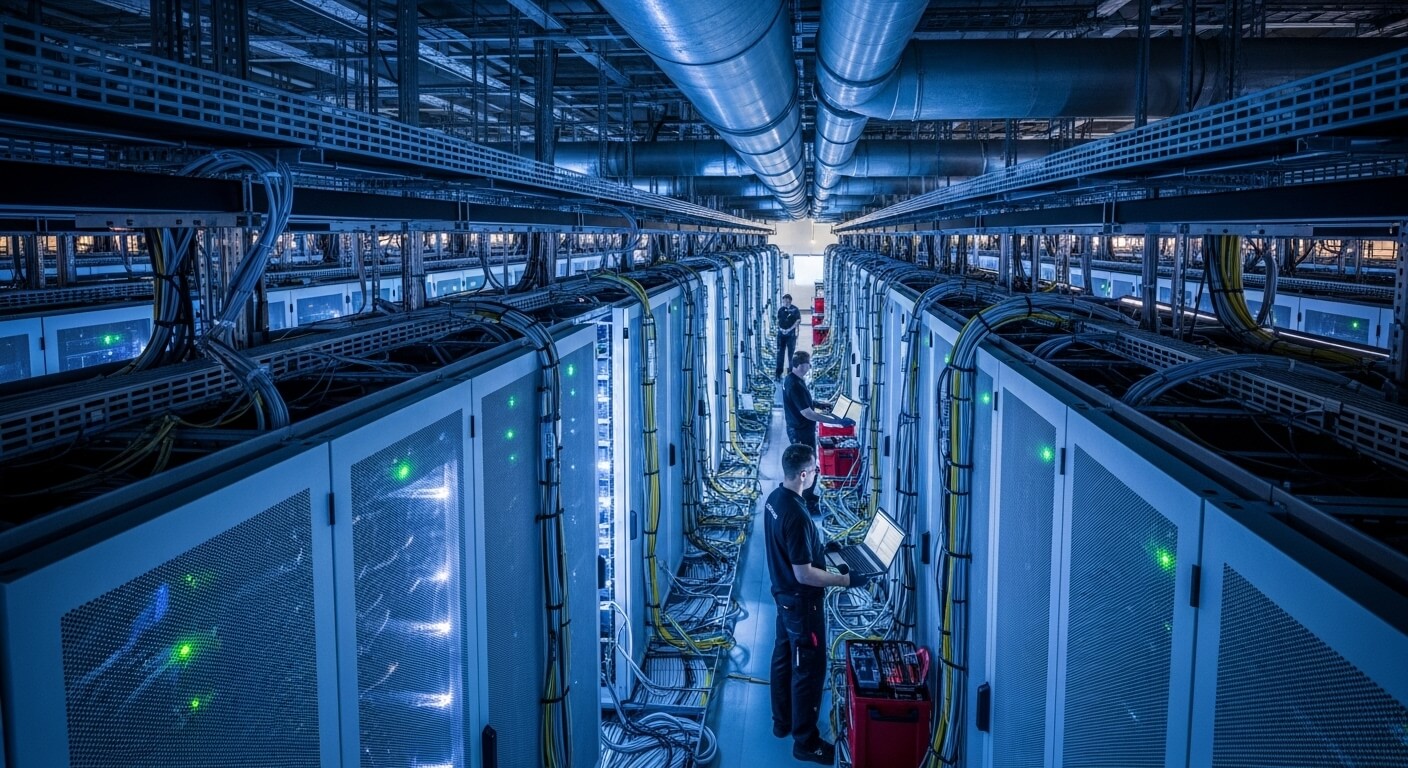
The latest Q1 2026 earnings reports and infrastructure announcements from AI neocloud providers point to a new stage in the AI infrastructure cycle: the industrial-scale buildout of specialized AI cloud platforms optimized for training and inference. Companies including CoreWeave, IREN, Nebius, Nscale, Lambda, and xAI are collectively accelerating deployment of GPU clusters, liquid-cooled campuses, high-density power infrastructure, and AI-optimized networking fabrics at a pace that increasingly resembles hyperscale cloud expansion from the prior decade.
Unlike traditional public cloud operators that evolved around general-purpose compute, the neocloud sector is building vertically integrated AI factories designed specifically around accelerated compute infrastructure. These deployments combine NVIDIA GPU clusters, Ethernet AI fabrics, liquid cooling systems, and increasingly dedicated power generation strategies. The emphasis is shifting from experimental AI capacity toward long-duration infrastructure commitments measured in gigawatts, hundreds of thousands of GPUs, and multi-campus regional deployments. Recent developments underscore this transition, with several providers securing landmark, multi-year contracts and substantial capital infusions that de-risk aggressive expansion while delivering clear revenue visibility.
CoreWeave delivered particularly compelling evidence of scaled demand in its Q1 2026 results, reported on May 7, 2026. Revenue reached $2.078 billion, representing 112% year-over-year growth from $982 million in Q1 2025 and 32% sequential growth. Adjusted EBITDA rose to $1.157 billion (56% margin), while the company recorded more than $40 billion in new customer commitments during the quarter. Revenue backlog expanded to $99.4 billion—up nearly 50% quarter-over-quarter and approximately 4× year-over-year—with 36% expected to convert within 24 months and 75% within four years. Weighted average contract length for new capacity remained approximately five years. Operationally, CoreWeave surpassed 1 GW of active power capacity and increased contracted power by more than 400 MW to 3.5 GW. The company reaffirmed full-year 2026 revenue guidance of $12–13 billion and raised the floor on its 2026 exit annualized run-rate revenue expectation. Key commercial milestones included a $21 billion multi-year commitment signed with Meta in March and an expanded multi-year agreement with Anthropic. A $2 billion equity investment from NVIDIA further accelerates plans to deploy more than 5 GW of AI factories by 2030, with the company targeting over 8 GW of total capacity by the same horizon. These figures demonstrate that enterprise and foundation-model customers are committing capital at hyperscale levels to dedicated AI infrastructure rather than relying solely on general-purpose cloud capacity.
IREN has similarly advanced its transformation through a transformative multi-year AI cloud contract with Microsoft valued at approximately $9.7 billion, announced in November 2025 (during its fiscal Q1 2026). The agreement covers phased deployment of NVIDIA GB300 GPUs across 200 MW at the Childress campus through 2026, with a five-year average term, 20% upfront prepayment, and expected contribution of roughly $1.94 billion in annualized recurring revenue at an estimated 85% project EBITDA margin once fully online. IREN is targeting $3.4 billion in AI Cloud annualized run-rate revenue by the end of 2026 through expansion to 140,000 GPUs. In its most recent reported quarter (calendar Q1 2026), AI Cloud Services revenue reached $33.6 million, up substantially from $3.6 million in the prior-year period, while total revenue stood at $144.8 million. The Microsoft contract provides direct validation from a leading hyperscaler and illustrates how neocloud operators with access to power and land are securing long-term, high-margin offtake agreements that de-risk multi-billion-dollar capital programs. Recent analyst commentary, including an upward price target revision by Bernstein following additional NVIDIA-related milestones, further validates the trajectory.
Nebius Group has sustained hypergrowth in its core AI cloud business. Although Q1 2026 results are scheduled for release on May 13, 2026, the company’s prior performance provides clear momentum: consolidated revenue reached $227.7 million in Q4 2025 (up 547% year-over-year), while the core AI cloud segment delivered 830% year-over-year growth and 63% sequential growth. Annualized run-rate revenue for the core business stood at $1.2 billion at year-end 2025, exceeding prior guidance, with active power capacity reaching 170 MW. Analyst consensus anticipates approximately $375 million in Q1 2026 revenue. Nebius has complemented organic growth with the acquisition of Eigen AI and maintains a focus on high-utilization, high-margin AI infrastructure deployments across its platform. The company’s trajectory underscores that European-headquartered neocloud platforms are capturing meaningful share in the global AI compute market, even as investors await further visibility on operating leverage following CoreWeave’s Q1 results.
Nscale secured a major capital infusion in March 2026, raising $2 billion in its Series C round—the largest such round in European technology history for an AI infrastructure company—at a $14.6 billion valuation. The round was led by Aker ASA and 8090 Industries, with participation from NVIDIA, Dell, Nokia, Citadel, Jane Street, and others. Proceeds will accelerate vertically integrated AI infrastructure deployments across Europe, North America, and Asia, including facilities in the United Kingdom, Norway, Iceland, Portugal, and the United States. Nscale’s platform combines GPU compute, networking, data services, and orchestration software, with existing relationships including Microsoft and OpenAI. The capital raise and valuation reflect investor conviction that purpose-built European neocloud capacity can compete effectively in the global market while addressing sovereign AI and data-residency requirements. This development parallels the funding and expansion momentum observed across the sector.
Lambda continues aggressive capacity additions aligned with hyperscaler demand. A 24 MW AI Factory in Kansas City—expected to house more than 10,000 NVIDIA Blackwell Ultra GPUs with the potential to scale past 100 MW—is slated to come online in early 2026, with the entire initial deployment dedicated to a single customer under a multi-year agreement. Partnerships with EdgeConneX add more than 30 MW of additional capacity across sites in Chicago and Atlanta, both targeted for 2026 readiness and featuring hybrid direct-to-chip liquid cooling. Lambda has secured significant funding, including a $1.5 billion Series E round in November 2025, and maintains multi-year agreements with major customers including Microsoft and NVIDIA. Revenue growth has remained robust, with estimates exceeding $500 million annualized in recent periods, positioning the company for further scaling ahead of anticipated IPO activities. These expansions mirror the broader neocloud trend toward dedicated, high-density AI factories backed by long-term commercial commitments.
xAI has undergone a structural transformation that exemplifies the sector’s evolution toward vertically integrated, multi-gigawatt platforms. In February 2026, SpaceX acquired xAI in an all-stock transaction that valued the combined entity at $1.25 trillion (with xAI at a $250 billion standalone valuation), the largest private corporate merger in history. This integration combines xAI’s large language models and compute infrastructure with SpaceX’s aerospace, satellite, and launch capabilities, advancing a vision of orbital data centers and end-to-end AI-space platforms. xAI’s Colossus supercomputer in Memphis has expanded rapidly: the acquisition of a third facility (“Macrohardrr”) in early 2026 brought total capacity to approximately 555,000 NVIDIA GPUs across nearly 2 GW of power. In a landmark May 6, 2026, agreement, SpaceXAI leased the entirety of Colossus 1—over 220,000 NVIDIA H100, H200, and GB200 GPUs and approximately 300 MW of capacity—to rival Anthropic. This arrangement provides xAI with approximately $6 billion in annual revenue recognition, materially offsetting reported losses, while Anthropic gains immediate high-performance capacity to enhance Claude Pro and Claude Max subscriber experience (including higher usage limits). xAI has migrated its own training workloads to Colossus 2, retaining the larger, more advanced cluster for Grok development. The deal also includes Anthropic’s expressed interest in partnering to develop multiple gigawatts of orbital AI compute capacity, leveraging SpaceX’s launch expertise for sustainable, high-power infrastructure beyond terrestrial constraints. This transaction highlights both the sector’s compute scarcity and the pragmatic collaboration emerging even among competitors, while underscoring xAI’s shift to a broader, vertically integrated entity with unique differentiation in space-based compute.
Collectively, these developments signal that AI neocloud spending has entered a phase defined by gigawatt-scale commitments, multi-year contracted revenue visibility, and vertical integration spanning power generation, liquid cooling, high-density networking, and dedicated GPU orchestration. Traditional public cloud operators evolved around general-purpose virtual machines; neocloud providers are constructing specialized AI factories optimized for training and inference workloads at densities and power envelopes that require purpose-built campuses. Key differentiators now include power as a strategic moat (via dedicated generation, long-term PPAs, and site selection), contract structures with five- to seven-year terms and prepayments that align customer commitments with capital deployment, project-level EBITDA margins in the 80%+ range for fully contracted deployments, and scale economics where individual clusters are measured in hundreds of thousands of GPUs and hundreds of megawatts, with roadmaps extending to multiple gigawatts per operator. The Q1 2026 data from CoreWeave and supporting announcements across the sector—coupled with AMD’s data-center revenue surge that lifted neocloud equities—demonstrate that demand from both AI-native companies and established enterprises remains robust enough to support continued heavy capital expenditure. While near-term profitability remains pressured by aggressive buildouts, the combination of record backlogs, hyperscaler validation (Meta, Microsoft, Anthropic, OpenAI), substantial funding rounds (Nscale’s $2 billion), and multi-gigawatt pipelines (xAI’s 2 GW Colossus, CoreWeave’s 3.5 GW contracted power and 8 GW target) indicates that the current expansion cycle is structural rather than cyclical. For professional observers, the implication is clear: the AI infrastructure buildout has graduated from pilot projects to a sustained, multi-year industrial program. The companies executing most effectively on power, capital discipline, long-term customer alignment, and—in xAI’s case—cross-domain integration with space infrastructure will define the competitive landscape through the remainder of the decade.