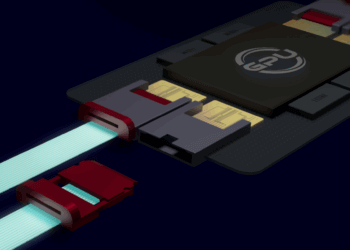
Molex introduced its Impress Co-Packaged Copper Solutions, targeting next-generation AI servers and high-density data center systems operating at 224Gbps PAM-4 and higher. The Lisle, Illinois-based connectivity supplier designed Impress as a compression-based, on-substrate connector and cable assembly that places the interconnect directly on the ASIC package substrate, reducing signal path length and improving full-channel performance.
The new platform builds on Molex’s NearStack On-the-Substrate (OTS) connectors, with more than one million units shipped to date. Impress moves the connection point even closer to the silicon, shrinking PCB trace distance and isolating the channel from substrate to cable interconnect to reduce insertion loss and crosstalk. The two-piece connector system attaches via compression to protect the substrate and simplify rework, maintenance, and upgrades in high-density server environments.
Molex positions Impress within its broader 224G ecosystem, alongside Mirror Mezz Enhanced, Inception, and CX2 Dual Speed solutions. The product supports 224Gbps PAM-4 today, with development underway for 336G and 448G applications as the industry transitions from 1.6T to 3.2T networking. Molex will demonstrate Impress and related 224G technologies at DesignCon 2026 in Santa Clara.
- Compression-based, on-substrate connector and mating cable assembly
- Supports 224Gbps PAM-4; roadmap for 336G and 448G
- Over 1 million NearStack OTS units delivered to date
- Reduces PCB trace length, insertion loss, and crosstalk
- Compression attachment protects ASIC substrate and enables easier rework
- Designed for AI servers, hyperscale data centers, and 1.6T–3.2T networking
“As AI workloads push data centers to their physical limits, we are focused on maximizing efficiency without sacrificing signal integrity,” said Jairo Guerrero, VP & GM, Copper Solutions, Molex. “Impress is our latest innovation built to help scale infrastructures without exponential increases in power consumption or cost. By enabling high performance at the rack level, Molex is making next-generation compute more technically and economically viable.”
🌐 Analysis: The shift to 224G SerDes and 3.2T switching forces system architects to shorten electrical channels and move interconnects closer to the ASIC. Molex’s on-substrate compression approach aligns with broader industry moves toward co-packaged optics and near-ASIC copper as hyperscalers balance reach, power, and cost. Competitors across the connector and cable ecosystem are also racing to qualify 224G and 448G interconnects, making substrate-level integration a key battleground for AI-optimized rack design.