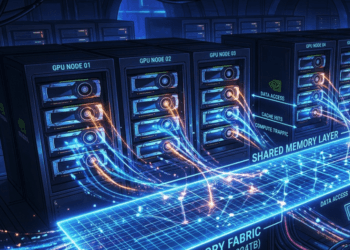

Salience Labs is partnering with Tower Semiconductor to move photonic integrated circuit (PIC)-based optical circuit switches into pre-production, targeting large-scale AI data center deployments. The companies will manufacture optical circuit switch (OCS) devices using Tower’s silicon photonics platforms, including PH18DA with integrated III-V lasers and TPS45PH featuring low-loss silicon nitride waveguides.
The collaboration focuses on shifting switching functions deeper into the optical domain to reduce latency, power consumption, and electrical bottlenecks in AI clusters. Optical circuit switching offers an alternative to traditional optical-electrical-optical (OEO) conversion and electronic packet switching (EPS) architectures, which can introduce added latency and energy overhead in large-scale AI back-end networks. Dell’Oro Group projects that AI-driven data center switch spending will exceed $100 billion by 2030, reflecting accelerating investments across scale-up, scale-out, and scale-across architectures.
Salience Labs, founded in 2021 and building on research from the University of Oxford and the University of Münster, develops photonic switching technologies designed to support high-bandwidth, ultra-low latency interconnect fabrics. Tower Semiconductor, a specialty foundry with 200 mm and 300 mm fabs in Israel, the U.S., Japan, and Italy, will provide high-volume silicon photonics manufacturing to support industrialization and volume production of the OCS devices.
• Partnership targets PIC-based optical circuit switches for AI data centers
• Manufacturing leverages Tower’s PH18DA (with integrated III-V lasers) and TPS45PH (low-loss silicon nitride) platforms
• Focus on reducing OEO conversions and minimizing electrical bottlenecks
• Pre-production phase underway, with path to volume manufacturing
• AI back-end network switch spending projected to exceed $100 billion by 2030
“Silicon photonics with integrated light sources is a key enabler for scaling next-generation optical connectivity, and our collaboration with Salience Labs reinforces our strong momentum in AI and data-center infrastructure,” said Dr. Ed Preisler, Vice President and General Manager of RF Business Unit, Tower Semiconductor.
🌐 Analysis: Optical circuit switching has re-emerged as AI cluster topologies push the limits of electrical switching fabrics and pluggable optics. By combining integrated lasers and low-loss waveguides in a foundry-ready platform, the partnership positions Salience Labs to compete in a field that includes optical switching efforts from established silicon photonics vendors and hyperscaler-backed startups. The move into pre-production also reflects broader industry momentum toward co-packaged optics and photonic fabrics as AI networks scale beyond traditional leaf-spine designs.
Salience Labs is a UK-based photonic networking startup focused on optical circuit switching (OCS) for AI data center fabrics. Founded in 2021, the company emerged from more than a decade of academic research at the University of Oxford (UK) and the University of Münster (Germany), targeting a fundamental bottleneck in large-scale AI clusters: the latency, power, and scaling constraints of electronic packet switching.
The company positions its architecture as a shift from traditional optical-electrical-optical (OEO) conversion toward direct optical-domain switching. Rather than converting light to electrical signals at each switching stage, Salience integrates switching functions within photonic integrated circuits (PICs), aiming to reduce energy per bit and eliminate electrical bottlenecks in back-end AI networks. The design targets scale-up, scale-out, and emerging scale-across cluster architectures that hyperscalers deploy for large language models and distributed AI training. The intellectual foundation centers on silicon photonics device engineering, low-loss waveguide integration, and scalable switching fabrics capable of supporting high-radix optical connectivity.