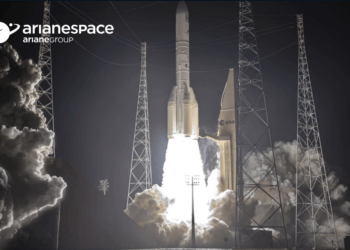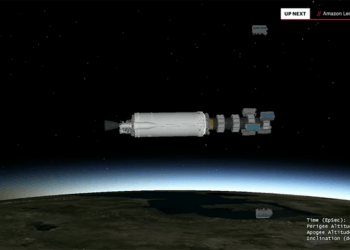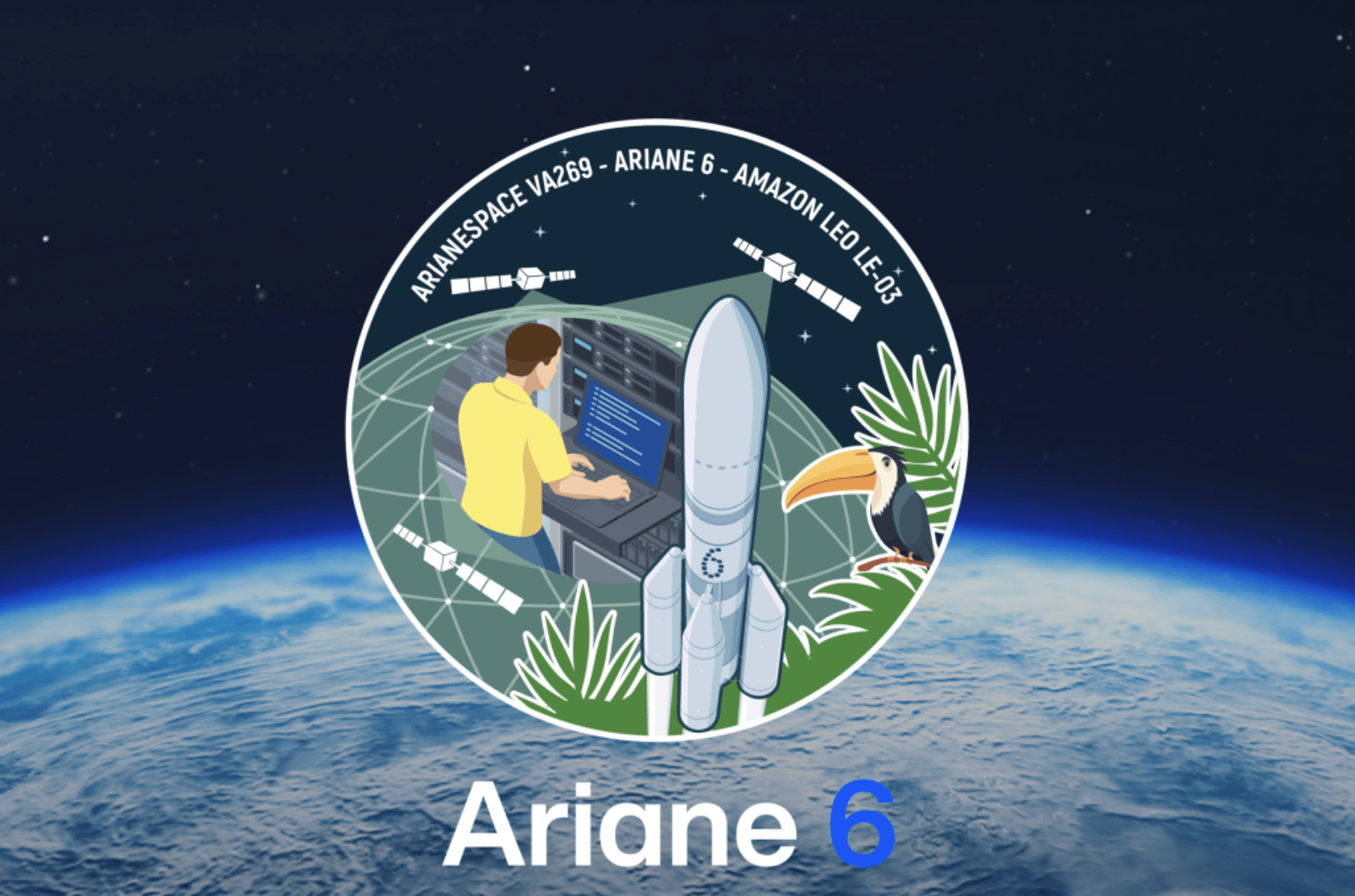
Arianespace launched 36 additional Amazon Leo satellites on June 17, 2026, marking the first flight of an Ariane 64 rocket equipped with four upgraded P160C solid-propellant boosters. The mission, designated VA269 by Arianespace and LE-03 (Leo Europe 03) by Amazon, lifted off from Europe’s Spaceport in French Guiana and deployed the satellites into a low Earth orbit at approximately 465 km (289 miles). The launch lasted 1 hour and 51 minutes from liftoff through separation of the final spacecraft.
The mission represents the third Ariane 6 launch dedicated to Amazon Leo this year and the eighth Ariane 6 flight overall. With 36 satellites onboard—four more than the previous two Amazon Leo launches—the mission carried the heaviest payload ever launched by an Ariane vehicle. The increased capacity came from the debut of the P160C booster, an evolution of the P120C design. The new motor is approximately one meter longer internally and carries up to 156 metric tonnes of propellant, increasing Ariane 64’s low Earth orbit performance by roughly 10% and raising total payload capacity to approximately 22 tonnes.
The launch also highlights the growing partnership between Arianespace and Amazon. VA269 is the third mission within a planned series of 18 launches supporting deployment of the Amazon Leo broadband constellation. With this flight, Arianespace has now placed 100 Amazon Leo satellites into orbit in less than five months. Amazon Leo aims to provide broadband connectivity to underserved and remote regions through a large-scale low Earth orbit satellite network.
• First Ariane 64 launch using upgraded P160C boosters
• 36 Amazon Leo satellites deployed into a 465 km (289 mile) orbit
• Heaviest payload ever launched by an Ariane rocket
• P160C boosters increase Ariane 64 LEO performance by approximately 10%
• Ariane 64 payload capacity increased to approximately 22 tonnes in LEO
• Third Amazon Leo launch by Ariane 6 in 2026
• 100 Amazon Leo satellites launched by Arianespace in less than five months
• Mission is part of a broader 18-launch agreement between Amazon and Arianespace
• Eighth Ariane 6 launch overall and third Ariane 64 mission
“With 100 satellites now placed in orbit by Arianespace for Amazon Leo and the launch of four more satellites than the first two missions, we are setting records with an increasingly powerful and versatile launcher,” said David Cavaillolès, CEO of Arianespace. “This further demonstrates our ability to address new markets, and especially constellation deployment.”
🌐 Analysis: The successful introduction of the P160C booster marks an important step in Ariane 6’s maturation as Europe seeks to expand its independent launch capabilities and compete more effectively in the commercial constellation market. The ability to increase payload capacity without changing the vehicle’s external architecture demonstrates a relatively rapid upgrade cycle for a heavy-lift launch system, arriving less than two years after Ariane 6’s inaugural flight.
🌐 Analysis: For Amazon Leo, the mission reflects continued progress in deploying a constellation intended to compete with other low Earth orbit broadband systems, most notably SpaceX’s Starlink and projects from operators such as Eutelsat. The 18-launch agreement with Arianespace diversifies Amazon’s launch strategy across multiple providers while helping Europe establish Ariane 6 as a key platform for large-scale constellation deployment.
| Profile: Arianespace | |
| Headquarters | Évry-Courcouronnes (Paris Region), France |
| CEO | David Cavaillolès |
| Parent Company | ArianeGroup |
| Founded | 1980 |
| Primary Launch Vehicle | Ariane 6 |
| Launch Site | Guiana Space Centre, Kourou, French Guiana |
| Amazon Leo Contract | 18 Launches |
| Ariane 6 Status | 8 Launches Completed |
| Latest Milestone | First Successful Flight of the P160C Booster |
| VA269 Payload | 36 Amazon Leo Satellites |
| Payload Capacity | Approximately 22 Tonnes to Low Earth Orbit (LEO) |
| Record Achieved | Heaviest Payload Ever Launched by an Ariane Rocket |