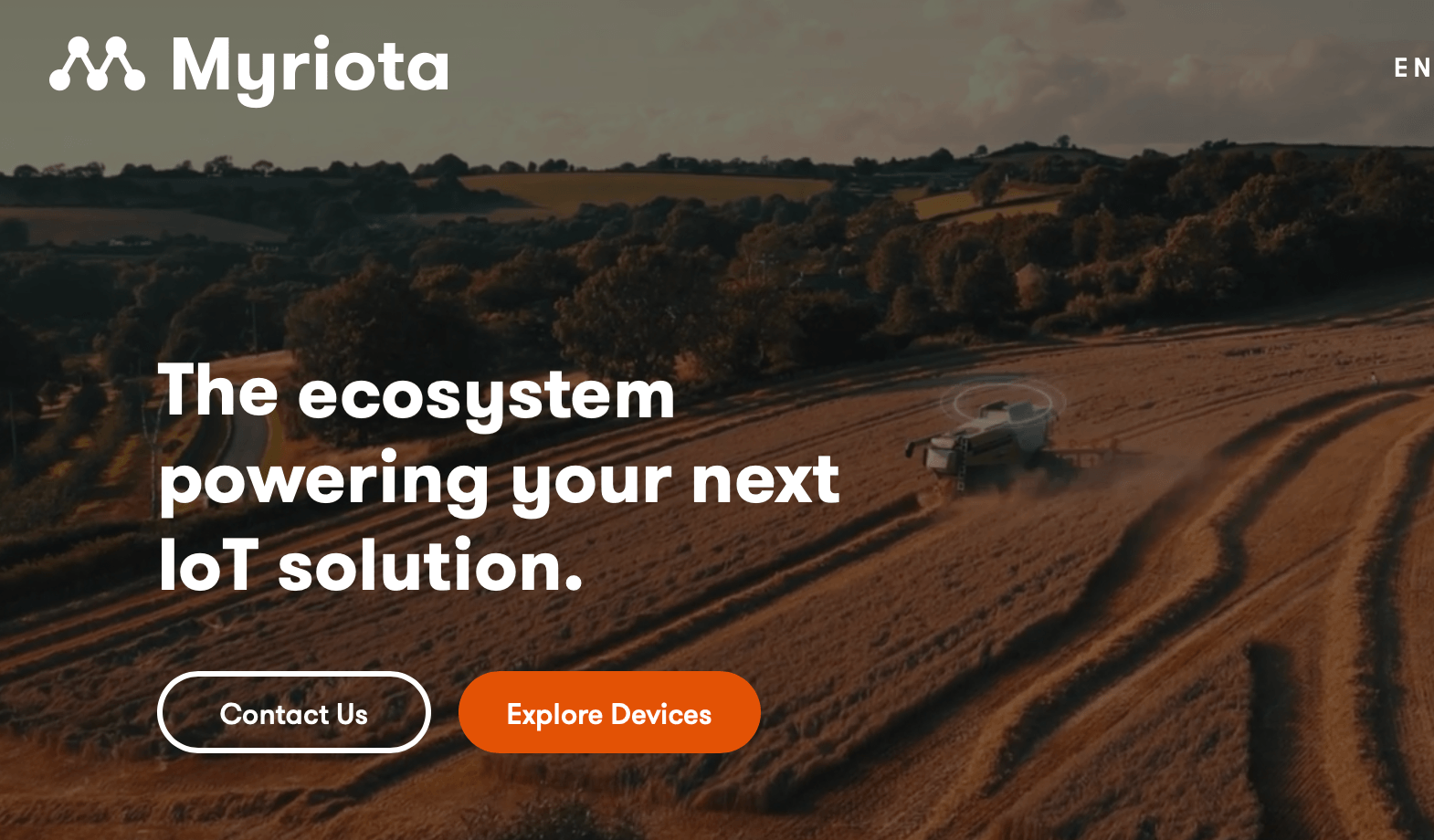
Myriota has expanded its HyperPulse 5G non-terrestrial network (NTN) by adding terrestrial cellular connectivity, creating a hybrid IoT service that automatically switches between satellite and cellular networks. The Australian company also introduced hybrid connectivity for its AssetHawk industrial asset tracker, enabling a single device and connectivity plan to support tracking across urban, rural, and remote environments without requiring multiple network providers or management platforms.
The hybrid architecture automatically routes messages over the most appropriate network based on coverage and configuration. Myriota said the approach addresses a longstanding challenge for industrial IoT deployments, where assets frequently move between terrestrial cellular coverage and remote areas that require satellite connectivity. The company targets applications including transportation trailers, shipping containers, generators, utilities, mining equipment, agriculture, and distributed infrastructure. Hybrid service will initially be available across the United States, Mexico, Argentina, Brazil, Australia, New Zealand, and Saudi Arabia, with additional markets planned later this year.
HyperPulse complies with 3GPP Release 17 NTN standards and operates on Myriota’s own satellite network while supporting standards-based silicon. The company said hybrid pricing starts at US$0.99 per device per month by automatically routing traffic over the lowest-cost available network. AssetHawk, a rugged battery-powered tracker designed for industrial deployments, also supports Bluetooth Low Energy (BLE) sensors, allowing it to function as a local sensor hub for systems integrators and OEM partners. According to ABI Research, standards-based non-terrestrial IoT connections are projected to grow from approximately 2.08 million in 2024 to nearly 14 million by 2032.
• Adds terrestrial cellular connectivity to the HyperPulse 5G NTN satellite network.
• Creates a unified hybrid satellite/cellular IoT service using a single device and connectivity contract.
• Automatically routes messages over cellular or satellite depending on network availability.
• Built on 3GPP Release 17 non-terrestrial network standards.
• Hybrid service launches in the U.S., Mexico, Argentina, Brazil, Australia, New Zealand, and Saudi Arabia.
• Hybrid data plans start at US$0.99 per device per month.
• AssetHawk tracker supports BLE sensors for localized industrial monitoring.
• Targets logistics, utilities, mining, agriculture, environmental monitoring, and industrial asset tracking.
Ben Cade, CEO of Myriota, said: “For decades, vast numbers of remote and distributed operational assets have remained disconnected—not because the technology didn’t exist, but because the economics never worked. HyperPulse changes that equation. For the first time, it’s commercially viable to connect almost any asset, anywhere, for less than a dollar per month.”
🌐 Analysis: Hybrid satellite and cellular connectivity is becoming a major trend in industrial IoT as operators seek to eliminate coverage gaps while reducing deployment complexity. Rather than forcing customers to manage separate terrestrial and satellite subscriptions, vendors are increasingly integrating both into a unified service based on emerging 3GPP NTN standards. This approach aligns with broader industry efforts by satellite operators, mobile network providers, and silicon vendors to create seamless global IoT connectivity.
Myriota has steadily expanded beyond its proprietary low-power satellite network toward standards-based NTN technology. The company competes in a rapidly evolving market alongside providers such as Skylo, Sateliot, OQ Technology, Kinéis, and major satellite operators pursuing direct-to-device and NTN IoT services. As 3GPP Release 17 adoption grows and compatible chipsets become more widely available, hybrid terrestrial-satellite architectures are expected to accelerate enterprise IoT deployments.
🛰️ Myriota Hybrid Satellite & Cellular IoT Connectivity Platform | |
| Myriota develops low-power satellite connectivity solutions for the Internet of Things (IoT), enabling secure, energy-efficient communications for sensors and industrial assets in remote locations. The company’s platform combines proprietary satellite technology with standards-based 5G Non-Terrestrial Networks (NTN) and, more recently, hybrid satellite and cellular connectivity, providing seamless global coverage for asset tracking, environmental monitoring and industrial IoT deployments. | |
| Why It Matters | As enterprises deploy millions of connected sensors beyond terrestrial coverage, Myriota is helping bridge the gap between cellular and satellite networking. Its ultra-low-power architecture enables battery-powered devices to operate for years while remaining connected across farms, mines, utilities, logistics networks and critical infrastructure. |
| Founded | 2015 |
| Headquarters | Adelaide, South Australia |
| Chief Executive Officer | Ben Cade |
| Company Type | Private • Satellite IoT Connectivity |
| Business Focus | Satellite IoT • Hybrid Satellite & Cellular • 5G NTN • Asset Tracking • Remote Monitoring • Industrial IoT • Environmental Monitoring |
| Key Technologies | HyperPulse • AssetHawk • Hybrid Satellite/Cellular Routing • Ultra-Low-Power Communications • 5G NTN • Cloud-Based IoT Management |
| Target Markets | Agriculture • Mining • Utilities • Water Management • Logistics • Transportation • Environmental Monitoring • Government |
| Editorial Coverage | Converge Digest tracks Myriota across satellite IoT, hybrid satellite-cellular networking, 5G NTN, industrial IoT, asset tracking, low-power communications and the convergence of terrestrial and non-terrestrial connectivity. |
| Related Knowledge Hubs | Space Networking & Orbital Data Centers • Myriota • NTN • IoT • 5G |
🌐 We’re tracking the latest developments in satellite communications, non-terrestrial networks, and hybrid space-terrestrial connectivity. Follow our ongoing coverage at: https://convergedigest.com/category/space/