• Home
  • About
  • Events Calendar
  • Blueprint Guidelines
  • Privacy Policy
  • Manage Email Delivery
  • NextGenInfra.io
No Result
View All Result
Converge Digest
Friday, June 5, 2026
  • Home
  • About
  • Events Calendar
  • Blueprint Guidelines
  • Privacy Policy
  • Manage Email Delivery
  • NextGenInfra.io
No Result
View All Result
Converge Digest
No Result
View All Result

Home » Intel Shows its Optical Compute Interconnect (OCI) Chiplet at Hot Chips

Intel Shows its Optical Compute Interconnect (OCI) Chiplet at Hot Chips

August 27, 2024
in Optical, Semiconductors
A A

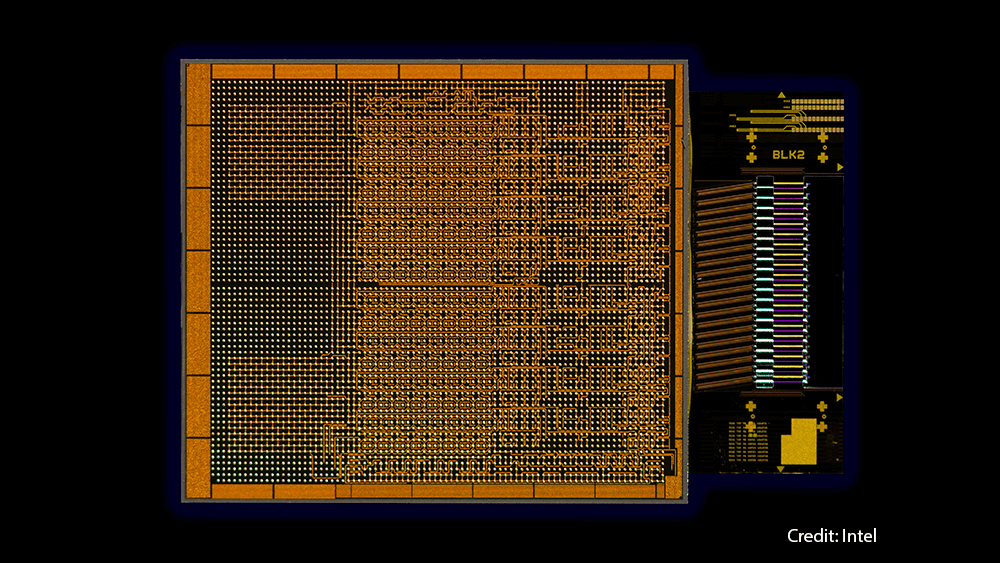
At Hot Chips 2024, Intel presented a series of advancements across AI and compute technologies, including showcasing its integrated optical compute interconnect (OCI) chiplet which is designed to meet the increasing demands of AI data processing, offering high-speed connectivity and efficiency for next-generation computing architectures. Intel also shared new details about its Intel Xeon 6 SoC, Lunar Lake client processors, and the Intel Gaudi 3 AI accelerator, all of which are aimed at enhancing performance across data centers, edge environments, and consumer devices.

The OCI chiplet, which was demonstrated at OFC earlier this year, represents a significant leap forward in XPU-to-XPU connectivity. Capable of supporting 64 channels of 32 gigabits per second (Gbps) data transmission over distances up to 100 meters of fiber optics, this technology promises higher bandwidth, lower power consumption, and longer reach for AI infrastructure.

In addition to the OCI chiplet, Intel’s new Intel Xeon 6 SoC was highlighted for its edge-optimized design, which addresses challenges such as unreliable network connections and limited power availability. The Lunar Lake processor, focused on the next generation of AI PCs, offers significant improvements in power efficiency and AI performance. Meanwhile, the Intel Gaudi 3 AI accelerator was introduced as a solution for the scalability issues of generative AI workloads, offering optimized compute, memory, and networking architectures.

• Optical Compute Interconnect (OCI) Chiplet:

• Supports 64 channels of 32 Gbps data transmission in each direction.

• Operates over distances up to 100 meters over fiber optics.

• Designed to enhance bandwidth, reduce power consumption, and extend connectivity reach.

• Enables scalability of CPU/GPU clusters and supports novel computing architectures.

• Intel Xeon 6 SoC:

• Up to 32 PCIe 5.0 lanes and 16 CXL 2.0 lanes.

• 2x100G Ethernet and four to eight memory channels.

• Edge-specific enhancements for rugged environments and industrial reliability.

• Integrated AI acceleration for efficient AI workflow management.

• Lunar Lake Processor:

• 40% lower system-on-chip power compared to previous generations.

• Neural processing unit up to 4x faster for generative AI tasks.

• 1.5x improvement in graphics performance with new Xe2 GPU cores.

• Intel Gaudi 3 AI Accelerator:

• Optimized for compute, memory, and networking efficiency.

• Features efficient matrix multiplication engines and two-level cache integration.

• Extensive RoCE networking for cost-effective AI data center operations.

“Intel continuously delivers the platforms, systems, and technologies necessary to redefine what’s possible,” said Pere Monclus, CTO of Intel’s Network and Edge Group. “With proven expertise across the compute continuum, Intel is well-positioned to power the next generation of AI innovation.”

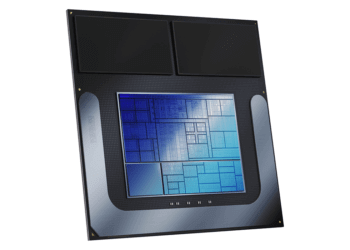
Intel highlights 4 Tbps optical compute interconnect chiplet
Source: Intel
Tags: ChipletHot ChipsIntel
ShareTweetShareSummarizeSummarize
Previous Post

Cerebras Launches AI Inference Solution 20x Faster Than GPUs”

Next Post

Keysight Intros Advanced Wire Bond Inspection Tool for Chip Manufacturing

Jim Carroll

Jim Carroll

Editor and Publisher, Converge! Network Digest, Optical Networks Daily - Covering the full stack of network convergence from Silicon Valley

Related Posts

Financials

Intel Appoints Client Computing Chief and CTO

May 4, 2026
All

Intel Q1 2026: AI Drives 22% Data Center Growth, Foundry Revenue Up

April 23, 2026
Semiconductors

Intel, Google Expand AI Infrastructure Pact Around Xeon and Custom IPUs

April 9, 2026
AI Infrastructure

SambaNova and Intel Advance Heterogeneous Architecture for Agentic AI Inference

April 8, 2026
Semiconductors

Intel Foundry Demos 19 μm GaN Chiplet with Integrated Logic 

April 8, 2026
All

Intel Confirms Role in Terafab Initiative

April 7, 2026
Next Post

Keysight Intros Advanced Wire Bond Inspection Tool for Chip Manufacturing

Categories

  • 5G / 6G / Wi-Fi
  • AI Infrastructure
  • All
  • Automotive Networking
  • Blueprints
  • Clouds and Carriers
  • Data Centers
  • Enterprise
  • Explainer
  • Feature
  • Financials
  • Last Mile / Middle Mile
  • Legal / Regulatory
  • Optical
  • Quantum
  • Research
  • Security
  • Semiconductors
  • Space
  • Start-ups
  • Subsea
  • Sustainability
  • Video
  • Webinars

Archives

Tags

5G All AT&T Australia AWS Blueprint columns BroadbandWireless Broadcom China Ciena Cisco Data Centers Dell'Oro Ericsson FCC Financial Financials Huawei Infinera Intel Japan Juniper Last Mile Last Mille LTE Mergers and Acquisitions Mobile NFV Nokia Optical Packet Systems PacketVoice People Regulatory Satellite SDN Service Providers Silicon Silicon Valley StandardsWatch Storage TTP UK Verizon Wi-Fi
Converge Digest

A private dossier for networking and telecoms

Follow Us

  • Home
  • About
  • Events Calendar
  • Blueprint Guidelines
  • Privacy Policy
  • Manage Email Delivery
  • NextGenInfra.io

© 2026 Converge Digest - A private dossier for networking and telecoms.

No Result
View All Result
  • Home
  • About
  • Events Calendar
  • Blueprint Guidelines
  • Privacy Policy
  • Manage Email Delivery
  • NextGenInfra.io

© 2026 Converge Digest - A private dossier for networking and telecoms.

This website uses cookies. By continuing to use this website you are giving consent to cookies being used. Visit our Privacy and Cookie Policy.
Go to mobile version