
• Home
  • About
  • Events Calendar
  • Blueprint Guidelines
  • Privacy Policy
  • Manage Email Delivery
  • NextGenInfra.io
No Result
View All Result
Converge Digest
Monday, June 8, 2026
  • Home
  • About
  • Events Calendar
  • Blueprint Guidelines
  • Privacy Policy
  • Manage Email Delivery
  • NextGenInfra.io
No Result
View All Result
Converge Digest
No Result
View All Result

Home » Cornelis–Supermicro Pairing Targets Power and Network Limits

Cornelis–Supermicro Pairing Targets Power and Network Limits

December 9, 2025
in Data Centers
A A

Cornelis and Supermicro advanced a joint infrastructure model that targets mounting power and networking limits in AI and HPC data centers. The companies validated Supermicro’s liquid-cooled FlexTwin server platforms with Cornelis’ CN5000 400Gbps fabric, creating a combined system designed to handle larger AI training and simulation workloads without increasing power draw or cluster complexity. The integration focuses on predictable performance at scale, addressing a growing trend in which network congestion—not compute capacity—dictates real workload throughput.

The collaboration arrives as operators push against tight thermal envelopes and rising energy costs. Supermicro’s FlexTwin architecture captures up to 95% of system heat through liquid cooling, while Cornelis’ CN5000 fabric provides deterministic, congestion-free communication between nodes. Together, the platform aims to improve workload throughput, enable higher rack-level efficiency, and allow clusters to scale while maintaining consistent performance. Both companies emphasized that power, cooling, and network scalability now define the upper bounds of AI and HPC deployment strategy.

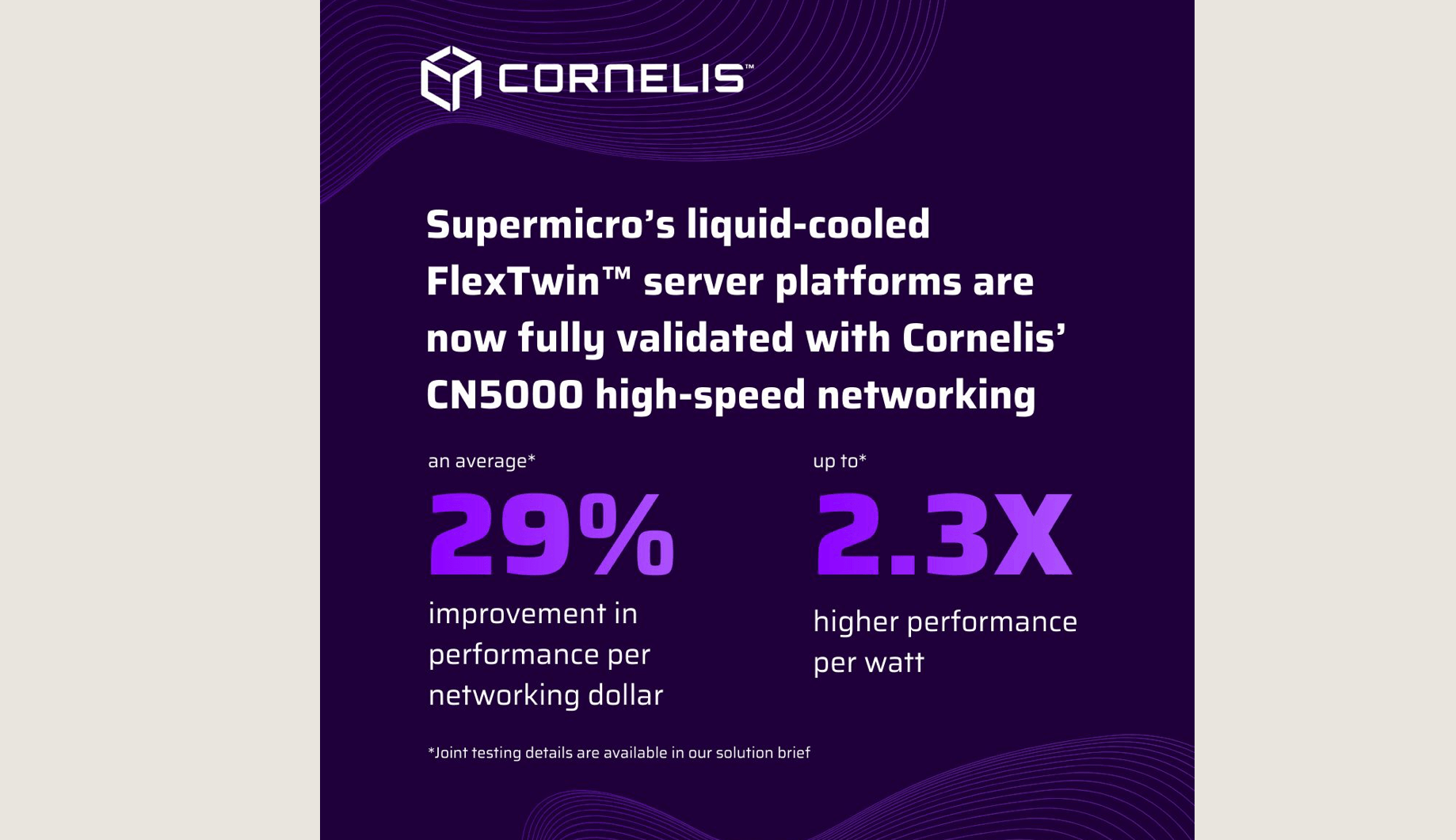
Across manufacturing, physics, life sciences, and climate modeling benchmarks, the validated FlexTwin + CN5000 system produced measurable efficiency gains: up to 1.5× higher application performance versus competing 400Gbps fabrics, a 29% average increase in performance per networking dollar, and up to 2.3× higher performance per watt in liquid-cooled environments. The companies said these improvements allow customers to run larger problems on fewer nodes while staying within fixed energy budgets.

• Integration validates Cornelis CN5000 with Supermicro FlexTwin liquid-cooled platforms

• Targets AI and HPC environments constrained by power, cooling, and network congestion

• CN5000 delivers deterministic 400Gbps communication and congestion-free data movement

• FlexTwin captures up to 95% of heat removal via direct liquid cooling

• Supports both air- and liquid-cooled CN5000 switches, plus air- and conduction-cooled SuperNICs

• Up to 1.5× higher application performance vs. competitive fabrics

• 29% improvement in performance per networking dollar

• Up to 2.3× higher performance per watt

• Improved scaling efficiency for larger clusters

• Solution available now through Supermicro and Cornelis partners

“We’re giving our customers the tools they need to accelerate the most demanding HPC and AI workloads without compromise,” said Vik Malyala, President & Managing Director EMEA, SVP Technology & AI, Supermicro.

🌐 Analysis

This collaboration underscores how AI and HPC system design is shifting toward power-efficient networking and dense liquid-cooled compute architectures. Cornelis has steadily positioned CN5000 as an alternative to Ethernet and InfiniBand fabrics in large-scale simulation environments, while Supermicro continues to expand its portfolio of liquid-cooled platforms aimed at hyperscale and enterprise AI deployments. 

ShareTweetShareSummarizeSummarize
Previous Post

ECL Hires Michael Glickman to Lead its Charge into Hydrogen Power Data Center

Next Post

Deutsche Telekom Expands AI Strategy With New OpenAI Collaboration

Jim Carroll

Jim Carroll

Editor and Publisher, Converge! Network Digest, Optical Networks Daily - Covering the full stack of network convergence from Silicon Valley

Related Posts

Semiconductors

MACOM Intros Hot Via Chip Scale Tech to Eliminate Wire Bonds at mmWave

June 8, 2026
AI Infrastructure

Stark Power to Acquire Sagebrush Infra, Securing 5.6 GW U.S. Data Center Pipeline

June 8, 2026
Data Centers

AMD Backs UK Sovereign AI with £2 Billion Investment Plan

June 8, 2026
AI Infrastructure

NVIDIA Expands Korea AI Push

June 7, 2026
Space

NTT Targets Space with Coherent Optical

June 7, 2026
AI Infrastructure

Singapore’s DayOne Accelerates Growth with US$4.5 Billion Raise 

June 7, 2026
Next Post

Deutsche Telekom Expands AI Strategy With New OpenAI Collaboration

Categories

  • 5G / 6G / Wi-Fi
  • AI Infrastructure
  • All
  • Automotive Networking
  • Blueprints
  • Clouds and Carriers
  • Data Centers
  • Enterprise
  • Explainer
  • Feature
  • Financials
  • Last Mile / Middle Mile
  • Legal / Regulatory
  • Optical
  • Quantum
  • Research
  • Security
  • Semiconductors
  • Space
  • Start-ups
  • Subsea
  • Sustainability
  • Video
  • Webinars

Archives

Tags

5G All AT&T Australia AWS Blueprint columns BroadbandWireless Broadcom China Ciena Cisco Data Centers Dell'Oro Ericsson FCC Financial Financials Huawei Infinera Intel Japan Juniper Last Mile Last Mille LTE Mergers and Acquisitions Mobile NFV Nokia Optical Packet Systems PacketVoice People Regulatory Satellite SDN Service Providers Silicon Silicon Valley StandardsWatch Storage TTP UK Verizon Wi-Fi
Converge Digest

A private dossier for networking and telecoms

Follow Us

  • Home
  • About
  • Events Calendar
  • Blueprint Guidelines
  • Privacy Policy
  • Manage Email Delivery
  • NextGenInfra.io

© 2026 Converge Digest - A private dossier for networking and telecoms.

No Result
View All Result
  • Home
  • About
  • Events Calendar
  • Blueprint Guidelines
  • Privacy Policy
  • Manage Email Delivery
  • NextGenInfra.io

© 2026 Converge Digest - A private dossier for networking and telecoms.

This website uses cookies. By continuing to use this website you are giving consent to cookies being used. Visit our Privacy and Cookie Policy.
Go to mobile version