• Home
  • About
  • Events Calendar
  • Blueprint Guidelines
  • Privacy Policy
  • Manage Email Delivery
  • NextGenInfra.io
  • buzzwords
  • Archives
  • Milestones
  • On This Day
  • Video Search
Converge Digest
Wednesday, July 15, 2026
  • Home
  • About
  • Events Calendar
  • Blueprint Guidelines
  • Privacy Policy
  • Manage Email Delivery
  • NextGenInfra.io
  • buzzwords
  • Archives
  • Milestones
  • On This Day
  • Video Search
No Result
View All Result
Converge Digest
No Result
View All Result

Home » Germany’s updated security requirements avoid ban on Huawei

Germany’s updated security requirements avoid ban on Huawei

March 10, 2019
in All
A A

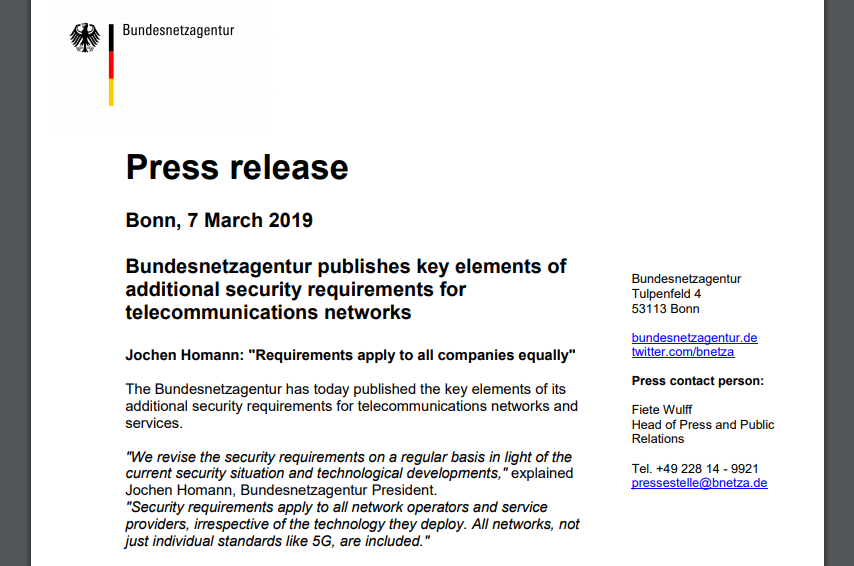
The Bundesnetzagentur, which is the German regulatory office in charge of telecommunications, published additional security requirements for telecommunications networks and services without banning Huawei or other Chinese vendors.

The key elements of the new security policy are:

  • Systems may only be sourced from trustworthy suppliers whose compliance with national security regulations and provisions for the secrecy of telecommunications and for data protection is assured.
  • Network traffic must be regularly and constantly monitored for any abnormality and, if there is any cause for concern, appropriate protection measures must be taken.
  • Security-related network and system components (critical key components) may only be used if they have have been certified by the Federal Office for Information Security (BSI) and undergone IT security checks by a BSI-approved testing body. Critical key components may only be sourced from trustworthy suppliers/manufacturers, ie those that can provide assurance of their trustworthiness.
  • Security-related network and system components (critical key components) may only be used following an appropriate acceptance test upon supply and must be subjected to regular and ongoing security tests. The components that are security-related (critical key components) will be defined by the BSI and Bundesnetzagentur by mutual agreement.
  • Only trained professionals may be employed in security-related areas.
  • Proof must be provided that the hardware tested for the selected, security-related components and the source code at the end of the supply chain are actually deployed in the products used.
  • When planning and building the network, “monocultures” must be avoided by using network and system components from different manufacturers.
  • Where system-related processes are outsourced, only professionally competent, reliable and trustworthy contractors may be selected.
  • Adequate redundancy must be available for critical, security-related network and system components (critical key components). 

“We revise the security requirements on a regular basis in light of the current security situation and technological developments,” explained Jochen Homann, Bundesnetzagentur President. “Security requirements apply to all network operators and service providers, irrespective of the technology they deploy. All networks, not just individual standards like 5G, are included.”

https://www.bundesnetzagentur.de/SharedDocs/Pressemitteilungen/EN/2019/20190307_SL.html?nn=404530

Tags: Blueprint columnsGermanyHuawei
ShareTweetShareSummarizeSummarize
Previous Post

Austria completes 5G auction in 3.4 – 3.8 GHz band

Next Post

Aquantia intros 10 Gigabit Ethernet MAC Controller

Staff

Staff

Related Posts

All

Huawei Promotes A2A-T Standard for Highly Autonomous Telecom Networks

June 26, 2026
AI Infrastructure

Huawei Cloud Unveils Agentic AI Infrastructure Stack

June 11, 2026
Clouds and Carriers

Deutsche Telekom and SAP to Build Sovereign AI for Germany

May 28, 2026
Corporate Strategies

Deutsche Telekom Raises 2026 Outlook on T-Mobile US Momentum

May 13, 2026
5G / 6G / Wi-Fi

MTN Nigeria and Huawei Bring Massive MIMO to Sub-1 GHz Spectrum

April 24, 2026
Clouds and Carriers

Deutsche Telekom CEO Pushes Digital Sovereignty for AI and 6G

April 22, 2026
Next Post

Aquantia intros 10 Gigabit Ethernet MAC Controller

Please login to join discussion

Categories

  • 5G / 6G / Wi-Fi
  • AI Infrastructure
  • All
  • Automotive Networking
  • Blueprints
  • Clouds and Carriers
  • Corporate Strategies
  • CPO
  • Data Centers
  • Enterprise
  • Explainer
  • Feature
  • Hot Start-ups
  • Last Mile / Middle Mile
  • Legal / Regulatory
  • Optical
  • Optical I/O
  • Pluggable Optics
  • Quantum
  • Research
  • Security
  • Semiconductors
  • Silicon Photonics
  • Space Networking & Orbital Data Centers
  • Subsea
  • Sustainability
  • Video
  • Webinars
Converge Digest

A private dossier for networking and telecoms

Follow Us

  • Home
  • About
  • Events Calendar
  • Blueprint Guidelines
  • Privacy Policy
  • Manage Email Delivery
  • NextGenInfra.io
  • buzzwords
  • Archives
  • Milestones
  • On This Day
  • Video Search

© 2026 Converge Digest - A private dossier for networking and telecoms.

No Result
View All Result
  • Home
  • About
  • Events Calendar
  • Blueprint Guidelines
  • Privacy Policy
  • Manage Email Delivery
  • NextGenInfra.io
  • buzzwords
  • Archives
  • Milestones
  • On This Day
  • Video Search

© 2026 Converge Digest - A private dossier for networking and telecoms.

This website uses cookies. By continuing to use this website you are giving consent to cookies being used. Visit our Privacy and Cookie Policy.
Go to mobile version