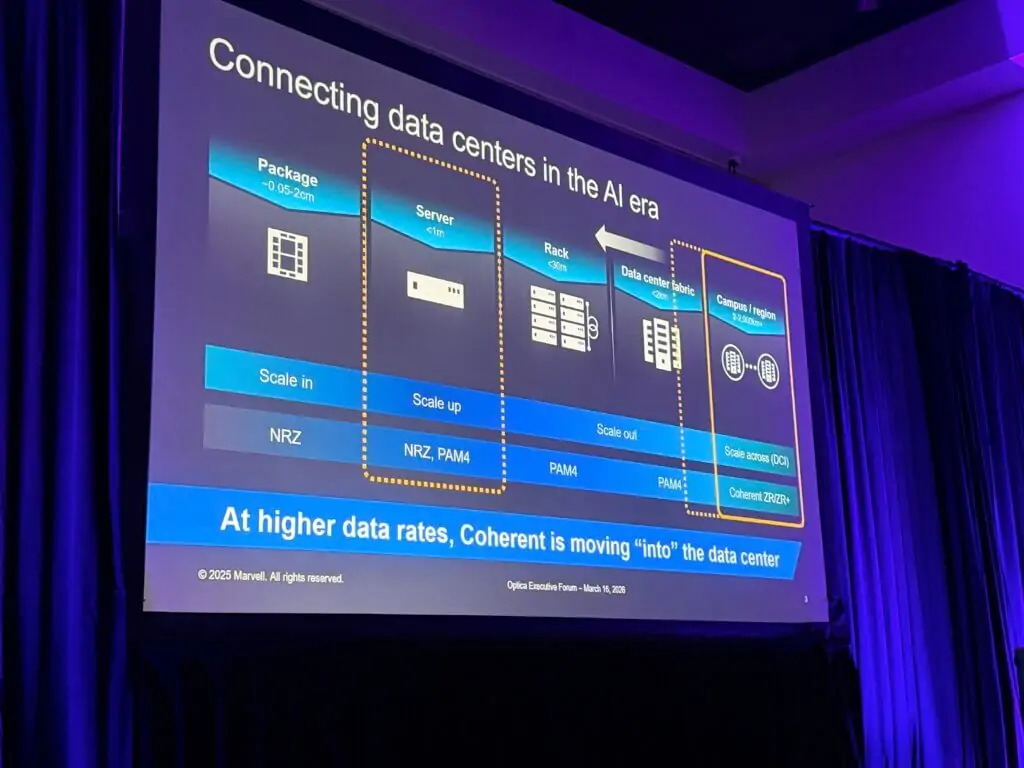
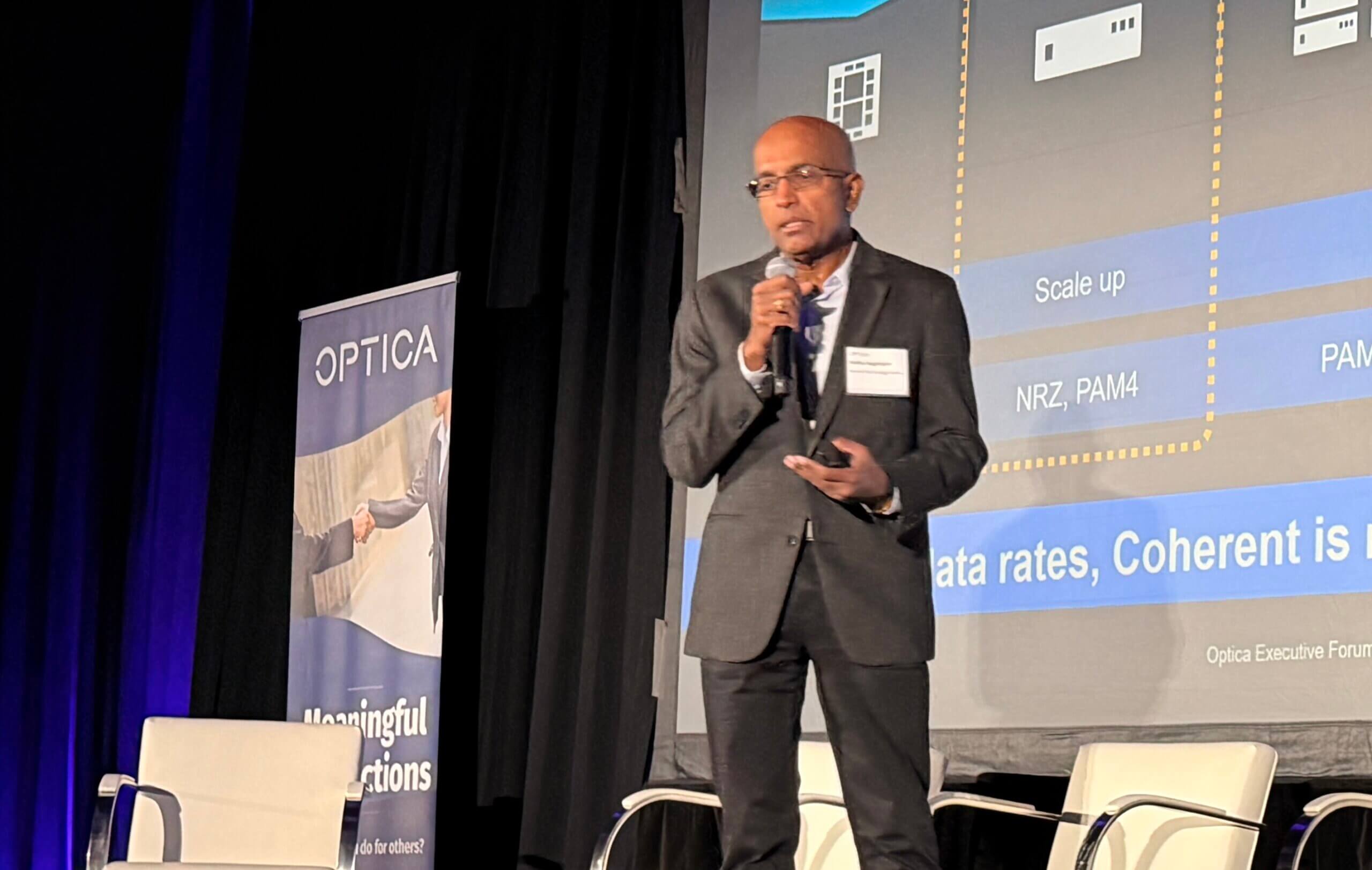
Marvell’s Radha Nagarajan, SVP and CTO of Optical Engineering, used his keynote at the Optica Executive Forum on Monday to frame AI interconnects as a continuum spanning scale-in, scale-up, scale-out, and scale-across networks, arguing that the old boundaries between those domains are beginning to break down. His core message was that as AI clusters expand and lane speeds rise, coherent optics are moving inward from traditional DCI roles while highly integrated light engines and co-packaged approaches are pushing outward from the package and server edge.
Nagarajan described the current transition as a “squeeze in the middle” of the data center fabric. On one side, pluggable optics continue to dominate scale-out deployments inside the data center. On the other, coherent technology, long associated with longer-reach interconnects, is advancing toward shorter campus and data center links. At the same time, near-packaged and co-packaged optical approaches are gaining relevance because higher bandwidth density, tighter signal integrity requirements, and system-level integration demands are making conventional packaging and electrical interconnect assumptions less sustainable.
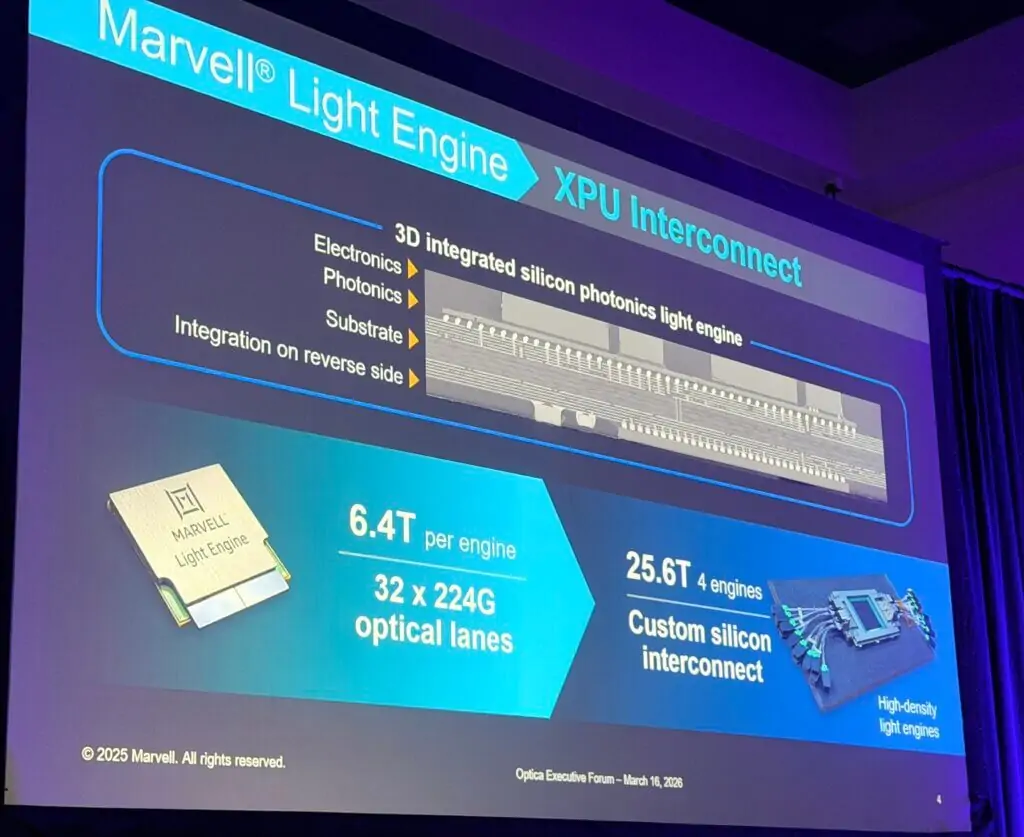
A key part of the presentation focused on Marvell’s light-engine architecture. Nagarajan emphasized that these designs should not be viewed purely through the lens of co-packaging, but rather as a response to the combined pressures of speed, integration, and signal integrity. He highlighted a 3D integrated silicon photonics light engine that stacks electronics over photonics and routes through the substrate, creating what he described as a practical vehicle for next-generation optical interconnects. The example shown was a 6.4 Tbps light engine with 32 lanes at 224G, which Marvell sees as applicable across XPU interconnects, pluggables, scale-up systems, and switch interconnects.
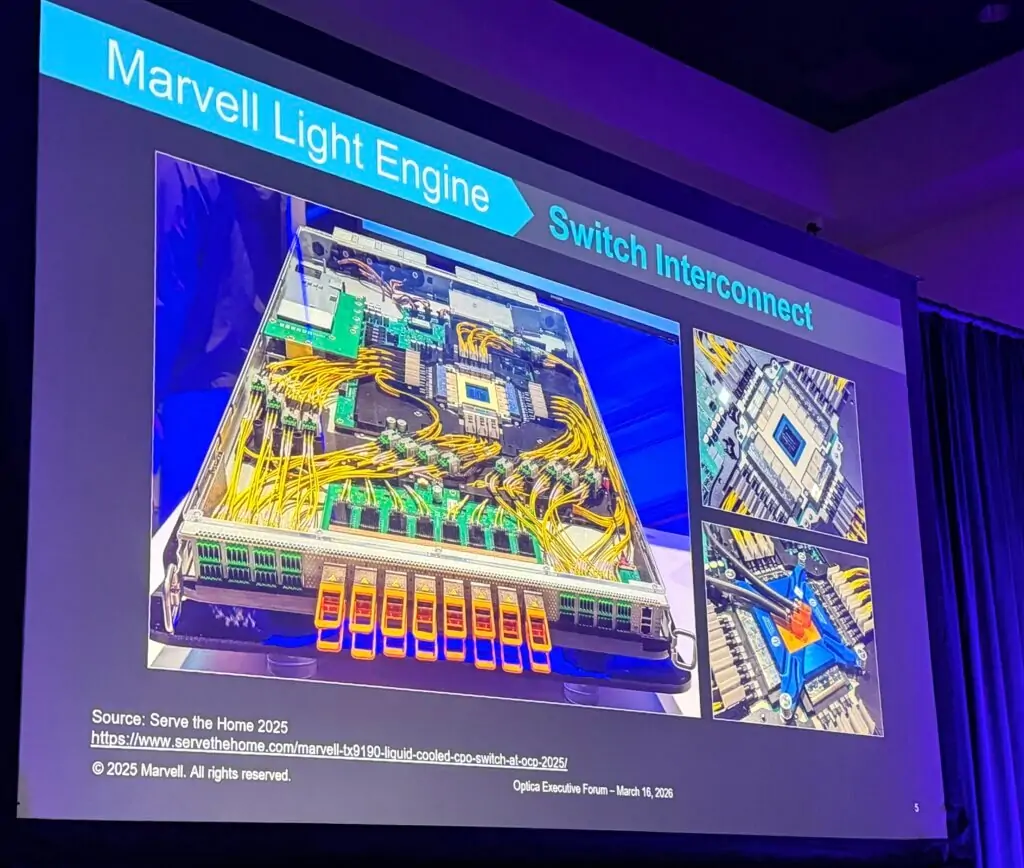
He also argued that thermal objections to tightly integrated optics are becoming less relevant as liquid cooling spreads across AI infrastructure. Nagarajan noted that the industry is moving beyond the assumption that air cooling can handle future thermal densities, especially for high-performance switches, XPUs, and advanced optical subsystems. In that context, light engines can be deployed not only for processor adjacency but also in switch platforms and compact optical modules, helping increase bandwidth density and enabling more aggressive system architectures.
On the coherent side, Nagarajan made the strongest claim of the talk: coherent optics will enter scale-out networks. He positioned Marvell’s coherent technology as evolving from scale-across and DCI use cases toward shorter-reach campus and intra-data-center applications, especially as the industry approaches 200G and 400G per lane optics. While he did not suggest IMDD disappears, he argued that at higher baud rates dispersion penalties become increasingly difficult to ignore, making coherent techniques a necessary complement. In his view, the argument is no longer whether coherent comes into scale-out, but when.
Importantly, Nagarajan distinguished “coherent-lite” implementations for shorter reaches from classic ZR/ZR+ designs. For 2 km to 20 km campus links, he suggested the industry can shed some of the power and complexity associated with long-haul coherent modules by relaxing or eliminating features such as nonlinear compensation, probabilistic constellation shaping, and tunable lasers, while still retaining the advantages coherent DSPs can provide as lane rates climb. In the slide deck, Marvell positioned coherent-lite as optimized for campus-reach 800G, 1.6T, and 3.2T optical links, sitting between conventional client optics and full coherent implementations.
Nagarajan closed on component readiness, arguing that the optical and analog building blocks needed for the 400G-per-lane era are now coming into view. Marvell showed optical modulator bandwidth above 110 GHz, optical detector bandwidth above 100 GHz, and amplifier bandwidth above 145 GHz, positioning those advances as critical enablers for future 1.6T and higher-speed interconnects. The implication was that the component ecosystem is no longer the main constraint; the bigger challenge is how to productize these capabilities into power-efficient, manufacturable systems for AI networks at scale.
Key points:
• Marvell framed AI interconnects across four domains: scale-in, scale-up, scale-out, and scale-across.
• Nagarajan said coherent optics are “moving in” from DCI and campus links toward shorter-reach data center fabrics.
• He argued that pluggables still dominate scale-out today, but higher lane rates will increasingly favor coherent approaches in parts of the network.
• Marvell highlighted a 6.4 Tbps silicon photonics light engine with 32 x 224G optical lanes.
• Four such engines were shown supporting 25.6 Tbps of custom silicon interconnect bandwidth.
• Nagarajan said tightly integrated optical architectures are being driven by speed, integration, and signal integrity, not just co-packaging.
• He argued that liquid cooling is now becoming foundational for future optical and switch integration.
• Marvell’s slides positioned coherent-lite optics for 2 km to 20 km campus-reach applications.
• The company contrasted coherent-lite with full ZR/ZR+ coherent, suggesting there is room to reduce DSP and laser complexity for shorter-reach deployments.
• Marvell also showed component progress toward the 400G/lane era, including modulator, detector, and amplifier bandwidths above 100 GHz.
“The real battle, we think, is going to happen at 200-gig and 400-gig per lane optics. At 400 gig, there are some real challenges with IMDD. I’m not saying IMDD is going away. The point is to complement the technology. And where that boundary stops — whether it’s 300 meters, 500 meters, or a kilometer — scale-out will see coherent light.”