• Home
  • About
  • Events Calendar
  • Blueprint Guidelines
  • Privacy Policy
  • Manage Email Delivery
  • NextGenInfra.io
No Result
View All Result
Converge Digest
Sunday, June 7, 2026
  • Home
  • About
  • Events Calendar
  • Blueprint Guidelines
  • Privacy Policy
  • Manage Email Delivery
  • NextGenInfra.io
No Result
View All Result
Converge Digest
No Result
View All Result

Home » Six Videos from Marvell Industry Analyst Day 2025 Highlight AI Infrastructure Shift

Six Videos from Marvell Industry Analyst Day 2025 Highlight AI Infrastructure Shift

December 17, 2025
in Video
A A

Marvell’s Industry Analyst Day last week provided a system-level view of how compute, memory, networking, optics, software, and power delivery must be co-designed as AI clusters scale in size, cost, and criticality. The following six new videos now posted to NextGenInfra.io extend that narrative, offering deeper technical insight into the architectural choices shaping hyperscale AI data centers.

Will Chu describes how Marvell’s custom XPU engagements with hyperscalers have expanded beyond processors to include CXL-enabled memory, infrastructure security devices, and custom NICs built on Certis IP. The session explains how these elements are integrated to improve performance efficiency, reduce latency, and give cloud operators tighter control over AI platforms.

Xi Wang introduces Marvell’s RELIANT software suite and the Golden Cable program, focusing on observability and deployment speed in large AI fabrics. By leveraging DSP data from copper cables and optical modules, Marvell enables remote monitoring and link-level insight, while the Golden Cable reference design provides the industry with a free, end-to-end framework combining hardware, software, and validation.
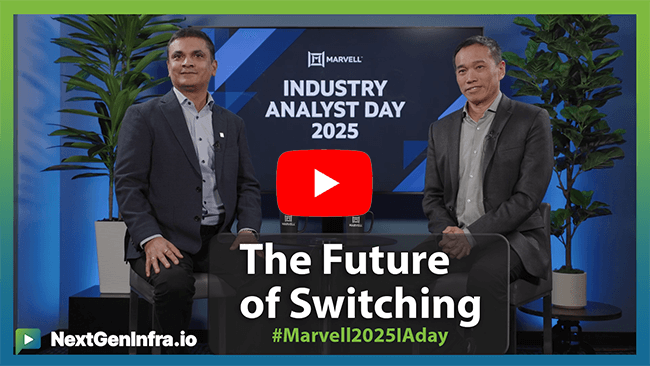
Rishi Chugh and Roy Chua examine how AI training workloads are driving flatter, two-tier data center network architectures. The discussion highlights the need for predictability and reliability, as network failures during GPU-intensive training runs can invalidate months of compute and significantly increase costs.

Radha Nagarajan outlines Marvell’s approach to optical connectivity across three distance regimes: scale-up links under 30 meters for memory disaggregation, scale-out links from 30 to 300 meters based on Ethernet PAM4, and scale-across connections spanning up to 2,000 kilometers using coherent DWDM. The session ties these domains to Marvell’s internal development efforts, its existing coherent optics business, and the Celestial acquisition.

Annie Liao traces Marvell’s PCIe roadmap from Gen 5 through Gen 8, explaining how higher data rates push electrical solutions toward their limits. She details how optical PCIe—both pluggable and co-packaged—will become necessary to support longer reach, higher bandwidth, and improved signal integrity in AI systems.

Matt Kim addresses power delivery constraints in next-generation AI chips, presenting Marvell’s Package Integrated Voltage Regulator (PIVR) technology. By moving voltage regulation into the XPU package, PIVR increases current density by up to 2×, cuts transmission losses by up to 85%, and supports 4 kW-class and higher compute platforms.


Tags: Marvell
ShareTweetShareSummarizeSummarize
Previous Post

AT&T Advances 50G PON and Future Optical Standards 

Next Post

Verizon Taps Array Digital Infrastructure for 5G Tower Footprint

Jim Carroll

Jim Carroll

Editor and Publisher, Converge! Network Digest, Optical Networks Daily - Covering the full stack of network convergence from Silicon Valley

Related Posts

Automotive Networking

Marvell Launches 102.4 Tbps Teralynx T100 Switch

June 1, 2026
Financials

Marvell Posts Record $2.418B Quarter as AI Infrastructure Surges

May 27, 2026
Optical

Marvell Adds Plasmonics to Optical Stack with Polariton Acquisition

April 22, 2026
Video

Marvell: Big Outlook for XPU-Attach

April 16, 2026
Semiconductors

NVIDIA Invests $2B in Marvell to Extend NVLink Fusion AI Ecosystem

March 31, 2026
All

Optica Executive Forum: Marvell’s Radha Nagarajan on Optical Interconnects for AI

March 19, 2026
Next Post

Verizon Taps Array Digital Infrastructure for 5G Tower Footprint

Categories

  • 5G / 6G / Wi-Fi
  • AI Infrastructure
  • All
  • Automotive Networking
  • Blueprints
  • Clouds and Carriers
  • Data Centers
  • Enterprise
  • Explainer
  • Feature
  • Financials
  • Last Mile / Middle Mile
  • Legal / Regulatory
  • Optical
  • Quantum
  • Research
  • Security
  • Semiconductors
  • Space
  • Start-ups
  • Subsea
  • Sustainability
  • Video
  • Webinars

Archives

Tags

5G All AT&T Australia AWS Blueprint columns BroadbandWireless Broadcom China Ciena Cisco Data Centers Dell'Oro Ericsson FCC Financial Financials Huawei Infinera Intel Japan Juniper Last Mile Last Mille LTE Mergers and Acquisitions Mobile NFV Nokia Optical Packet Systems PacketVoice People Regulatory Satellite SDN Service Providers Silicon Silicon Valley StandardsWatch Storage TTP UK Verizon Wi-Fi
Converge Digest

A private dossier for networking and telecoms

Follow Us

  • Home
  • About
  • Events Calendar
  • Blueprint Guidelines
  • Privacy Policy
  • Manage Email Delivery
  • NextGenInfra.io

© 2026 Converge Digest - A private dossier for networking and telecoms.

No Result
View All Result
  • Home
  • About
  • Events Calendar
  • Blueprint Guidelines
  • Privacy Policy
  • Manage Email Delivery
  • NextGenInfra.io

© 2026 Converge Digest - A private dossier for networking and telecoms.

This website uses cookies. By continuing to use this website you are giving consent to cookies being used. Visit our Privacy and Cookie Policy.
Go to mobile version