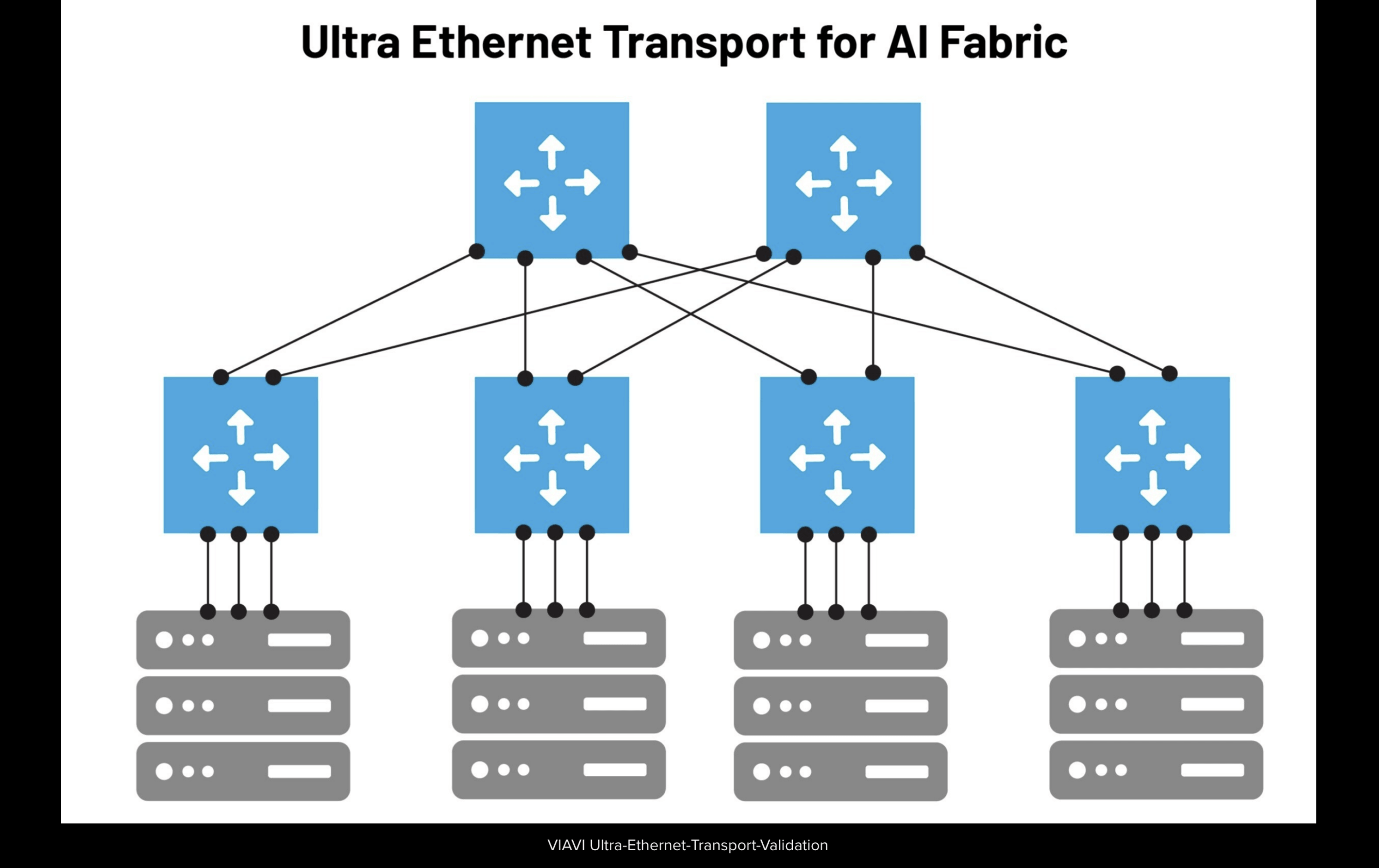
VIAVI Solutions introduced what it describes as the industry’s first Ultra Ethernet Transport (UET) validation solution for AI fabrics, extending its VIAVI TestCenter platform with traffic generation and analysis capabilities designed for next-generation AI data center networks. The new offering targets hyperscalers, cloud providers, neocloud operators, and network equipment vendors developing Ultra Ethernet-based AI infrastructure.
The platform enables validation of both scale-up and scale-out AI networks without requiring physical GPU clusters. Instead, it emulates realistic AI traffic patterns at the transport layer, allowing operators to test network performance, resiliency, congestion management, and load balancing before deploying large-scale AI environments. The announcement comes as the Ultra Ethernet Consortium’s UEC 1.0 specification gains traction as an Ethernet-based alternative for connecting massive AI clusters.
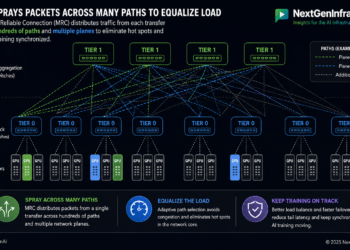
VIAVI said its solution supports full-fidelity emulation of AI workloads, including collective communications (CCL) and large language model (LLM) traffic flows. The platform can generate realistic UET traffic patterns, including Reliable Ordered Delivery (ROD), Reliable Unordered Delivery (RUD), packet trimming, congestion control, and dynamic multipathing. It also validates AI fabric load-balancing mechanisms such as ECMP, packet spraying, and flowlet switching. VIAVI highlighted collaboration with HPE and Juniper Networks, including validation of UET transport on the Juniper QFX5240 platform running Junos Evolved software.
• GPU-free validation platform for Ultra Ethernet-based AI fabrics
• Supports emulation of realistic AI workload traffic, including CCL and LLM flows
• Validates Ultra Ethernet Transport (UET) features such as ROD, RUD, packet trimming, congestion control, and dynamic multipathing
• Enables testing of AI fabric load balancing including ECMP, packet spraying, and flowlet switching
• Designed for hyperscalers, cloud providers, neocloud operators, and network equipment vendors
• Supports validation of both scale-up and scale-out AI network architectures
• Collaboration includes testing on the Juniper QFX5240 running Junos Evolved
“AI clusters will soon scale to millions of endpoints, which means relying on physical GPUs alone to validate network behavior is no longer practical,” said Aniket Khosla, Vice President of Product Management, Optical Transport and High-Speed Ethernet at VIAVI Solutions. “The launch of this GPU-free, full-fidelity UET validation solution gives customers the confidence to deploy scalable, high-performance AI fabrics faster and more cost-effectively.”
🌐 Analysis
The significance of this announcement extends beyond test equipment. As AI clusters scale toward hundreds of thousands—and eventually millions—of endpoints, network architects increasingly need methods to validate transport behavior without assembling expensive GPU infrastructure. This creates a growing market for high-fidelity emulation platforms capable of reproducing AI traffic patterns while exposing congestion, latency, and load-balancing issues before production deployment.
The launch also highlights growing momentum behind the Ultra Ethernet Consortium and its effort to establish Ethernet as a primary interconnect technology for large-scale AI systems. While proprietary approaches such as NVIDIA InfiniBand remain dominant in many AI deployments, the broader industry—including switch vendors, hyperscalers, and networking suppliers—continues to invest in open Ethernet-based AI fabrics. Validation tools capable of emulating UET traffic will likely become increasingly important as vendors move from standards development to large-scale production deployments.
| Ultra Ethernet (UEC) Profile Updated: June 2026 | |
| Organization | Ultra Ethernet Consortium (UEC) |
| Announced | July 2023 |
| Specification Status | UEC Specification 1.0 released in June 2025. |
| Mission | Create an open Ethernet-based communications stack optimized for AI and High Performance Computing (HPC) clusters. |
| Transport Layer | Ultra Ethernet Transport (UET), a transport protocol designed for AI and HPC workloads. |
| Delivery Modes | ROD Reliable Ordered Delivery; RUD Reliable Unordered Delivery; RUDI Reliable Unordered Delivery for Idempotent Operations; UUD Unreliable Unordered Delivery. |
| In-Network Compute | Supports switch-based collective operation acceleration, including In-Network Collectives (INC) and AllReduce offload for AI training fabrics. |
| Congestion Management | Advanced congestion control, packet trimming, telemetry, adaptive traffic steering, path-aware forwarding, and dynamic multipathing. |
| Load Balancing | ECMP, packet spraying, adaptive routing, flowlet switching, and dynamic path optimization. |
| Scale Target | Designed for AI and HPC clusters ranging from thousands to more than 1 million endpoints. |
| Ethernet Roadmap | Aligns with 400GbE, 800GbE, and future 1.6TbE Ethernet deployments. |
| Founding Members | AMD, Arista Networks, Broadcom, Cisco, Eviden, HPE, Intel, Juniper Networks, Meta, and Microsoft. |
| Competitive Context | Positions Ethernet as the primary open, multi-vendor alternative to NVIDIA InfiniBand for large-scale AI back-end networks. |
| Long-Term Vision | Establish Ethernet as the dominant open networking fabric for AI training, inference, HPC, and exascale computing infrastructure. |