Arelion is expanding its Danish backbone and cable landing infrastructure as AI traffic pushes more capacity demand into the Nordics. The company said it is upgrading its Nørre Nebel cable landing station to support additional cable landings and long-term scaling, while also increasing capacity across Denmark to better serve new data center developments in Jutland and Copenhagen. Arelion said the site is already operational and equipped with front-haul, back-haul, and subsea horizontal directional drilling infrastructure to support multiple diverse sea-cable landings.
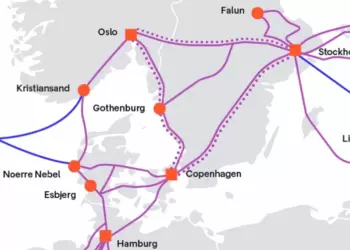
The Danish build-out centers on route diversity as much as raw capacity. Arelion said it is using its north route from Nørre Nebel to Copenhagen, including a subsea segment from Aarhus to Copenhagen, alongside a south route running via Esbjerg and Kolding to Copenhagen. Kolding also serves as a junction toward Germany, which gives operators an alternate path into continental Europe. The company also said it recently completed new duct and cable extensions linking atNorth’s DEN01 site in greater Copenhagen to its Nordic AI superhighway. atNorth describes DEN01 as its first Denmark facility in Ballerup, built for high-density workloads and district-heating reuse.
Arelion also added new optical systems for wavelength capacity between Amsterdam and Kolding, aimed at improving routing efficiency and offering diversity options that bypass Hamburg. The company framed the Denmark expansion as part of a broader Nordic and Baltic AI infrastructure push. In earlier network updates, Arelion highlighted its Scandinavian AI-focused backbone build-out and its broader regional mesh of subsea connectivity. The Denmark data center market figure cited in the release, $2.9 billion by 2030 at an 11.44% CAGR, aligns with a 2025 market forecast carried by multiple outlets.
- Upgrades target the Nørre Nebel cable landing station on Denmark’s west coast.
- Arelion says the site is prepared for additional subsea cable landings with HDD infrastructure already in place.
- The north route runs from Nørre Nebel toward Copenhagen, including a subsea segment from Aarhus to Copenhagen.
- The south route runs via Esbjerg and Kolding to Copenhagen, adding resilience and route diversity.
- Kolding also functions as a key junction for onward connectivity into Germany.
- Arelion added new wavelength-capacity optical systems between Amsterdam and Kolding.
- The carrier recently extended ducts and cable to connect atNorth’s DEN01 Copenhagen-area data center to its Nordic backbone.
- Arelion says it serves more than 2,900 customers in nearly 130 countries and operates AS1299, which it describes as the world’s top-ranked global Internet backbone.
“These upgrades to our Danish network reflect our broader commitment to strengthening digital infrastructure across the Nordics, helping us support enterprise and wholesale customers with low-latency, fully diverse connectivity and predictable performance as they deploy AI applications,” said Johan Ottosson, VP Strategy & Product Management at Arelion. “Our continued investment ensures the capacity needed to keep pace with accelerating demand for AI-driven services, providing a scalable and secure foundation for both training workloads and latency-sensitive inference use cases.”
🌐 Analysis: This move fits Arelion’s broader effort to position its Nordic and Baltic footprint as an AI transport layer, not just a traditional long-haul backbone. The emphasis on diverse terrestrial and subsea paths, plus Amsterdam-Kolding wavelength upgrades, suggests the company sees rising demand not only from training clusters in Scandinavia but also from cross-border inference, cloud, and data replication flows into major European hubs.
🌐 Analysis: Denmark’s role in that strategy is strengthening as operators add power-efficient data center capacity in and around Copenhagen and western Denmark. Arelion is not alone in reinforcing Nordic subsea and terrestrial corridors: other regional providers, including GlobalConnect, are also adding new cable capacity between Denmark and neighboring markets as AI infrastructure spending accelerates.