
Corning outlined an expanded and extended version of its “Springboard” growth strategy, raising long-term revenue targets as demand accelerates for AI-driven optical connectivity, photonics, and enterprise networking infrastructure. Speaking at an investor event hosted at the New York Stock Exchange, the company said it now expects to achieve a $20 billion annualized sales run rate by the end of 2026, representing a 15% CAGR from Q4 2023 through Q4 2026. Corning also projected a higher 19% CAGR from Q4 2026 through Q4 2030 as AI infrastructure spending expands globally.
The company upgraded its internal Springboard targets for 2028 and extended the framework through 2030. Corning now aims for a $30 billion annualized sales run rate by the end of 2028, alongside a “high-confidence” target of $27 billion. By the end of 2030, Corning expects to reach a $40 billion annualized sales run rate, with a high-confidence target of $35 billion. Management attributed the stronger outlook to growth across its Market-Access Platforms (MAPs), particularly Enterprise Networks and the newly emphasized Photonics MAP.
Corning said AI infrastructure trends are reshaping its networking business as hyperscale AI clusters expand in both scale-out and emerging optical scale-up architectures. The company expects its Photonics MAP to generate a $10 billion revenue stream by 2030, driven by demand for optical interconnects, fiber connectivity, and advanced photonic components used in AI factories and large-scale GPU clusters. Corning also highlighted its recently announced partnership with NVIDIA to expand U.S.-based optical manufacturing capacity for AI infrastructure deployments.
- Corning expects to achieve a $20 billion annualized sales run rate by the end of 2026.
- The updated Springboard plan targets a $30 billion annualized sales run rate by the end of 2028.
- Corning extended the plan through 2030 with a target of $40 billion annualized sales.
- The company forecasts a 19% CAGR from Q4 2026 through Q4 2030.
- Corning identified AI scale-out clusters and optical scale-up architectures as major growth drivers.
- The company expects its Photonics MAP business to generate $10 billion in revenue by 2030.
- Long-term customer agreements are expected to offset investment risk while supporting manufacturing expansion.
- Corning’s Enterprise Networks business is positioned to benefit from increasing optical density inside AI data centers.
Wendell P. Weeks, chairman, CEO, and president of Corning, said, “In our Enterprise MAP, we expect to capture strong growth as AI data center cluster size increases in scale out – and optical scale up takes hold. In our new Photonics MAP, we plan to build a $10 billion revenue stream by 2030.”
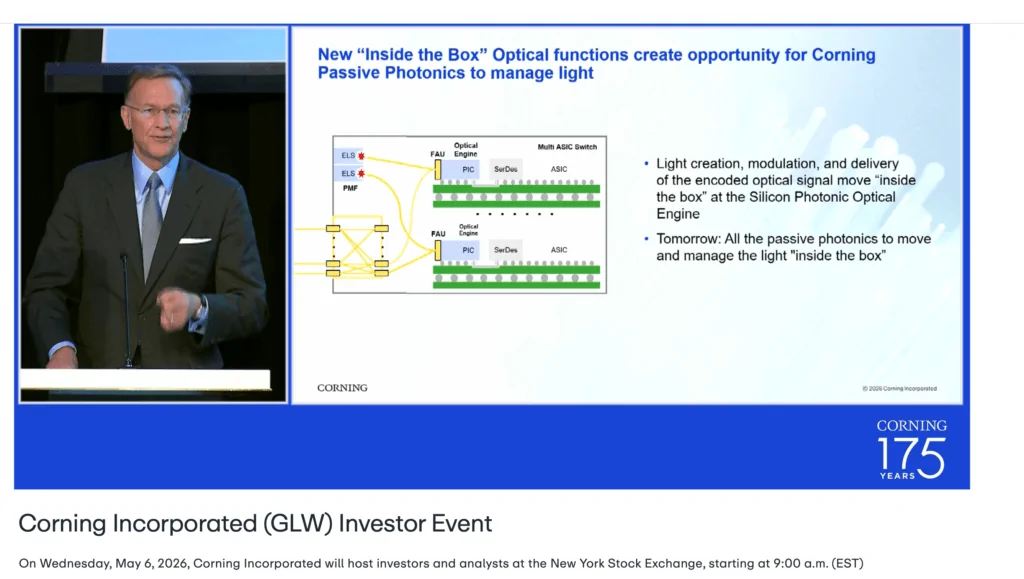
🌐 Analysis: Corning is increasingly positioning itself as a foundational supplier for AI infrastructure buildouts, particularly as hyperscalers transition from copper-heavy architectures toward high-density optical fabrics. The company’s emphasis on “optical scale up” aligns with broader industry efforts to extend accelerator interconnects beyond traditional rack boundaries using optical I/O, co-packaged optics, and photonic switching technologies.