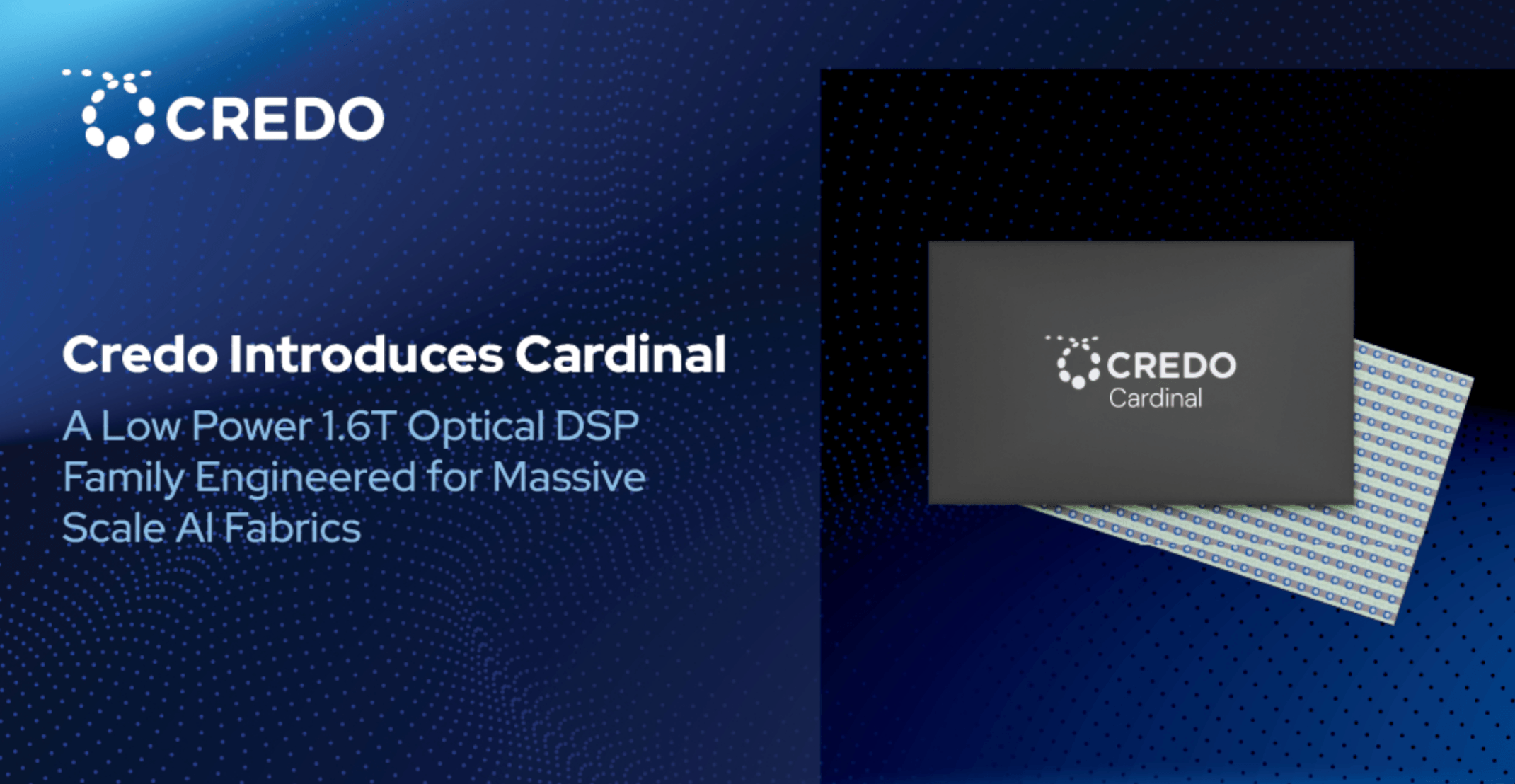
Credo introduced Cardinal, a new family of 3nm 224G/lane optical DSPs aimed at 1.6T transceivers for AI compute fabrics. The company said the new devices target the bandwidth, latency, reliability, and power constraints emerging in large-scale AI clusters, where high-radix switching, dense GPU topologies, and heavy east-west traffic are reshaping optical interconnect requirements. Credo said Cardinal is its second-generation 1.6T optical DSP family and is now sampling to lead customers.
The Cardinal family includes dedicated DSPs for both full-retimed optics and linear receive optics (LRO), along with integrated high-swing drivers for electro-absorption modulated laser (EML) and silicon photonics designs. Credo said the architecture is built on its seventh-generation DSP platform and supports advanced diagnostics, predictive monitoring, and latency below 40 ns per direction. For LRO implementations, the company said Cardinal can enable 1.6T transceivers while consuming less than 15W.
The announcement underscores how DSP vendors are tuning optical silicon more tightly to AI scale-up and scale-out networks, where power per bit, thermal density, and serviceability now carry as much weight as raw bandwidth. Credo is positioning Cardinal as a flexible platform for module makers building both conventional retimed optics and lower-power LRO designs for rack-scale AI infrastructure. Jabil endorsed the LRO variant, saying the power and thermal profile could help support denser GPU cluster deployments.
- 3nm optical DSP family for 224G/lane and 1.6T optical modules
- Second-generation 1.6T optical DSP family from Credo
- Supports both full-retimed optics and linear receive optics
- Integrated high-swing drivers for EML and silicon photonics
- Latency specified at below 40 ns per direction
- LRO implementations specified at less than 15W
- Sampling now to lead customers
- Jabil highlighted the LRO option for rack-scale AI infrastructure
“AI fabrics have shifted the center of gravity for optical design, and Cardinal was developed from day one with those unique requirements in mind,” said Chris Collins, AVP of Sales & Optical Product Marketing at Credo.
🌐 Analysis: Credo’s Cardinal launch lands in the middle of a broader industry shift toward 224G/lane optics, 1.6T modules, and lower-power interconnects for AI clusters. Across the market, vendors are trying to reduce optical module power, shrink latency, and add telemetry as hyperscalers push toward denser rack-scale and row-scale architectures. Credo’s emphasis on both retimed and LRO options reflects that the market is still evaluating where linear approaches fit best in future AI fabrics.
🌐 Analysis: The integration of EML and silicon photonics driver support is also notable. Module makers want fewer components, cleaner power envelopes, and more design flexibility as they balance manufacturability, thermals, and interoperability across different optical engine approaches. That makes DSP integration and diagnostics increasingly strategic, not just a signal-integrity feature.